The artificial intelligence investment boom continues to support equities, but rising costs, data centre constraints and questions around monetization are creating new challenges for investors.
BNN Bloomberg spoke with Andrew Pyle, senior investment advisor and portfolio manager at CIBC Wood Gundy, about AI spending trends, geopolitical developments in the Middle East, opportunities in energy and the importance of maintaining a long-term investment strategy.
Key Takeaways
- Rising AI token costs and growing pressure on energy and water resources could make it more difficult for companies to generate returns on artificial intelligence investments.
- Concerns about data centre electricity consumption and water usage are becoming more prominent and could slow expansion plans in some regions.
- Investors should be cautious about assuming a lasting U.S.-Iran agreement, as shifting geopolitical developments continue to create uncertainty.
- Portfolio decisions should be driven by economic fundamentals rather than short-term geopolitical headlines because conditions can change rapidly.
- Energy remains attractive due to long-term global demand growth and evolving energy needs, including natural gas, LNG and nuclear power.
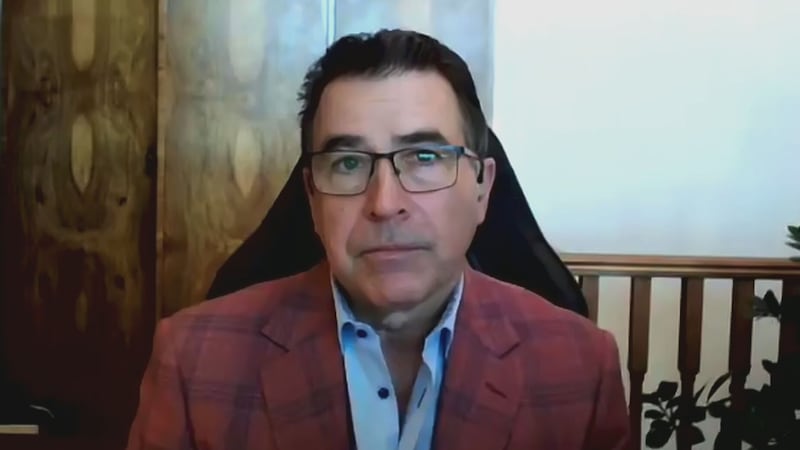
Read the full transcript below:
LINDSAY: Intel led chip stocks higher on Thursday after U.S. President Donald Trump said the company would partner with Apple to design chips in the U.S., but the question now is whether the rally has further to run. So, let’s bring in Andrew Pyle, senior investment advisor and portfolio manager at CIBC Wood Gundy, for more. It’s great to have you join us this morning. Thanks so much.
ANDREW: Great to be here, Lindsay.
LINDSAY: I just want to get your thoughts, first of all, on this news that was announced by the President between Intel and Apple yesterday.
ANDREW: I mean, this is a company that continues to get a leg up as we look back over the last year, and it’s Donald Trump, typically, who is giving this company the boost, which we’ve seen over the last 24 hours.
LINDSAY: I wonder, though, how long AI spending can actually keep supporting market valuations as we continue to see so many of these deals coming out.
ANDREW: Well, it’s a great question, and a lot of people have basically criticized what we’ve seen as really being circular in terms of the investment from one company into another, or, in fact, governments into another company. And I think on the AI spend, Lindsay, we’ve been talking about this for a while. At some point, we need to see a tangible path toward monetization of the end product.
One of the things we’re hearing more recently is the cost of tokens is going through the ceiling, a lot of this being absorbed by the companies at the front end of this pipe and really struggling to contain those costs so that the consumer, the ultimate consumer of this product, is not affected. I think that’s a naive assumption to make, that this can be prevented.
So, I think cost is going to be one of the headwinds for this. Energy, obviously, as energy costs are going up. Water is going to be another. So, we take the stand that we’re probably getting close to the end of this cycle, at least on the investment side. Now we have to see the other end of the pipe: monetization, and can we actually make money or get ROI on the spend?
LINDSAY: Well, that’s kind of the big question, right? What challenges do companies face in passing the rising AI token costs that you’re talking about on to customers?
ANDREW: Well, they face huge challenges because this is not a normal world right now, Lindsay. As you and I know, we’re dealing with higher inflation, a completely different macro backdrop than what we were talking about at the end of 2025. Even at the end of 2025, there were plenty of challenges in terms of how do we get the end product to the user in a reasonable-cost fashion.
Now we’ve changed all that. And, of course, overnight, even the euphoria over a deal between the U.S. and Iran and perhaps getting some of these inflationary pressures down, even that seems to be fading.
So there is no end of challenges, in our opinion, facing this industry as we start to roll this product out. And I think we’re going to be clear on this. It’s not that we’re saying AI is not going to be pervasive, that it’s not going to be a game changer for the global economy. But, similar to the late 1990s, you do reach a point where you have to start looking at the potential for oversupply and overcapacity if demand is not going to be there at the end of the day.
LINDSAY: Right. And you mentioned earlier energy use and water shortages. These are some of the environmental and social concerns that are really starting to come up when we’re talking about data centres. I wonder how that might impact the expansion of data centres moving forward.
ANDREW: Well, I think over the near term it’s going to have a huge impact because we’re going into midterm elections in November, Lindsay. And to your point, a lot of communities across the United States are voicing their opinions to politicians as to what is going to happen to the cost of my hydro, what is going to happen to the availability of water, especially in states like Virginia.
So, I think this is going to be a massive issue in the next several months. Does that really derail the expansion of data centres over the near term? I think it might. But, again, these are things that we weren’t talking about a year ago and are now starting to bubble to the surface.
LINDSAY: Okay, the other big news today, obviously, is what’s been happening in the Middle East because investors have been positive this week, in particular on word that there’s going to be some kind of peace agreement, or the beginning of a peace deal, between the U.S. and Iran. Talks have now stalled because there’s ongoing fighting happening in Lebanon, which is a big condition for Iran.
I wonder what you think that’s going to be doing to the markets. Obviously, U.S. markets today are closed, but whether we might see a trickle-down effect, especially when we keep seeing this kind of start-and-stop pattern in negotiations.
ANDREW: Yeah, so most of the clients that we talked to this week, Lindsay, on this agreement, would look at us and say, “Do you really believe this is going to stick?”
We’re obviously hopeful that it sticks because no one wants this war to continue to drag out because of the effects it’s having on the global economy. But we have to look at what the impediments are to this agreement really sticking over the next 60 days.
I would have thought, at least yesterday afternoon, that this was going to stick into next week, perhaps over the next few weeks. And here we are this morning dealing with a potential unraveling.
So, for investors, I don’t think you want to get too giddy on what we saw develop this week. Markets obviously got giddy. Oil prices have plunged. I would argue right now that oil prices have probably overshot and that if this unraveling continues, we’re going to see oil prices rebound next week, which means there’s probably some opportunity on the energy side if you look at some of the oil and gas companies that have weakened on this optimism that somehow we can get this agreement in place.
LINDSAY: And obviously, as we say, things are changing so fast. Even as I was asking you that last question, my producer, Alina, was in my ear to tell me that just moments ago Israel and Hezbollah agreed to a ceasefire, effective 4 p.m. local time today.
So potentially maybe a peace deal between the U.S. and Iran can continue to be negotiated. Obviously, things are moving so fast, they always are in this situation. But has a peace deal already been priced into the markets based on what we’ve seen over the last couple of weeks?
ANDREW: Hard to say whether it’s completely priced in. If you look at the price of oil, we’re still, or at least last night we were, trading 30 per cent higher than we were at the lows in December.
So that, to me, suggests that there’s still some part of this war being priced in and that a full agreement where everyone just goes home and forgets about this has not been priced in.
So, yes, there is potential for equities to move higher and for oil to move lower. But based on what we’ve seen over the last 18 hours, I don’t think anyone should be betting the farm on one direction versus the other. This is still fluid.
It goes back to the advice we were giving weeks ago, in that the last thing you want to be doing right now is changing portfolios based on headlines because you’re going to be changing your portfolio by the minute over the next few weeks.
I think you just want to keep a strategy and watch the macro numbers as they evolve, which for now have been relatively decent. That’s really where your focus should be.
LINDSAY: So, just lastly then, what’s your strategy? What sectors are you leaning into right now?
ANDREW: Well, in the wake of the last few weeks, we do like energy. So, I think these are opportunities for individuals. And keep in mind this is not just an Iran story. This is basically an energy demand story.
To the extent that we continue to see energy demand ramp up, to the extent that we continue to see the world having to shift to different forms of energy to fill that demand, whether it’s nuclear, natural gas or LNG, we still think opportunities are in that space.
Take advantage of the recent pullbacks that we’ve seen in that sector to gain exposure.
LINDSAY: Okay, we’ll leave it there. Andrew Pyle, senior investment advisor and portfolio manager at CIBC Wood Gundy. Appreciate your time, as always. Thank you.
---
This BNN Bloomberg summary and transcript of the June 19, 2026 interview with Andrew Pyle are published with the assistance of AI. Original research, interview questions and added context was created by BNN Bloomberg journalists. An editor also reviewed this material before it was published to ensure its accuracy and adherence with BNN Bloomberg editorial policies and standards.

