The TSX continues to trade at a discount to the S&P 500, reflecting differences in sector composition rather than a simple valuation gap. As AI spending accelerates, investors are weighing how Canadian and U.S. markets offer different ways to gain exposure to the trend.
BNN Bloomberg spoke with Kelsey Keane, director, equity capital markets at National Bank of Canada, about why the TSX offers indirect exposure through power, infrastructure and utilities, how Micron’s latest earnings reinforce the AI investment cycle, and why diversification across both markets remains important.
Key Takeaways
- The TSX trades at a discount to the S&P 500 because it has greater exposure to commodities and financials, while the U.S. index is more heavily weighted toward technology.
- AI spending is benefiting both markets, with the S&P 500 gaining from direct exposure to chipmakers and networking companies, while the TSX benefits through utilities, power and infrastructure.
- Micron’s earnings reinforced the view that AI demand remains strong, with memory demand continuing to outpace supply and supporting the broader AI investment theme.
- Keane sees opportunities in AI infrastructure, power and electrification, and data centres as the multi-year AI capital spending cycle continues.
- Diversification across Canadian and U.S. equities allows investors to participate in different parts of the AI value chain while balancing sector-specific risks.
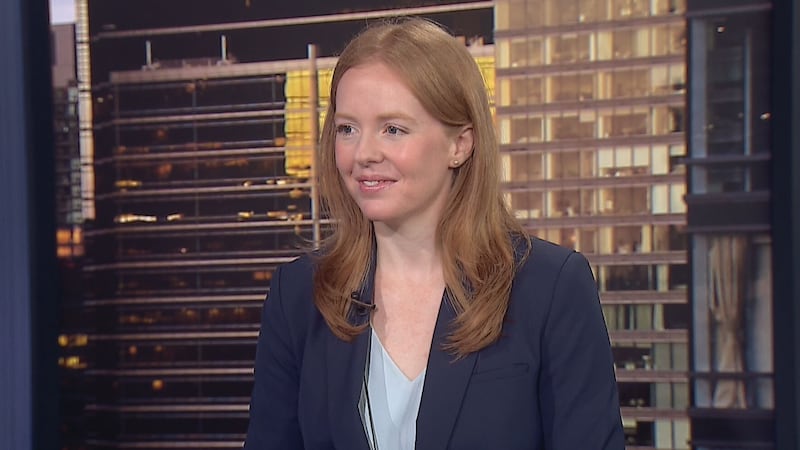
Read the full transcript below:
LINDSAY: Micron Technology topped expectations, reporting a massive beat and raising guidance, giving investors a read-through on AI demand. So now the question for investors is how to choose the winners moving forward. Let’s get more now from Kelsey Keane, director, equity capital markets at National Bank of Canada. She joins us in studio. As always, great to have you in.
KELSEY: Thank you for having me.
LINDSAY: We’ll start with Micron. What are your takeaways from the latest earnings report and the guidance for the next quarter?
KELSEY: After the company reported earnings last night, the stock soared in after-hours trading. Investors really viewed this as a step change in its earnings power, more than just an earnings beat. I would say the big takeaways are that demand for memory is exceeding supply and hyperscalers are really locking in longer-term contracts. So the AI trade is going to be able to withstand ups and downs and is more of a long-term investment theme. Also, that supply gap is really giving pricing power to these AI infrastructure companies.
LINDSAY: You say demand is exceeding supply. I wonder, is that eventually going to become a problem for companies like Micron?
KELSEY: It could, and competitors could come in and take some of that market share as well. But right now, there seems to be a supply constraint across the AI buildout.
LINDSAY: If Micron’s earnings support the thesis for that AI buildout, how should investors look at what they’re seeing and choose winners moving forward?
KELSEY: It’s a good question. Number one, you have to look for companies that are on the leading edge right now and are able to gain market share early. We’re in a multi-year capital spending supercycle, so investors need to look for companies operating in supply-constrained parts of the buildout. They should also look for companies that can capture higher margins and have pricing power.
LINDSAY: Looking ahead, when we’re talking about which sectors will be the direct beneficiaries of this AI capital spending, which sectors do you think will win, and which ones might not?
KELSEY: Number one, we saw it last night with Micron. AI infrastructure, including semiconductors and networking, is the direct beneficiary because that’s where hyperscalers’ capital spending is going. There are also second-order beneficiaries seeing significant gains from the AI buildout, including power and electrification. AI is limited by electricity availability. Then there’s the data centre space, which is the real asset trade, where there appears to be a supply constraint and a significant backlog.
LINDSAY: So what do you think happens next? We’ve seen this AI story evolve over the past year, with chipmakers leading the gains. What comes next?
KELSEY: On the TSX, we have companies that are benefiting from the AI buildout more on the power and infrastructure side. I think we’ll continue to see strong tailwinds for all three of those industries. There is a lot of positive sentiment right now. The risk is if that sentiment changes, or if we start to see supply catching up with demand.
LINDSAY: Before we talk about the TSX in more detail, where are you seeing opportunities right now? Is it those sectors you mentioned?
KELSEY: Exactly. I would point to those three areas: AI infrastructure, power and electrification, and data centres.
LINDSAY: Let’s talk about the TSX. You point out it’s trading at a discount to the S&P 500. How does AI exposure affect both of those markets?
KELSEY: AI exposure plays into both markets. When we talk about the TSX Composite trading at a discount to the S&P 500, it’s important to look at the structural makeup of each index. The S&P 500 has a much heavier weighting in technology companies, including AI chipmakers and networking firms that are direct beneficiaries of hyperscaler capital spending. The TSX has greater exposure to commodities and financials. While Canadian companies benefit from AI through power and electrification, the index also has greater commodity exposure, making it more cyclical.
LINDSAY: If the TSX is more cyclical because of its commodity exposure, how should investors think about positioning themselves when the economic cycle starts to turn?
KELSEY: Number one, diversification.
LINDSAY: It’s hard to know, right?
KELSEY: It’s hard to know.
LINDSAY: Especially right now. There’s so much uncertainty.
KELSEY: Exactly. It’s hard to know, and diversification usually answers those questions. But investors can also target specific industries, such as utilities and independent power producers, that are helping build the electricity infrastructure needed to support AI. The TSX offers meaningful exposure to those areas.
LINDSAY: Is the TSX a better place to be because it’s trading at a discount right now, or do you still prefer diversification?
KELSEY: I would say investors can own both and benefit from the different exposures each market provides.
LINDSAY: We’ll leave it there. Kelsey Keane, director, equity capital markets at National Bank of Canada. Thanks so much for coming in.
KELSEY: Thank you.
---
This BNN Bloomberg summary and transcript of the June 25, 2026 interview with Kelsey Keane are published with the assistance of AI. Original research, interview questions and added context was created by BNN Bloomberg journalists. An editor also reviewed this material before it was published to ensure its accuracy and adherence with BNN Bloomberg editorial policies and standards.

