The Canadian dollar remains under pressure as a stronger U.S. economy and shifting Federal Reserve expectations lift the U.S. dollar. With central banks providing less forward guidance, investors are relying more heavily on economic data to gauge the path for interest rates and currencies.
BNN Bloomberg spoke with Mark McCormick, Chief FX Strategist at BMO Capital Markets, about the outlook for the loonie, why the U.S. dollar continues to strengthen, and how a more data-dependent approach from central banks is changing currency markets.
Key Takeaways
- The Canadian dollar could fall to around 69 U.S. cents as the U.S. economy continues to outperform Canada and policy divergence widens.
- Markets are increasingly being driven by interest rate expectations rather than geopolitical developments or energy prices.
- Central banks are moving away from detailed forward guidance, making economic data releases more important for investors.
- Reduced forward guidance is likely to increase macroeconomic volatility as markets interpret policy without as much central bank direction.
- McCormick expects the Federal Reserve to raise interest rates before cutting them, contrary to current market expectations.
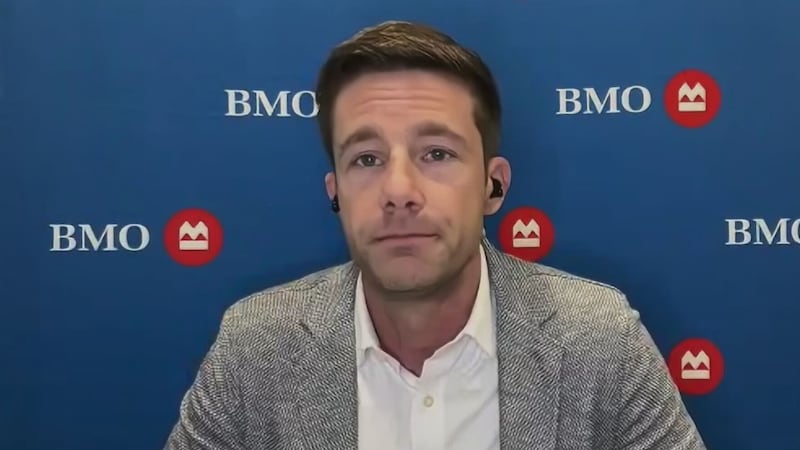
Read the full transcript below:
LINDSAY: Well, the Canadian dollar is ticking slightly higher after a week of declines, up a 10th of a cent to about 70 and a half U.S. cents. That means roughly $1.42 Canadian buys you one U.S. dollar and about $1.62 for a euro. So let’s get more on the loonie and how changes at the Fed are shaping the macro picture. Let’s bring in Mark McCormick, chief FX strategist at BMO Capital Markets. Good morning. Thanks for joining us.
MARK: Morning.
LINDSAY: So when we last talked to you, your prediction for the loonie was that it would go below 71 U.S. cents. I believe it now has. Where do you think the loonie goes from here? And what straw... what are the drivers for it dropping lower?
MARK: Yeah, I think the major drivers are still the same, right? This is a broad U.S. dollar market, and the themes are evolving into what we thought they would be, which was, again, the Fed was going to be much more hawkish than people expected to start the year. We assumed there’d be no cuts. Again, we’re getting to the point now where there’s probably going to be a hike, probably as early as September. I think the other theme that’s resonating with markets is the U.S. is just doing pretty well. The economy is quite strong. It’s accelerating in Q. U.S. equities are outperforming the rest of the world, and the world has obviously changed, the macro regime has changed, and the world that we’re in now is just currently dollar positive. So I think where this goes, the Canadian dollar is really just kind of, it’s being driven partly by the, you know, the risk sentiment, risk appetite, and things like that, but the main driver, I think, for dollar CAD right now is really about the divergence in the U.S. economy, the Canadian economy and relative central bank policy. So I think where we’re going is probably 69 cents. That’s, I think, we can touch that level. I don’t think we’re going to stay there, but I think we’re stuck with a stronger dollar for longer here.
LINDSAY: Sixty-nine cents. Okay, so let’s talk about the U.S. then, because you brought that up. Obviously, the U.S. dollar has been breaking higher as the Fed turns more hawkish, which we’ve seen over the last couple of months. Tell us more about this pivot for the U.S. dollar.
MARK: Well, I think what’s important is this is not what consensus had felt. If you look at pretty much every note to start the year, it was really a very similar story. It was the Fed’s going to cut rates, the U.S. economy is weak because of trade uncertainty, the dollar is going to go down because of geopolitical uncertainty inspired by Trump and political policy around there, and at the exact same time, the world was going to diversify out of U.S. assets. None of those things came true. I think what people need to respect is that correlations in the market change. The dollar went from, again, kind of reflecting geopolitical risk to hedging it again, and again, I think a lot of it comes down to what the underlying story is. Again, the U.S. economy has been quite resilient. The market was wrong to kind of bet against it last year, and I think a big story was that Europe would kind of take over the growth story, and then Europe would offer a counterpunch in terms of where equity should flow. I think what’s massively disrupted this is, again, you had a terms-of-trade shock and an energy shock, but even coming into the shock that we had with the Strait of Hormuz and oil prices going up, Europe was dealing with extremely low natural gas inventories, which is what powers our manufacturing sector. So they had a very cold winter, they had really low stockpiles of natural gas, so Europe was very vulnerable to a growth shock, which is, again, changing the entire outlook again from the way that people are viewing markets. So I think the number one thing you want to think about here is if equities, terms of trade, carry and interest rates all favour one currency, and that currency is still kind of the world’s kind of major dominant reserve currency, it’s still going to function that way until something else changes.
LINDSAY: I know it’s just begun, but how would you describe the new Kevin Warsh era of the Fed?
MARK: Yeah, I think it’s quite interesting, right? So the theme that we’re seeing in central banks is, I think Warsh has just kind of become the most open about it, but this is happening across all major central banks. They’re offering less forward guidance. I think forward guidance is just less relevant and needed in a world where inflation is going up and we’re living in a world with higher interest rates. I think the whole point of forward guidance was trying to compress term premium and try to keep yield curves under control in an era where quantitative easing dominated and central banks were trying to keep rates at a certain level. I think the point is, is when you continue to try to do the same thing over and over again, you get different results. Central banks have just not been great at predicting GDP and inflation and the outlook for the macro economy because of all the external drivers, whether it be geopolitics, whether it be fiscal, whether it be, again, oil shocks, energy shocks. There’s just all these external factors just making it extremely complicated for them to offer extremely credible forward guidance. So I think what Warsh is doing, and he seems to be kind of spearheading this, is they are removing forward guidance. They want to remove essentially the dot plot or provide less forward guidance to markets. We’re more data dependent. But I think what people need to recognize is, like before the financial crisis, before Lehman Brothers went under, this is kind of how markets worked. So you didn’t have central banks telling you what they were going to do. You had to read the data. The data was important and created macro volatility, and this is what drives fixed income and currencies, is really kind of understanding the data, understanding the fundamental driver. So I think that’s the direction where we’re going.
LINDSAY: I wonder, though, if that increases volatility, if markets are left to kind of interpret it, interpret policy on their own, and if that’s the case, like, what should investors be watching for?
MARK: Yeah, absolutely. That’s, I think, a very right conclusion, is, again, we’re dealing with all types of uncertainty, economic uncertainty, geopolitical uncertainty, trade uncertainty. It’s kind of the buzzword. It kind of defines the era that we’re in right now. But, again, volatility is different than uncertainty. But volatility, again, is something you can particularly hedge. It’s something that, you know, reflects the underlying changes and the dynamics in the market. So I don’t think investors should be nervous about volatility. I think it’s, again, something you have to hedge, it’s something you have to understand more. But I think what it does is, instead of investors trying to listen to the central banks and expect the central banks to tell them what they’re doing, you’ve got to do a little bit more work on what you think is going on in the country, what you think is going on in markets, and where you think, you know. Again, this brings us back to more fundamental macroeconomic analysis, which, for me, I think is just much more interesting than trying to read into what the central banks are saying.
LINDSAY: So, just in our last minute then, does the market have it wrong right now? Do they have it right with nearly 50 basis points of cuts priced in over the next year?
MARK: Cuts in the U.S. or Canada?
LINDSAY: In the U.S.
MARK: Yeah, I think the cuts are wrong. So, again, I think we’re going to see a hike before a cut, and again, my assumption coming into this year was the U.S. economy didn’t need the cuts that they got last year coming into this year, so there wasn’t going to be any follow-through. So, again, I think we go up. We could actually see a hike in July. I would not be, I would not be extremely surprised if that happened. But again, I think the baseline is you should expect a hike in September. But I don’t think they’re going to reverse that anytime soon. So, again, I go hike before a cut and hike into a higher neutral rate for a longer period of time.
LINDSAY: Okay, got to leave it there. Mark McCormick, chief FX strategist at BMO Capital Markets. Appreciate your time today. Thanks for joining us.
---
This BNN Bloomberg summary and transcript of the June 26, 2026 interview with Mark McCormick are published with the assistance of AI. Original research, interview questions and added context was created by BNN Bloomberg journalists. An editor also reviewed this material before it was published to ensure its accuracy and adherence with BNN Bloomberg editorial policies and standards.

