The U.S. economy added 29,000 jobs in September, down from the previous month and well short of expectations. The report puts the strength of employment growth in focus ahead of upcoming central bank decisions.
BNN Bloomberg spoke with Earl Davis, head of fixed income and money markets at BMO Global Asset Management, about the employment figures, the interest rate path and opportunities in government and corporate bonds.
Key Takeaways
- Softer wage growth reduces the likelihood of an October Fed hike, but Davis still expects a December increase and further hikes ahead.
- Davis expects the Bank of Canada to hold rates through 2026, with hikes likely in 2027 and inflation determining their pace.
- Davis favours five-year bonds, sees 10-year bonds nearing a buying opportunity and remains underweight 30-year bonds because of volatility and fiscal risks.
- Davis favours Arterra Wines’ roughly five-year corporate bonds, citing a yield of about 7.5 per cent and supportive business fundamentals.
- Expanded wine sales in Ontario grocery and convenience stores support distribution, while further reductions in interprovincial trade barriers remain a potential opportunity.
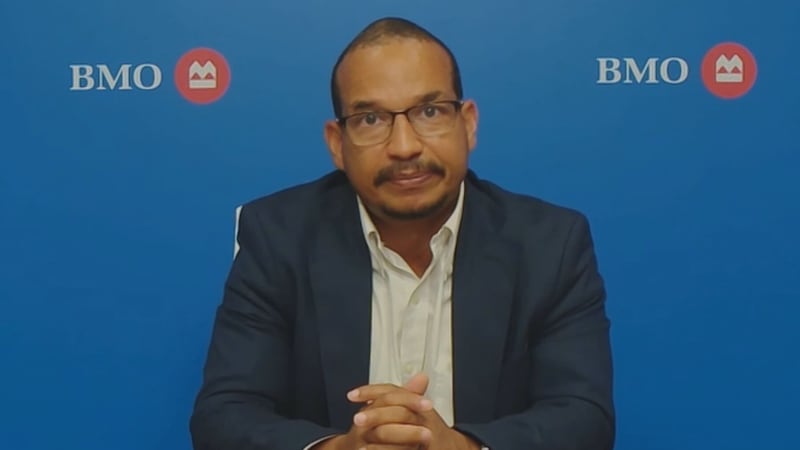
Read the full transcript below:
ROGER: U.S. economy created only 29,000 jobs in September, down from the prior month and well short of expectations. Let’s find out what that means for the markets and upcoming central bank rate decisions. Joining me now is Earl Davis, head of fixed income and money markets at BMO Global Asset Management. Earl, thanks, as always, for joining us.
EARL: Good morning. It’s a pleasure to be here.
ROGER: Okay, let’s get your reaction to the numbers for first. Well short of what expectations were, at least when it comes to those — that 29,000.
EARL: Yeah, so there’s three points I would take away from today’s number. So one is, being lower than expected, it does reduce the possibility or probability of a Fed hike in October. That’s what the market is contemplating now: whether they’ll hike in October and then again in December. So this reduces the probability of an October hike.
What’ll be interesting is we have two sort of bearish or hawkish Fed governors speaking today: Lorie Logan at 10 and Goolsbee, I believe, at 12 o’clock today. So what they say will give a very solid indication as to what happens in October. So that — that’s the first point.
The second point is, despite the weakness in this number, it’s still a good number. The structural growth for full employment in — in the U.S. is reduced just due to increased productivity and the reduced job force. So it’s still a solid number. It’s positive. So what’s interesting from that perspective, we will see how the markets look at the end of the day, and that’ll give us a good indication in the months ahead. Are we still going towards higher rates, or are we taking a pause?
So right now, yields, bonds, 10-year bonds, 30-year bonds are rallying off the weaker number. We’ll see if that’s still the case at the end of the day. Equities are all right. We’ll still see if that’s the case at the end of the day. So that’s the second point. Where do we close the week?
The third point, and most interesting, I just saw this, and I have to look into it further. The modelling of the employment number, birth-death rate, reduced the — the employment number by 190,000. So it’s interesting in regards to the noise created by the modelling, which says you have to look at this over the long term, and how does it look?
So good for October, reduces the probability of a hike, but we have to see the impact. As it turn around the market going forward in regards to higher bond yields, we don’t feel that it does.
ROGER: So just to clarify, so that means the modelling, with — when you include birth and death, that it dropped — the number actually dropped for jobs created, or there was actually a reduction.
EARL: Yes, so it reduced the jobs by 190,000. So I have to look into that further. Just saw that headline on one of my notes just prior to getting on the call, but that’s significant in regards to the confidence level I have in these jobs and the lower job growth.
ROGER: Okay, and within it, the wage growth was below expectations. What — how does that play in with everything?
EARL: That plays in very well to reducing the probability of a hike. Obviously, the FOMC is focused on inflation right now, so wage inflation would just be one more thing that adds to it, and that came in below expectations at three per cent. So that’s a good number. Good meaning it doesn’t induce the Fed to accelerate hikes or hike more than expected. So that’s good.
If we stay around this three per cent, two to three per cent, that’s good. There are some market participants calling for higher wage inflation going forward, just because of the demographics and reduced immigration in the U.S., but we’re not there yet, so that’s a very good thing.
ROGER: Okay, and if there was — say we don’t see a hike in October, do we still have a likelihood that we will see hikes no matter what, or could that change depending on — depending on, of course?
EARL: At this point in time, all else equal, yes, we will still see hikes. The market is still discounting 75 basis points of hikes by March next year. This is in the U.S. This is not Canada, so we do expect to see a hike in December, which was our base case anyways because it’s after the midterm elections. But yes, we do still expect to see one hike and more than one hike going forward.
ROGER: And then the BoC, where do we sit with that then? With everything that’s unfolding south of the border and up here?
EARL: Yeah, in Canada, we get our employment number next week. I think that’s going to be important. We believe the BoC will be on hold for the balance of 2026. Just too much uncertainty, too much moving — too many moving parts.
Having said that, the market does anticipate one hike this year. We don’t believe that will come to fruition just because of all the moving parts. The biggest thing and the biggest risk is, again, inflation. So as long as oil stays below $100 here, and more importantly, gas and diesel doesn’t rise quicker than the price of oil, then we should be on hold for the balance of 2026. But hikes are in the cards for 2027, just the pace of which is to be determined.
ROGER: Okay, and let’s talk quickly about bonds. How are you — where are you sitting right now with them?
EARL: So right now, what’s interesting is we are underweight bonds. We’re underweight long-duration bonds, so 30-year bonds, 10-year bonds. We like the five-year sector, just a very good amount of income and coupon coming in there.
And if we do get a further weakening or sell-off in bonds or higher yields, we believe we’re coming very close to a buying level in 10-year sector. So we are keeping our eyes out open on bonds for opportunities to go longer duration. We will limit that going longer duration to 10 years, just because there’s too much volatility in the 30 years, and the 30 years is where it takes into account the fiscal deficits and other factors.
So long five-year bonds, underweight 30s, looking to buy 10-year bonds.
ROGER: And I want to ask about a corporate bond recommendation: Arterra Wines.
EARL: Yeah, we like Arterra Wines. You know, the yield on — on is seven and a half per cent, and that’s on basically a five-year bond. That is significant. That’s almost 300 basis points above — that’s like 300 basis points greater than Treasuries, so very attractive bond yield there, and we like it because the fundamentals, not just the yield.
The opening up of grocery stores and convenience stores for wine in Ontario is good. They’re — their leader in retail sales in Canada, and they’re the largest producer of wine in Canada. So we think this buy Canada, interprovincial trade barriers going down is all beneficial, which is supportive of the coupon and the cash flow.
ROGER: And have we started to see any of that? The interprovincial trade barriers, have we started to see that come down for wine? Is it opening up a little more?
EARL: You know what? So no, there’s still a lot of tariffs that need to be opened up. So the tariffs that need to be cut to fully open it up. We do believe what’s going on in the U.S. will actually accelerate that with the U.S. ban on alcohol. It puts a little bit of fire behind the provincial ministers to do so. So we do think that will open up sooner rather than later.
ROGER: All right. And any real competition for this? This — how big is it in Canada relative to anyone else?
EARL: Yeah, relative. So they own 12. They have 2,000 acres across Canada, which is much larger than the others. But it’s not just their production. It’s that they have — they’re the leader in regards to their distribution methods.
They also own the Wine Rack, so they get great distribution there. And being the number one retail seller puts them in a first-mover shelf-space advantage.
ROGER: Okay, we’ll wrap it up there, Earl. Thank you, as always, for joining us. Thank you. Earl Davis, head of fixed income and money markets at BMO Global Asset Management.
---
This BNN Bloomberg summary and transcript of the Oct. 2, 2026 interview with Earl Davis are published with the assistance of AI. Original research, interview questions and added context was created by BNN Bloomberg journalists. An editor also reviewed this material before it was published to ensure its accuracy and adherence with BNN Bloomberg editorial policies and standards.

