The retirement announcement of Warren Buffett prompted me to refresh a theme that we have discussed on Berman’s Call for many years.
• Market timing is very hard
• Diversification is critical
• Periodic rebalancing is prudent
• Long-term focus is needed, but hard to execute
• And most important of all is your portfolio construction (tool box)
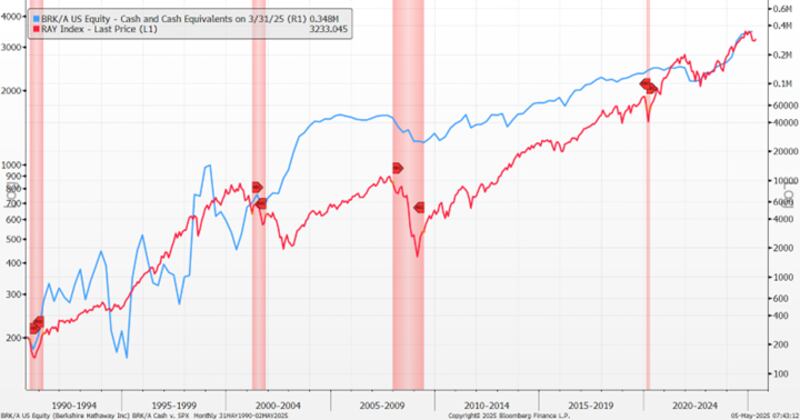
These are the key ingredients to long-term success. Buffett’s style is as a value investor, often quoted as saying: “Buy when there is blood in the street.” This long-term chart demonstrates this key “rebalancing” skill Buffett utilizes.
It’s not market timing! The blue line is the amount of cash and equivalents at Berkshire Hathaway. He tends to boost cash when there is less opportunity in equity markets and tends to use cash when markets (or parts of it) offer better value than cash.
He increases leverage when there is opportunity and reduces it when valuations are poor. It’s the best use of cash. He uses swaps and all sorts of other derivatives too.
What happened from 1998 to 2002 was a great example of an investment style going out of favour. We recall at the time that the Street was critical of Buffett that he did not understand the new economy and technology.
What he proved during that period is a long-term focus and patience is critical when you are an investor. It’s a great lesson for the click bait world we live in.
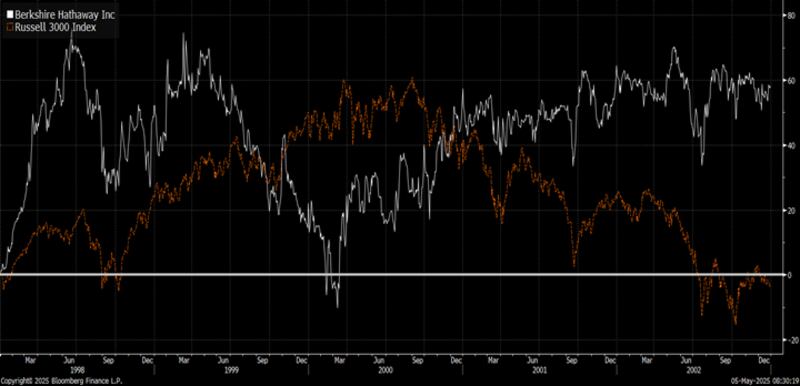
The best performance Buffett had was decades ago (pre-1998). Since the bottom of the Dot-Com bust in 2002, Berkshire has returned a bit more than the S&P 500 Index and has underperformed since the bottom of the Great Financial Crisis in 2009.
As Berkshire has grown, it’s become harder to beat the market. But when you think about what has lifted the S&P 500 over the years, Buffett has not held much at all of the disruptive new technology companies (think Tesla or Nvidia in recent years).
One could argue that a better benchmark should be a global equity index or better a global balanced fund. In recent years, Buffett has been a big buyer of Japanese stocks. Berkshire has done much better versus a world benchmark or a 70:30 balanced fund benchmark.
| Annualized returns since | 11/5/1987 | 10/9/2002 | 3/9/2009 |
|---|---|---|---|
| Berkshire Hathaway A | 16.20% | 11.59% | 16.03% |
| S&P 500 | 10.95% | 11.33% | 16.27% |
Berkshire Hathaway is the biggest leveraged balanced fund in the world. The current market capitalization is US$1.16 trillion, and the debt-to-equity ratio is 20 per cent.
When interest rates hit zero post Dot-Com bust, Buffett started to use a notable amount of leverage to boost enterprise value. The debt-to-equity ratio was as high as 40 per cent during the decade when cash yields were near zero.
So, what can we glean from the current reporting period and Buffett’s portfolio construction?
- Leverage is relatively low
- Cash is very high
- Seems to be waiting for some blood in the streets (in April we saw a bit of that)
- Better value globally using strong U.S. dollars to buy cheaper assets
Follow Larry
YouTube: LarryBermanOfficial
LinkedIn: LarryBerman

