
We have noted for the past decade that while low-cost bond exchange traded funds (ETFs) are a cheap management expense ratio (MER) versus what active delivers, they are not an effective way to get the “safe” fixed-income part of your cash flowing portfolio and a real return of your money.
This is a very different risk profile and after tax experience than equity dividends and cannot be compared unless one adjusts for volatility and income levels. As all investment funds write in their investor disclosures, past performance is not a guarantee of future performance. But when it comes to bonds, we kind of know the potential future performance will be when it comes to passive indexing. You can only earn the yield to maturity when buying a bond, so you actually do know what your forward return (less credit risk or loss of capital) is likely to be.
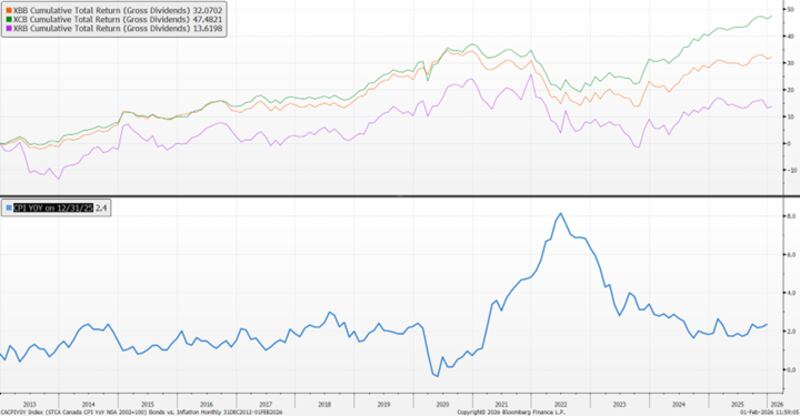
Since 2012, after the European debt crisis and the global financial crisis, Canadian bonds have barely kept up with inflation. Since Dec. 31 2012, the annual total return of iShares Core Canadian Universe Bond Index ETF (XBB) was 2.15 per cent, iShares Canadian Corporate Bond Index ETF (XCB) was 3.01 per cent per cent, iShares Canadian Real Return Bond Index ETF (XBB) was 0.98 per cent with Canadian consumer price index (CPI) averaging 2.3 per cent annually.
Going forward, the XCB weighted average coupon (WAC) is 4.35 per cent and the yield to maturity (YTM) is 3.87 per cent. The XBB WAC is 3.41 per cent and the YTM 3.5 per cent while the XRB YTM is 3.43 per cent and the WAC is 2.33 per cent with a real yield of 1.48 per cent. So basically, your safe money yields one to 1.5 per cent and that’s without paying your advisor.
A portfolio without alternative income sources just won’t cut it for most lower risk investors. While private credit exposure is considered high yield (and therefore riskier), you get compensated by earning significantly higher returns in the six per cent plus range and there are many good funds that target 10 per cent or more without materially higher risks.
The biggest issue for many investors is the illiquidity risk. The Chartered Alternative Investment Analyst Association (CAIA) guidelines have an outline of the risk equivalent levels for private credit.
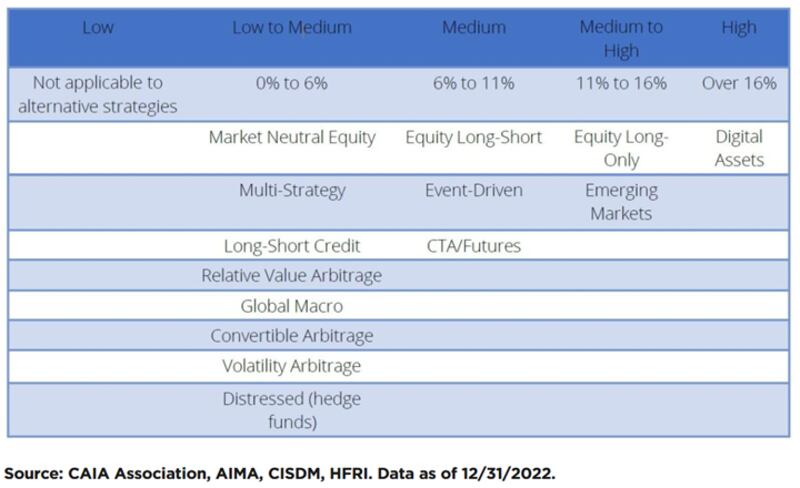
For private credit funds, the risk rating for an individual fund depends on the type of lending they do.
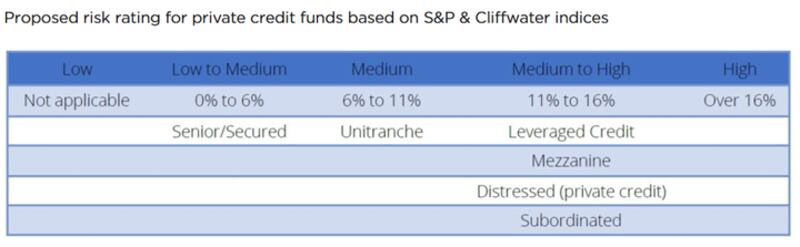
A great example of the low to medium risk in senior secured is a first mortgage fund. Typically, loan-to-value (LTV) is in the 50 to 70 per cent range where the first loss if the mortgagee does not pay is to them. The property can be sold (may take some time) and almost always you make out better because of fees and penalties. But a second mortgage, where LTV is higher than 70 per cent has a much higher risk. True, the yield might be better, but the second mortgage may need to buy out the first to control the sale of the property. A leveraged first mortgage fund is lower risk than an unlevered second mortgage fund. Land mortgages are higher risk than owner occupied homes. When it comes to business lending, and other types of specialty finance, the variables are broad.
According to (TIAA) Nuveen’s 2025 EQuilibrium survey, nearly half (49 per cent) of institutional investors plan to increase their allocation to private credit over the next two years, a clear signal that confidence in the asset class remains strong. For investors who can separate signal from noise, this growth presents an opportunity to focus on the segments, structures and managers most capable of delivering durable outcomes in a maturing market.
Nearly 95 per cent of institutional investors who hold alternatives now allocate to some form of private credit, up from 62 per cent just four years ago. Furthermore, the influx of new capital from a wider range of sources is reshaping the market’s structure.
As retail channels, defined contribution pension plans and insurance balance sheets grow their allocations, managers are adapting product structures, liquidity features and reporting standards to meet a wider range of investor needs. Understanding private credit’s segmentation is essential to optimizing its role within a portfolio. No longer an opportunistic niche, private credit now represents a core allocation that demands a considered approach to manager selection and portfolio construction.
Investment grade private credit
Putting it all together: the modern institutional portfolio The breadth of today’s private credit opportunity set is reflected in the portfolio construction of leading institutional investors. For example, TIAA, Nuveen’s parent company and one of the world’s largest institutional investors, maintains a highly diversified portfolio that integrates both public and private markets across asset classes.
Lending to middle market companies drives economic activity. In the U.S., one-third of all private sector gross domestic product (GDP) comes from the middle market, encompassing nearly 200,000 businesses employing 48 million workers and generating over US$10 trillion in annual revenues.
For individuals that look to add this important category to their portfolio, understanding liquidity (understand gating risks, can’t emphasize this enough) and risks are key. Much like with public equities and bonds, diversification is your best friend. When lending money, loans go bad. It’s part of the process. Don’t stress it. Understand what the manager will do to restructure and mitigate the risks. In some cases, you end up with a better return after a restructuring.

