It is widely expected that the U.S. administration will open the Canada-United States-Mexico Agreement (CUSMA) for review.
All will know that the U.S. is in the process of rebalancing global supply chains and while Canada and Mexico are friendly traders compared to the EU, Asian and other regions where geopolitical issues are far greater, we will nevertheless see some notable disruption to FX markets as snowbirds like me look to spend colder months in a warmer place.
The CUSMA trade deficit is largely a problem of oil imports from Canada and manufacturing imports from Mexico. Excluding petroleum, the U.S. actually ran a trade surplus of $55 billion with Canada in 2024, or $3 billion more than in 2020.
With Mexico, imbalanced trade is about manufacturing, not oil. The non-petroleum trade deficit with Mexico accelerated after CUSMA took effect, reaching $156 billion in 2024 (or $55 billion more than in 2020).
For the U.S., the main issue is likely closing the manufacturing backdoor from Mexico and less about Canada (and the 51st state nonsense). No matter what, the U.S. will not be able to solve the wage differentials between Mexico and the rest of North America.
As it pertains to Canada, the rhetoric that the U.S. is energy self sufficient is not exactly true. The U.S. consumes about 20 million barrels of oil per day equivalent while producing about 22 million, but the mix between crude and equivalents requires imports of certain blends for product production.
Most of it comes from Canada’s heavy crude. Milk quotas are another area that will be looked at from Canada’s perspective, but it does not move the needle much on the FX rate relative to the energy surplus.
- United States Oil Production Today | Oil Production Live
- STEO Data Browser - 3e. World Petroleum and Other Liquid Fuels Consumption
For Canada, terms of trade settles in the FX (capital and current) accounts and influences both speculator and investor flows. It’s well known that CUSMA will be debated for the few months or so before a new agreement is likely reached.
The U.S. still needs our heavy crude oil but does not need our natural gas. Don’t let Trump’s rhetoric change that fact, so in recent years, the capital account side (green line - read investment flows) has been much more highly correlated with the Canadian dollar exchange rate than the price of crude oil.
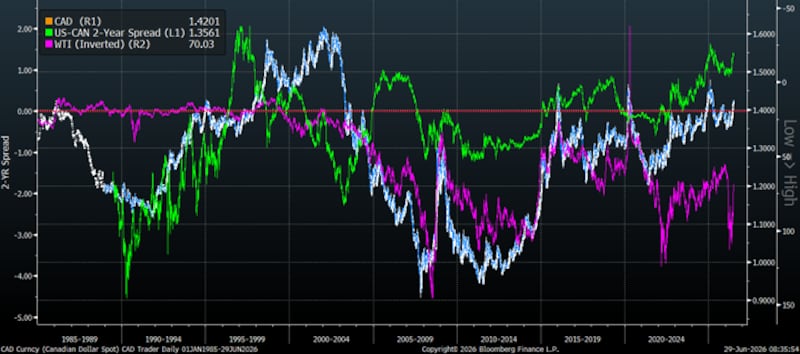
For most Canadian investors other than dividend seekers, with Canada representing three per cent of the global capital markets and the U.S. north of 60 per cent, foreign currency is a huge factor when making investment decisions.
At a CAD rate of 1.42, and an annual breakeven cost of hedging of about 1.25 per cent (this changes when central banks change rates), it may make sense for some investors to hedge in registered accounts (where tax issues are not a factor).
A structurally weaker Canadian economy will not be solved in CUSMA negotiations. Prime Minister Mark Carney is looking elsewhere, but that is a factor that Trump des not like (Chinese EVs as an example).
The reality is, Canada and the U.S. will always be tied geographically, and this is really just noise. Fair value of the Canadian dollar is likely closer to 80 (1.25) – 85 (1.1765) U.S. cents, but we need much better foreign investment policy to get there and drive capital flows to Canada. We will see if Carney can deliver – so far, not so much!
Follow Larry
YouTube: LarryBermanOfficial
LinkedIn: LarryBerman

