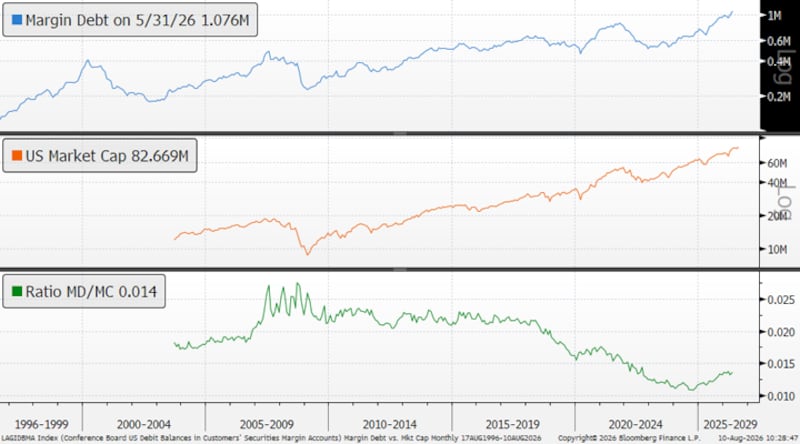
Many are asking if we are in a market bubble. There are clearly some characteristics of this in trading behaviour, the amount of leverage in the market, the use of derivatives (options) to create leverage, and structured products (such as leveraged ETFs).
In recent months, margin debt has also reached all-time highs. However, as a percentage of U.S. market capitalization, it is nowhere close to previous peaks (such as the Dot-Com bubble, the Great Financial Crisis, and the post-COVID era).
It’s been real earnings driving markets higher. The combination on AI related CapEx and tax incentives in the OBBB has added notable profitability tailwind in recent quarters despite the geopolitical challenges.
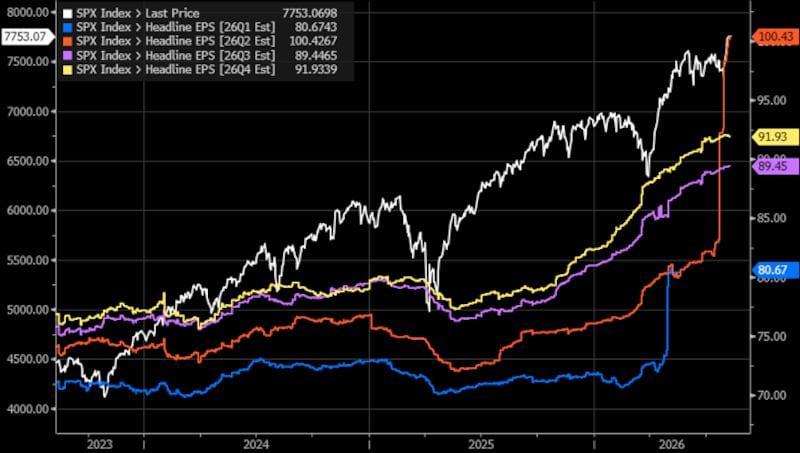
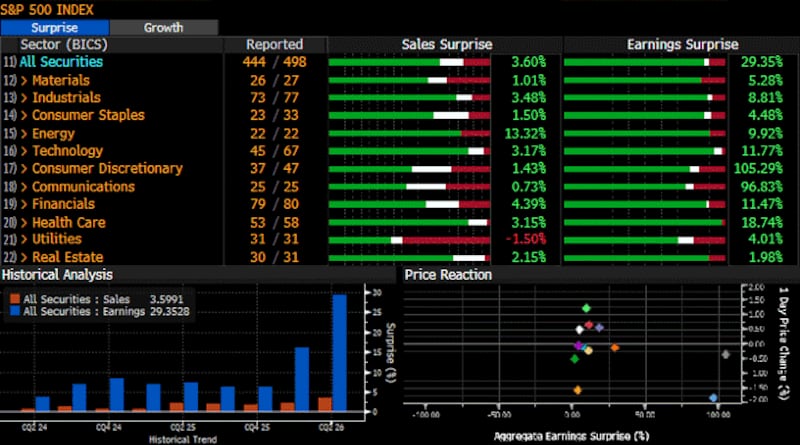
When we break it down by sector to see where it’s coming from this quarter, it’s AMZN and GOOGL, that have been the major contributors. Based on where Q1 EPS were ($80.67) and the massive jump in Q2 ($100.43), the market is not as expensive as it appeared to be at the start of the year.
We always need to look at the go forward and it’s clear the trend seems to be higher. Inflation trends act as a tailwind as long as that can be passed through to consumers. To be sure, the can is getting kicked, but that should continue to support markets this year.
I’m getting concerned that 2027 could hold the perfect storm in terms of geopolitics (Regime change in Iran), U.S. fiscal cliff gridlock (Congress flips to Democrats, OBBB benefits roll off), and a realization that AI Capex investment rates will slow significantly as revenues are rationalized.

