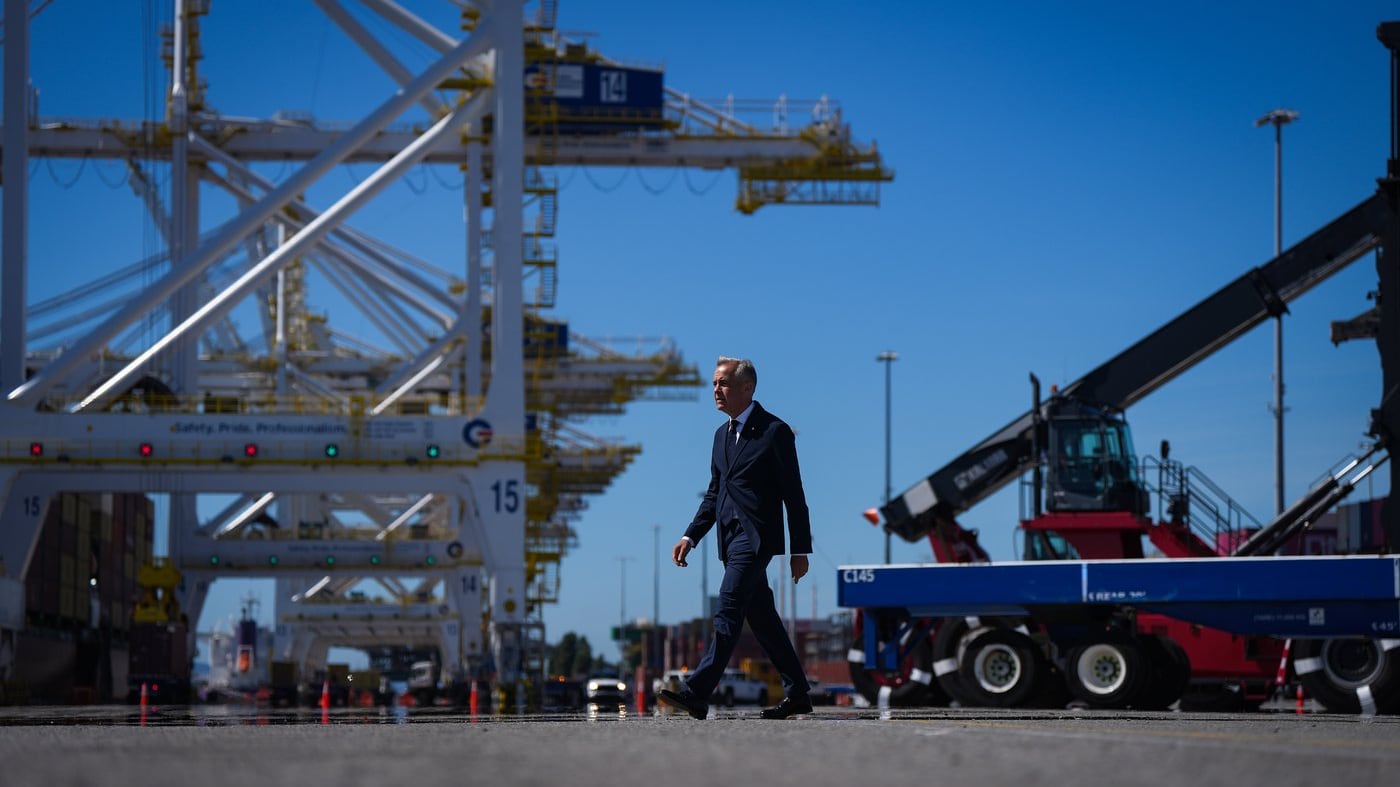
Of all the quotable quotes from Prime Minister Mark Carney following the break down of trade negotiations with the United States, it’s what he didn’t say that should resonate with Canadian households.
After walking away from the deal, he explained to reporters how Canada’s strong fiscal position gives us the upper hand in the trade war.
“We are entering a phase where fiscal strength, discipline, focus, is going to be very important,” he said.
The 61 year-old banker from Northwest Territories could have wagged his finger at over-leveraged Canadians and warned them to prepare for the fallout by getting their own fiscal houses in order, but he stopped short and reached beyond the gaggle of reporters.
“I will say to Canadians at home, as someone who’s been around financial markets for a long period of time, what I’m about to say doesn’t make sense but it’s the way the world works,” he said, before getting to the point.
“Markets sometimes ignore these fundamentals and then all of a sudden they focus on them, and when they focus on them, if you don’t have your house in order, it’s too late. We have our house in order and we’re getting stronger”.
Mark Carney knows a few things about strength through financial prudence. Before becoming Prime Minister last year he steered Canada through the 2008 global financial meltdown as Bank of Canada Governor - bolstering the nation’s banking system as the envy of the world.
He also orchestrated Britain’s mop-up from Brexit and Covid as head of the Bank of England.
Since then, the Harvard, Oxford and Goldman Sachs educated Carney has managed billions of dollars in infrastructure investments with Brookfield Asset Management.
And he’s a goalie.
Fiscal prudence on the home front
Carney knows Canadian households are vulnerable. We owe $1.80 for every dollar we bring in, according to the latest tally from Statistics Canada.
That’s double the debt to income ratio since the 1990s.
Most of that debt is set at low-interest mortgage rates of about 4 per cent over a 5-year term, but unsecured loans such as cash on credit card balances can compound at nearly 30 per cent.
Homeowners can consolidate higher-interest debt into one low-interest loan through a home equity line of credit (HELOC) secured against the property. However, the $180 billion Canada already owes on HELOCs, and the threat of further declines in house prices, could make them further vulnerable.
Building a war-chest for retirement
Canada’s benchmark stock index, the S&P/TSX Composite, has recaptured lost ground from the initial shock of the break down and remains up by over 15 per cent since the start of the year.
The stock benchmark for the rest of the world (including the U.S.), the S&P 500 Index, has shrugged the news off but has only advanced by 13 per cent so far
this year.
That could change if the trade war continues. A natural instinct for some retirement investors might be to stay on the sidelines for now but inflation will eat away at cash instead of compounding over time.
If you want your registered retirement savings plan (RRSP), registered retirement income fund (RRIF) or tax free savings account (TFSA) to grow, you must be in the market directly or through funds.
Most employer pension plans are also exposed to financial markets, so you might not have a choice.
Stay defensive by staying diversified
If you invest for the long-term, the best defense is diversification. Not all sectors and asset classes will perform the same if the trade war continues.
The right mix of asset classes, sectors and geographic regions can hedge your portfolio against isolated downturns.
For investors who are skittish on equity markets, fixed income guaranteed investment certificates (GICs) are yielding about 4 per cent annually.
Stocks carry more risk but also have the ability to generate income in any market climate through dividends. Large companies with strong track records for dividend payouts can exceed bond yields even when their stock prices are down.
It’s not easy to properly diversify an investment portfolio but a qualified financial advisor should have the experience and know-how to match the risk tolerance and return expectations of a client.
Cast a wide net in equities
Safe returns from fixed income and GICs won’t get you to a typical retirement goal of seven or eight per cent. That’s why advisors recommend a large weighting in equities, depending on how soon the cash is needed.
Equity market risk is unavoidable but there is a way to maximize returns and minimize risk by diversifying across sectors and geographic regions.
Most Canadian mutual fund providers offer a wide variety of global funds including broad global funds (all countries), international funds (all countries minus Canada and the U.S.), or funds that concentrate on specific countries, regions, or global sectors like technology.
Many foreign equity funds are actively managed by investment teams with vast research capabilities and experience in the focus area. Some funds are sub-managed by firms located in the specific geographic region.
Annual fees for that sort of reach and expertise can be two per cent to three per cent of the total amount invested, which is ultimately drawn from the total return.
Exchange traded funds (ETFs) generally have the same reach as mutual funds in terms of geographic regions and global sectors. The big difference is; they are passively managed. That means holdings are bought and sold according to a preset formula such as market weighting in the underlying index.
ETFs are not as effective as actively managed mutual funds at adjusting to changes or nuances relating to specific foreign markets.
On the plus side, fees on foreign ETFs are usually a fraction of mutual fund fees.
Investors can also get broad equity market exposure by investing directly in global stocks that trade on the S&P 500. Many generate revenue and grow earnings around the world, which can provide a hedge against whatever else Donald Trump has in store.

