After a period of significant outperformance, Canadian banks are showing signs of weakness, raising questions about whether there is more room for bank stocks to climb.
Canadian banks have been on a spectacular run since April 1, 2025, producing a return of 85 per cent as of Aug. 26, 2026, and outperforming the S&P/TSX Composite Index by 37 per cent, according to Bloomberg data.
The Big Six Canadian banks have generally had strong earnings during this period. More recently, however, Canadian banks started to underperform ahead of their third-quarter earnings as investors grew concerned that the banks had run too far, too fast.
Is there more room for Canadian banks to outperform, or are the best days in the rear-view mirror?
This week, the Big Six Canadian banks released their earnings. All six banks produced strong reports and beat their earnings expectations.
The strong performance of the Canadian banks is the result of more than solid earnings reports. It has also been in part because foreign investors perceive Canadian banks as a favourable investment vehicle.
The Canadian stock market has benefited from foreign investors increasing their exposure to stock markets in commodity-based countries. The Canadian banks are a particularly attractive proxy for a commodities-based country as the banks have an oligopoly structure and pay high dividends.
In addition, foreign investors have sought to diversify their investment holdings outside of the U.S. This phenomenon started back in early 2025 when the U.S. administration started to implement tariffs on countries around the world. Although the U.S. banks are structurally different from Canadian banks, nevertheless, they have substantially underperformed Canadian banks since the tariff debacle started in 2025.
So how far “stretched” have Canadian banks become based upon fundamental valuations?
One valuation method that is often used for Canadian banks is the price-to-earnings ratio (P/E ratio). Over the last 20 years, the average P/E ratio (trailing 12 months) has been 11.8 and up until recently, the ratio has generally trended in a channel from 10 to 14, Bloomberg data shows.
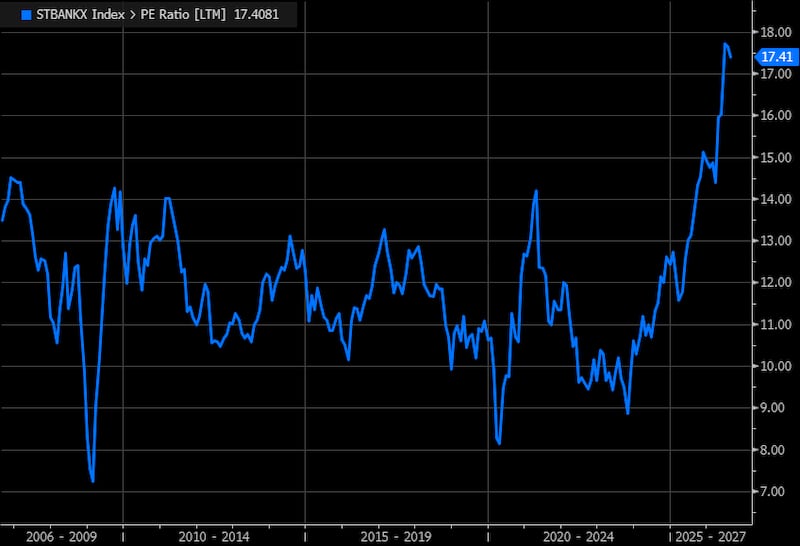
Since the P/E ratio bottomed in late 2023 below 10, the P/E ratio has climbed to its current 17.4. By historical standards, the P/E ratio is well above normal levels.
Can Canadian banks continue to perform well and maintain “lofty” valuations?
Yes, it is possible, particularly if the banks continue to beat expectations. However, it is important to note that with the P/E ratio of the banking sector at stratospheric levels, it is going to be hard for Canadian banks to continue to outperform the S&P/TSX Composite Index. If investors start to perceive that earnings may not be as strong in the future, the P/E ratio of Canadian banks could start to revert to more normal levels.
Canadian banks have benefited from foreign investors favouring commodity-based countries and diversifying away from the US, but these trends could reverse. If commodities were to head lower because of economic global growth concerns, foreign investors may start to withdraw some of their investments from the Canadian stock market, including banks. Very recently, the Canada-U.S. trade deal has fallen apart. If the U.S. were to maintain high levels of tariffs on Canada, the economic growth of Canada would be hurt in the short term. Foreign investors may take a pragmatic approach and favour investment alternatives outside of Canada, which would put downward pressure on Canadian banks.
Canadian banks are priced for perfection. It would be a mistake to assume that just because Canadian banks have outperformed in the past they are set to outperform in the future. The risks to Canadian banks continuing to outperform the S&P/TSX Composite Index are rising and it would not be unexpected for the banks to enter a period of underperformance.
The views and opinions expressed herein are solely those of the author(s) and may not necessarily reflect the views of Global X Investments Canada Inc. All comments, opinions and views expressed are generally based on information available as of the date of publication and should not be considered advice to purchase or sell any securities mentioned. Before making any investment decision, please consult your investment advisor or advisors.

