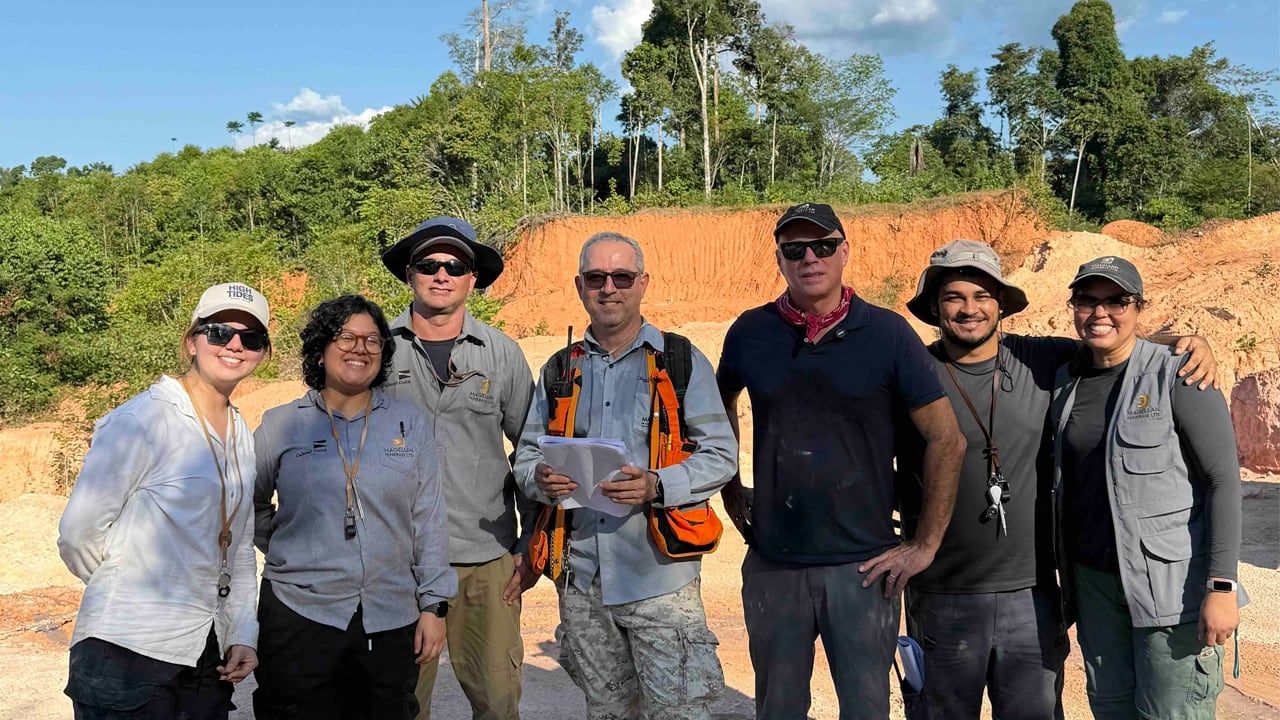
Disseminated on Behalf of: Cabral Gold Inc.
- As currencies weaken and debt concerns rise, investors are returning to gold. Prices are up nearly 50 per cent in 2025, with forecasts up to US$5,000 per ounce in 2026.
- Cabral’s discovery-proven team is advancing the Cuiú Cuiú gold district in Brazil toward first production. Its Stage 1 heap-leach operation, fully funded by a US$45 million gold loan, is under construction and is expected to produce approximately 25,000 ounces per year at an all-in cost of US$1,200 per ounce and generate early cash flow for expansion.
- Currently, three drill rigs are actively advancing discoveries and expanding deposits across a 10 to 15 kilometre-long structural corridor. Cabral continues to outline a much larger gold system, unlocking additional resource growth district-wide, suggesting the presence of a major gold district.
In a world questioning the value of currencies, the durability of debt and the direction of global markets, investors are returning to gold as a place of certainty. Central banks are now buying bullion at the strongest and most sustained pace seen in decades. Gold-backed ETFs have also surged, recording some of their largest quarterly inflows on record.
Recent analysis reinforces this trend. Gold has gained over 50 per cent in 2025, and the World Gold Council (WGC) says gold could rise between 15 and 30 per cent in calendar year 2026 from current levels, cementing its place as one of the year’s strongest-performing asset classes. Bank of America strategists project gold could reach US$5,000 per ounce in 2026 driven by expectations of U.S. rate cuts, a weakening dollar, and continued central bank accumulation.
At the same time, supply growth is struggling to keep pace. S&P Global data indicates that global gold production is expected to peak around 2026 before declining, as the industry contends with a shortage of major new discoveries, prolonged permitting cycles, and complex regulatory environments.
In other words, demand is rising while new supply is slowing, creating a market that rewards companies that can turn geology into ounces, and ounces into cash flow.
Cabral Gold Inc. (TSXV: CBR | OTCQB: CBGZF) is doing exactly that at Cuiú Cuiú in northern Brazil, the historic heart of the Tapajós gold rush, the largest gold rush ever recorded, where an estimated 30 to 50 million ounces of placer gold were recovered between the late 1970s and mid-1990s. Cuiú Cuiú was the largest area of placer workings in the Tapajós and produced an estimated two million ounces of placer gold historically.
What makes Cuiú Cuiú different from so many other projects is that it was a massive placer gold field. An estimated two million ounces of gold was recovered from surface gravels, suggesting that there must be a large hard-rock source somewhere nearby. Our job is to identify, drill and connect those sources. And we are doing just that.
— Alan Carter, President and CEO, Cabral Gold Inc.
“We are building this step by step,” says Cabral Gold’s President and CEO, Alan Carter. “Cuiú Cuiú was the most productive placer gold camps in the Tapajos region, and we believe it will grow to become one of the largest hard rock gold deposits in Brazil. The hard-rock sources that fed that placer system are what we are drilling now. The scale is here. The history is here. And the two-stage development plan is designed to unlock it without overextending the company or its shareholders.”
A region shaped by gold
Between the late 1970s and mid-1990s, tens of thousands of informal miners worked the creeks and terraces around Cuiú Cuiú in the Tapajós, in what became Brazil’s largest gold rush and one of the most extensive placer mining events ever recorded in human history. The sheer volume of gold recovered from surface gravels alone at Cuiú Cuiú points strongly to a much larger mineralized system below.
“What makes Cuiú Cuiú different from so many other projects is that it was a massive placer gold field,” says Carter. “An estimated two million ounces of gold was recovered from surface gravels, suggesting that there must be a large hard-rock source somewhere nearby. Our job is to identify, drill and connect those sources. And we are doing just that.”
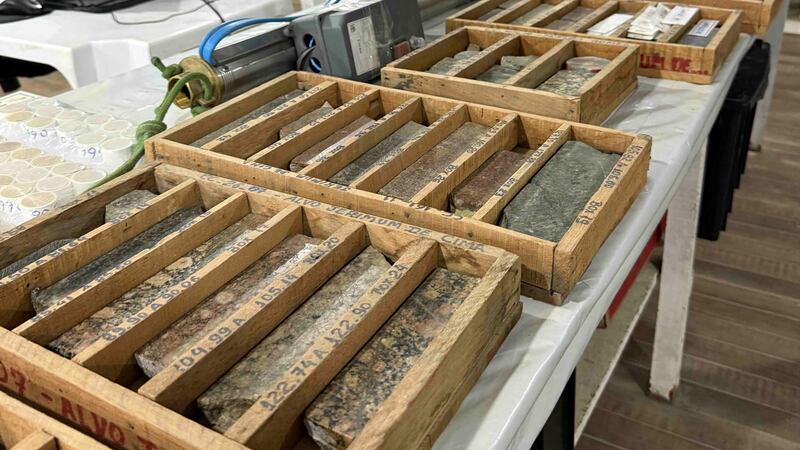
Cabral has so far defined two main deposits, MG and Central, which are five kilometres apart. More recently the company has made a series of newer discoveries including PDM, Machichie Main, Machichie NE, and Jerimum Cima. These are part of a structural corridor that runs at least 10 to 15 kilometres across the property. More than 40 additional targets with gold have been identified thus far all need follow up drilling.
“This is not a small footprint,” Carter states. “This is one of the largest mineralized systems I have seen in my career. The sheer scale of this mineralized system beggars belief. We are still very early in defining its full size.” Carter should know since he was intimately involved with the discovery of the Tocantinzinho gold mine next door and used to personally own the royalty. Tocantinzinho is Brazil’s third largest gold mine, knocking out 200,000 ounces of gold per year.
Drilling strengthens both scale and grade
Recent drilling has reinforced both the extent and the quality of the mineralized system at Cuiú Cuiú. At the PDM discovery, located just two kilometres northwest of the central gold deposit, the company expanded the gold-in-oxide blanket by about 50 per cent and drilled into several parallel high-grade primary structures beneath it.
One standout hole returned 23 metres averaging 4.7 grams per tonne of gold, including a one-metre section running above 90 grams per tonne. Meanwhile, at the Machichie NE discovery, located five kilometres to the southeast, intercepts include 11 metres at 33 grams per tonne of gold and 12 metres at 27.7 grams per tonne of gold. These intervals sit outside the more than 1.2-million-ounce resource footprint, pointing to significant resource growth potential.
“Our recent drill holes are not isolated hits,” Carter explains. “We are seeing repeatable mineralized intercepts in multiple zones. When you drill multiple targets within a district and continue to find grade over significant thicknesses, that is a strong indicator of scale. It tells you the mineralized system was extensive and robust.” Exploration continues with three drill rigs active on site, generating steady results.
“Because the district at Cuiú Cuiú is so large, we are pursuing a two-stage development strategy,” Carter says. “Stage 1 is aimed at mining the weathered surface material down to 60 metres depth and getting into cash flow. Stage 1 is fully funded and under construction and should commence production in Q4 2026. The cash flow from Stage 1 will allow us to drill test the numerous targets at Cuiú Cuiú and expand the much larger hard rock resource, without further dilution to the capital structure. The development of the much larger hard rock resource will constitute Stage 2 and is the much bigger prize.”
A staged pathway into production
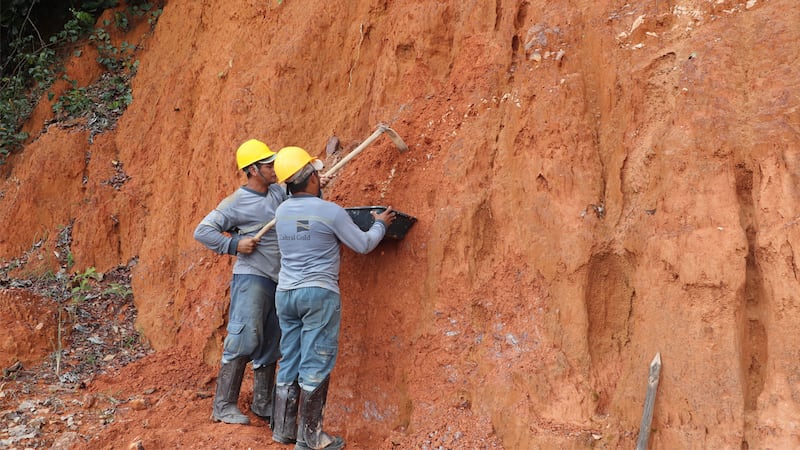
Cabral’s development strategy is designed to minimize risk and preserve shareholder value. The company will begin with a heap-leach operation targeting near-surface oxide gold at MG, Central, and Machichie. This oxide material is soft and does not require blasting or crushing, which reduces capital costs and simplifies recovery.
A pre-feasibility study outlined a project with strong margins and a rapid payback at gold prices well below today’s levels. The first phase is designed to deliver cash flow quickly starting in late 2026. “We structured Stage 1 to be achievable and capital efficient,” Carter says. “It allows us to move into production faster and to use that production to fund further drilling and expansion rather than relying on repeated equity raises which would have resulted in continued dilution to our capital structure. It keeps the value within the project.”
The company recently secured a US$45 million gold loan to finance the construction of the starter operation. “That financing was a pivotal milestone,” Carter explains. “It means the first phase of production is fully funded. With the necessary permits in place, and long lead items already ordered, we currently have over 140 people on site and are moving ahead with construction with our first gold pour anticipate in less than 12 months. The recently closed US$45 million gold loan avoided the need for further dilution to the capital structure so we are essentially self-funded moving forward.”
A region where mining works
Cuiú Cuiú is located immediately next door to the Tocantinzinho mine, one of Brazil’s largest open-pit gold operations. The geology is similar and both gold deposits are located on the same geological fault structure. Both projects are located in the state of Para, which besides gold, is a major producer of iron, copper and aluminium, and is the second most important mining state in Brazil. The permitting pathway is known. Access, power, and workforce capacity already exist in the region.
“When you have a large producing mine right next door, it tells you that mining works here,” Carter says. “It provides a level of confidence in the jurisdiction and in the mechanics of development that is very real.”
There has been speculation in the market that Cabral could eventually become part of a larger regional development strategy. Carter acknowledges the interest but stays focused. “Our priority is to prove up and build out the Cuiú Cuiú district,” he says. “If we execute on that, the strategic options will take care of themselves.”
What comes next
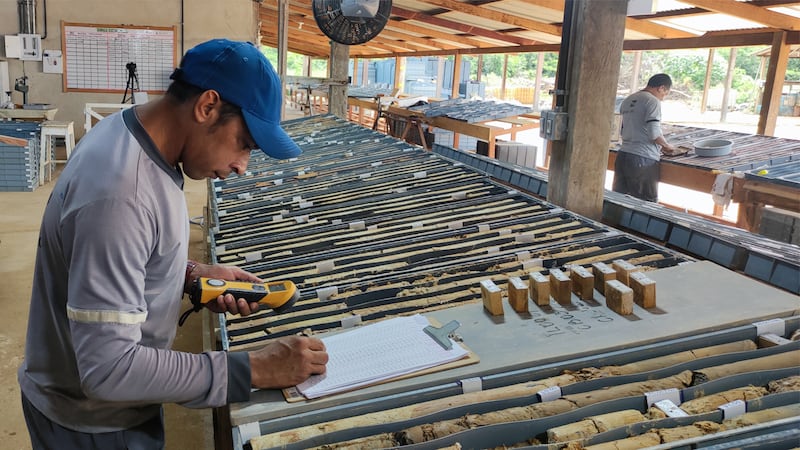
Cabral is now entering a period of sustained news flow and execution milestones. “We are building out our Stage 1 mine but also have three exploration drill rigs running at the same time,” Carter says. “Investors will see drill results from the MG and Central gold deposits over the next few months, as well as results from the PDM, Jerimum Cima, Machichie Main, and Machichie NE discoveries as we continue to expand our resources in both the oxide and primary mineralization. The mineralized systems remain open in several directions, so every new hole is aimed at increasing the current resource inventory and should add ounces.”
Key upcoming steps on the project are already in motion. The team is advancing construction of the heap-leach operation with over 140 people currently on site. This work includes detailed engineering and the sequencing of earthworks, heap leach pads, and plant layout.
Alongside that, Cabral is also moving through the remaining stages of the Provisional License for the Full Mining Permit, an important procedural step that will allow the Company to develop the Stage 2 much larger hard rock resources and set the foundation for long-term operations.
On the technical side, new resource estimates are expected as a result of drill results at the PDM, Machichie Main, Jerimum Cima and the spectacular Machichie NE discovery, and other recent discoveries are incorporated into the model, which should extend the mine plan and strengthen the long-term profile of the district. Drilling will continue across high-priority expansion targets, both within the existing deposit footprints and across the broader structural corridor, where more than 40 targets remain to be tested.
“We are still in the early stages of defining this district,” Carter says. “The oxide operation gets us into production. Production generates cash flow. That cash flow funds the next stage of exploration and development of the much larger hard rock resource base. This is how you build a district that lasts.”
Cabral’s investor appeal
For investors, the appeal of Cabral lies in its combination of near-term production and long-term district growth. The company is on track to bring a low-cost heap-leach operation online in an environment where the gold price is well supported, providing an early source of cash flow.
That first phase sits within a much larger mineralized system that continues to expand through drilling, offering the potential for a scaled hard-rock operation over time. Construction of the initial mine is already fully financed and in progress. This reduces execution risk and limits the need for share dilution at this stage.
At the same time, the management team has decades of experience working in Brazil and has invested significant personal capital in the project, aligning their interests directly with shareholders.
“We know we have something very special here,” Carter says. “The opportunity is to unlock this district step by step, without diluting our capital structure and in a way that maximizes value and builds long-term profitability. We are building something with continuity, depth, and scale. And we are doing it in a way that is methodical and disciplined.”
To learn more about Cabral Gold, visit their website or follow them on social media:

