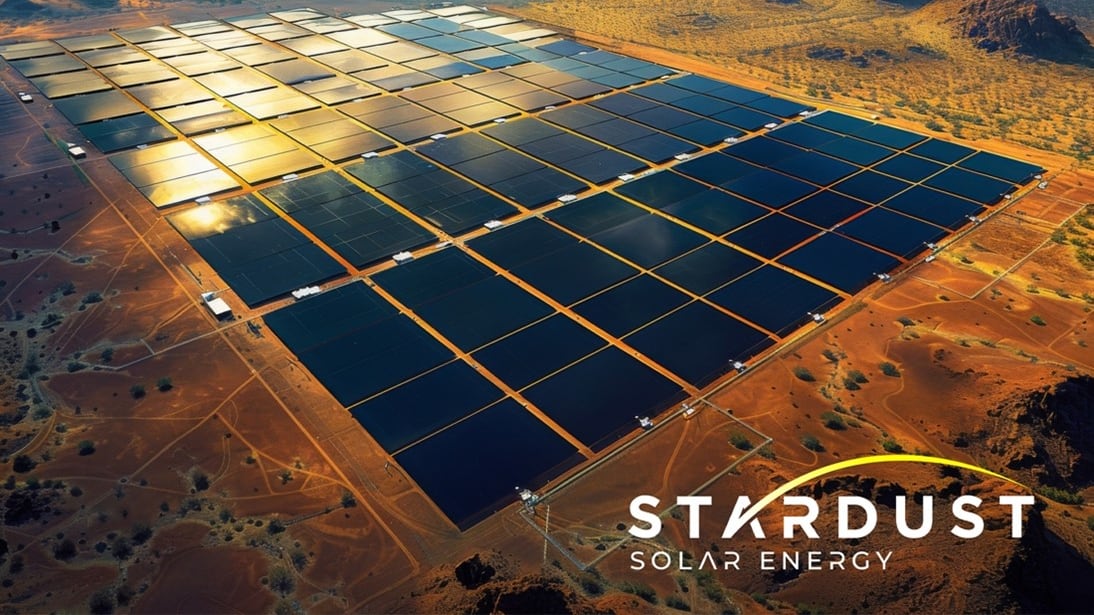
- Stardust Solar is expanding into a diversified solar royalty platform with recurring revenues from royalties, licensing, subscriptions, training and education programs, and clean-energy franchise operations.
- With exclusive rights to the StarDroid brand in Canada and the U.S., Stardust is deploying an AI-enabled home energy optimization solution designed to help customers save more, improve system performance, and strengthen the company’s recurring subscription revenue profile.
- Stardust Solar has secured a 20-year, government-backed Power Purchase Agreement (PPA) in Zambia tied to a 30-megawatt solar project, marking its largest royalty-based infrastructure milestone to date and opening the door to long-duration recurring revenue at scale.
Disseminated on Behalf of: Stardust Solar Energy Inc.
Solar power has moved from the margins to the mainstream, becoming one of the fastest-growing sources of electricity worldwide as demand rises across every major market. The North American shift is already visible. Solar costs have dropped roughly 74 per cent over the past decade, while solar efficiency has improved by almost 60 per cent in the same period, according to the International Renewable Energy Agency (IRENA).
The United States Department of Energy projects that solar could supply 40 per cent of the nation’s electricity by 2035, rising sharply from less than four per cent in 2023. Canada is moving in the same direction, with installed solar capacity expected to increase tenfold by 2035. Australia is generating so much rooftop solar that parts of the country now enjoy hours of free daytime electricity. Across Africa and Asia, communities are choosing off-grid solar because it is cheaper and faster than building new transmission lines. The off-grid market alone is forecast to grow at more than 11 per cent annually through 2035, reaching over US$8 billion in value, reports Market Research Future.
This is the market where Stardust Solar Energy Inc. (TSXV: SUN | OTCQB: SUNXF) is building its footprint. The company posted its strongest quarter to date in Q3 2025, with revenue of $1.78 million, a 99 per cent year-over-year increase.
Momentum is now being paired with Stardust Solar’s updated 2026 corporate vision. The company is building a diversified solar royalty platform with multiple recurring revenue streams across residential, commercial, and utility-scale markets, supported by international expansion initiatives.
The clearest proof point arrived on Jan. 13, 2026, when Stardust Solar announced it had secured a 20-year, utility-scale Power Purchase Agreement (PPA) in Zambia to support a 30-megawatt solar project. The government-backed agreement is expected to establish long-duration, recurring royalty streams and represents the largest royalty-based infrastructure transaction in the company’s history.
The contract provides the right to sell solar-generated electricity to the government of Zambia at a fixed rate of US$0.07 per kilowatt-hour for a 20-year term. Based on current assumptions and national energy demands, the project is expected to generate total gross revenues of approximately US$60–$90 million over the contract life.
“This agreement represents a defining milestone for Stardust Solar and the strongest validation to date of our royalty-based growth strategy,” said Mark Tadros, Chief Executive Officer of Stardust Solar Energy Inc. “By securing a 20-year, government-backed power purchase agreement with a 50 per cent recurring royalty interest (after approved allowable operating expenses), we are establishing long-duration, high-margin cash flows that directly support our objective of building a scalable global solar royalty platform while delivering clean, reliable energy to countries in need.”
In December 2024, Stardust acquired Solar Grids, adding 49 U.S. territories across Michigan, Colorado, Iowa, Florida, Nebraska, and Pennsylvania, bringing the company’s North American network to nearly 80 locations.
“This further strengthens our international footprint, enhances global brand recognition, and provides clear validation of the scalability of our platform,” said Erica Bearss, Stardust Solar’s Vice-President of Corporate Communications.
“We have trained thousands of people in the solar space. Our brand is getting recognized, and we are capitalizing on a 100 per cent forward-moving industry.”
A franchise model built for scale
Stardust Solar’s franchise-first model is a major driver of its rapid expansion across both established and emerging markets. Franchise partners receive mandatory certification, engineering support, marketing infrastructure, business systems, and access to a full suite of solar, storage, and EV-charging products. Bearss describes it as a comprehensive energy ecosystem powering long-term growth.
“We are offering a complete, end-to-end solution that empowers homeowners to generate and control their own electricity,” Bearss said. “Our platform integrates EV charging, energy-efficiency solutions, and solar technology. This full package is backed by the standards of a publicly traded company. With that comes a responsibility to uphold the highest levels of transparency, quality, and accountability.”
With more than 100 territories now sold across Canada, the United States, the Caribbean, and now Africa, Stardust Solar is expanding its franchise model into new high-growth regions.
“Solar technology continues to evolve, costs are declining, and the economics for homeowners have never been more favourable,” said Bearss. “Global demand is accelerating at an unprecedented rate. “We are in a great position, our foundation is strong, and the timing is ideal.”
It took the world 68 years to reach 1 TW of solar.
— Stardust Solar (@stardustsolar) September 26, 2025
It took just 2 years to double it. ⚡
That’s the acceleration Stardust Solar is building for—making clean energy adoption faster, smarter, and entrepreneur-led.#StardustSolar #CleanEnergy pic.twitter.com/jDCjaMda8j
Financial performance points to disciplined expansion
Corporate video caption: Stardust Solar’s leadership team highlights the company’s business model, earnings, and growth potential tied to rising demand for solar and energy storage.
Stardust Solar’s financial profile shows a business scaling with control. In Q3 2025, Stardust had its first EBITDA-positive quarter, with operating cash flow turning positive for the first time since listing in October 2024.
Record contract signings pushed backlog to $4.4 million, the highest in company history. Management now reports trailing twelve-month revenue of roughly $4.8 million, a 32 per cent increase over the prior comparable period.
The company strengthened its balance sheet as well. Cash and equivalents reached $340,000 at quarter’s end, up from $171,000 in June. Operating expenses remain controlled, rising 14 per cent year-over-year to support advertising, training, public-company compliance, and network expansion.
Seasonality continues to follow a clear pattern. New territories are typically signed in Q4, trained in Q1, and most field installations are completed in Q2 and Q3. This cadence keeps Stardust’s franchisees active throughout the year and aligns construction with the strongest installation windows.
Global demand is accelerating at an unprecedented rate. We are in a great position, our foundation is strong, and the timing is ideal.
— Erica Bearss, Vice-President of Corporate Communications, Stardust Solar Energy Inc.
Technology partnerships and innovation
Stardust Solar has been steadily building a lineup of reliable, recognized technology partners. The company works with leading equipment manufacturers and is certified to install Tesla Powerwall systems, a segment that has taken off fast, underscoring how quickly homeowners are adopting bundled solar-plus-battery solutions.
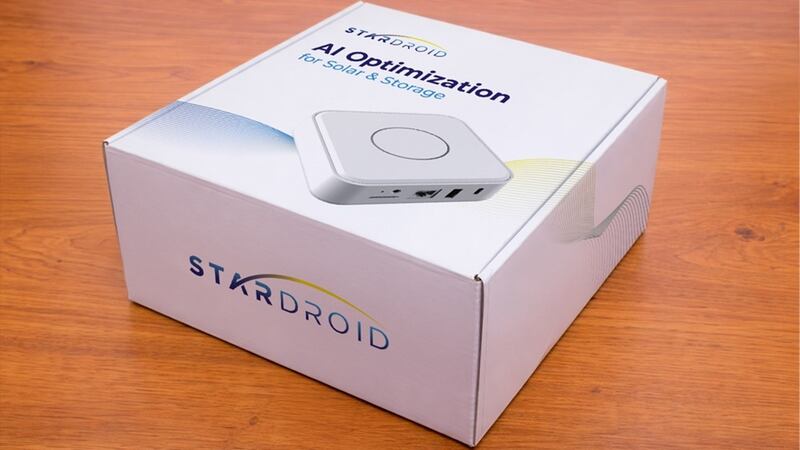
That product ecosystem is now being expanded through the commercial launch of StarDroid, an AI-enabled residential energy optimization device designed to enhance the performance of residential solar and battery systems. This partnership provides Stardust Solar with exclusive rights to the StarDroid brand in Canada and the U.S.
StarDroid uses artificial intelligence to analyze household load patterns, solar generation, storage availability, and price signals to automate battery arbitrage and flexibility-based optimization. The device is designed to increase household energy savings and improve long-term system efficiency.
In 2026, Stardust is positioning technology as a core revenue driver, using StarDroid to expand its subscription-based income while improving customer outcomes through smarter energy management, higher system efficiency, and more predictable long-term savings.
Through the StarDroid program, Stardust Solar will generate revenues from both an initial hardware margin and a 25 per cent share of subscription fees generated by each deployed device. For example, on a $20 monthly subscription, Stardust would receive $5 per month over the expected 25-plus-year operating life of the energy optimization system. These revenues are designed to be recurring, high-margin in nature, and scalable across potential networks of 10,000-plus devices over the coming years.
“The launch of StarDroid advances our technology roadmap while strengthening our recurring-revenue profile,” said Tadros.
“Our engineers are constantly exploring new possibilities and testing innovative solutions,” Bearss said. “At the same time, we balance innovation with affordability. Making solar accessible is a priority. We want homeowners to adopt solar with confidence. Our 25-year guarantees on both labour and parts remain a key differentiator.”
The company also has a track record of spotting practical technology early. It previously held exclusive Canadian rights to SunPower’s high-performance modules.
ESG, community engagement, and policy momentum

Stardust Solar’s ESG initiatives are focused on measurable, community-centred impact. Through strategic partnerships, the company contributes to reforestation and sustainable land management projects that support its long-term climate commitments. To date, Stardust Solar has supported the planting of more than 51,000 trees, and future contributions will be directed toward two long-term, high-impact initiatives, with a major focus on the Musokotwane–Nyawa Miombo Woodland Carbon Project in Zambia, aligned with the company’s growing presence and long-term commitment in the region. Stardust Solar will also continue supporting the Rubeho Mountains Carbon Project in Tanzania, a 40-year program dedicated to biodiversity conservation, watershed protection, climate mitigation, and sustainable community development.
In addition to its environmental work, Stardust Solar delivers hands-on solar training across its network, building local capacity for future renewable energy projects and creating meaningful economic opportunities. Bearss said the same community-focused philosophy guides their international engagement.
“We have invested in training and capacity building in communities, creating pathways to opportunity and empowering people with the skills and confidence to build careers in the clean energy sector,” said Bearss.
Supportive policy trends are now adding tailwinds for Stardust Solar. Canada is forecasting more than $200 billion in clean power investment by 2035, and a relaunch of the Canada Greener Homes Affordability Program is expected to drive wider residential solar adoption by removing upfront costs for low- and median-income households. Delivery will happen province by province, creating direct opportunities for installers and franchise networks.
Bearss adds that there is a gap between policy, academia, and industry. “As co-chair of the Sustainability Committee for the Burnaby Board of Trade, two of my students and I are writing a white paper to present the economics of solar,” she said. “With the infrastructure and the policies in place, the economics pay off quickly.”
What investors can expect in 2026
Stardust Solar is heading toward break-even in 2026, with a path to profitability as more royalty streams are implemented, territories are activated, product distribution scales, and installation volumes rise. In 2026, the company’s direction is centred on expanding beyond a single growth engine by building multiple recurring revenue streams that can scale across markets and customer segments. The growth formula is straightforward: expand the recurring royalty revenue model through its franchise international expansion, training and education subscription and licensing offerings, and technology advancements.
“Financially, the business is designed to grow through franchise expansion, education, and solar sales,” Bearss said. “My goal is to put more eyes on Stardust Solar, expand our community initiatives and marketing efforts, and help people understand that the economics of solar are now well-proven and highly compelling.”
She also highlighted the broader evolution of the energy landscape. “Demand is rising across EVs, AI, crypto, and automation, creating new opportunities for advanced energy solutions,” she said. “Solar paired with storage offers homeowners greater control and resilience, and with the economics now well-established, it is clear this is the direction the market is moving.”
Stardust’s current revenue profile is increasingly built around four royalty-style or recurring streams layered on top of more traditional product margins. Those include franchise fees and ongoing franchise royalties from its solar franchise network, training and education revenue through solar design and installation programs, licensing and royalty participation agreements in clean energy projects and technologies, and technology-enabled subscription models such as StarDroid AI, which combines an initial hardware margin with a 25 per cent share of subscription fees.
For investors, the signal is clear. The rooftop solar boom is accelerating, and the drivers are structural with rising electricity prices, households seeking energy security, and solar-plus-storage becoming practical for more homes at a lower cost. Stardust Solar’s strategy in 2026 and beyond is to monetize that demand through recurring revenues, with franchising now one layer within a broader royalty and subscription platform.
To learn more about Stardust Solar, visit its website. For the latest updates, follow Stardust Solar online: Facebook, X, LinkedIn, Instagram, and YouTube.

