Disseminated on Behalf of: Sun Summit Minerals Corp.
- Fresh off an $11.5 million financing deal, Sun Summit enters 2026 fully funded for a 10,000-metre drill program, setting up a maiden resource estimate targeted for the first half of 2027.
- Recent drilling at the JD Project delivered standout results, including 81 metres grading 4.8 grams per ton of gold from the surface, reinforcing the scale and continuity of a 4.5-kilometre mineralized corridor in the Toodoggone district.
- Alongside JD, the Buck and Theory projects provide additional gold and copper optionality, giving the company leverage across multiple commodities in a stable and increasingly active British Columbia mining jurisdiction.
Gold has entered 2026 with renewed momentum, driven by persistent inflation hedging, central-bank buying, and a capital markets rotation back toward hard assets. At the same time, copper’s long-term demand curve continues to steepen as artificial intelligence, electrification, and grid buildouts collide with tightening supply.
In that macro backdrop, investors are again rewarding explorers that combine scale, jurisdictional certainty, and balance sheet strength to drill without interruption.
That is where Sun Summit Minerals Corp. (TSXV: SMN | OTCQB: SMREF) now finds itself.
The company controls a focused portfolio of projects in British Columbia, anchored by its flagship JD Project in the Toodoggone district. JD hosts a large epithermal gold-silver system with emerging copper-gold porphyry potential and has become the clear priority for the company as drilling shifts toward scale and resource definition.
Complementing JD is the nearby Theory Project, an earlier-stage copper-gold target that gives Sun Summit exposure to porphyry-style mineralization in the same broader geological belt. While still in the target-generation phase, Theory adds longer-term optionality tied to copper’s tightening supply outlook.
Supporting that upside is the Buck Project in central B.C., which provides an established gold-equivalent resource and year-round access, along with additional copper-gold targets that extend the company’s reach across multiple commodities.
With $11.5 million in new funding secured, the Vancouver-based explorer enters 2026 in a rare position for a junior being fully funded, focused, and ready to drill at scale. The task ahead is to turn strong, high-grade results at the JD Project into a maiden resource, without giving up any of the upside that comes with discovery in British Columbia’s rapidly emerging Toodoggone district.
“We raised $11.5 million in December, and that fully funds our 2026 program,” said CEO Niel Marotta. “It gives us the ability to execute a 10,000-metre drill campaign and advance toward a maiden resource estimate without having to come back to the market midstream.”
From validation to acceleration
When Market One last checked in on Sun Summit in October, the story centred on confirming historical work and refining targets at JD. Since then, the company has delivered its strongest drill results yet and locked in the capital required to scale up.
Among the highlights was Hole CZ-25-021 at the Creek Zone, which returned 81 metres grading 4.8 grams per ton of gold from the surface, a result Marotta describes as transformational for the project.
“We actually drilled an even better hole than what we were talking about last fall,” he said. “81 metres of 4.8 grams from surface is a fantastic drill hole by any standard.”
Those results capped a two-year effort focused on modernizing the geological understanding of JD, which hosts more than 36,000 metres of historical drilling but had never benefited from contemporary 3D modelling.
📰NEWS: Sun Summit Confirms the High-Grade Gold-Silver Potential of the Finn Zone: Drills 5.30 g/t #Gold and 157.9 g/t #Silver over 6.0 meters at the #JDProject
— Sun Summit Minerals (TSXV:SMN)(OTC:SMREF) (@SunSummitMin) January 22, 2026
Finn Zone now a high-priority 2026 drill target.
🔗 News: https://t.co/58M1zsHJTV$SMN.V $SMREF#Toodoggone pic.twitter.com/24IS7rIkT5
According to Vice-President of Exploration Ken MacDonald, that work is now paying dividends.
“The three-dimensional model has really helped us pinpoint the highest-grade intercept opportunities along roughly an 800-metre strike length at the Creek Zone,” MacDonald said. “That’s what’s driving the consistency and confidence behind these results.”
A corridor, not a single zone
JD is not a one-target story. The project hosts a 4.5-kilometre epithermal gold-silver corridor stretching from the Creek Zone to the Finn Zone, with multiple mineralized centres and extensive historical drilling that has yet to be systematically integrated into a single resource framework.
“There’s a 4.5 kilometre-long zone of epithermal mineralization across JD,” MacDonald said. “Creek has been our focus, but Finn has seen the bulk of historical drilling and represents a major expansion opportunity.”
Much of that mineralization sits near surface, a factor that matters as investors increasingly look for projects that can demonstrate both grade and potential development simplicity.
“These are very near-surface mineralization zones,” MacDonald added. “They’re the kind of targets that could be considered open-pittable.”
Beneath the epithermal system, JD also carries a second layer of optionality. Geophysics and alteration mapping point to a porphyry copper-gold system along the McClair Creek corridor, in a geological setting comparable to Amarc and Freeport’s AuRORA discovery to the south.
Fully funded into 2026
The December financing fundamentally changes how Sun Summit operates.
“That funding covers at least a 10,000-metre drill program in 2026 and positions us for a maiden resource estimate in the first half of 2027,” Marotta said. “That’s a major milestone for this company.”
The 2026 program is expected to be larger than the combined drilling completed over the previous two seasons, with step-out and infill drilling focused on maximizing ounces across the Finn-to-Creek corridor.
For investors, that matters because it shifts Sun Summit into a different valuation conversation.
“As you move from pure exploration into publishing a resource, you unlock a much broader pool of capital,” Marotta said. “That’s when the market starts to look at you differently.”
Jurisdictional advantage in British Columbia
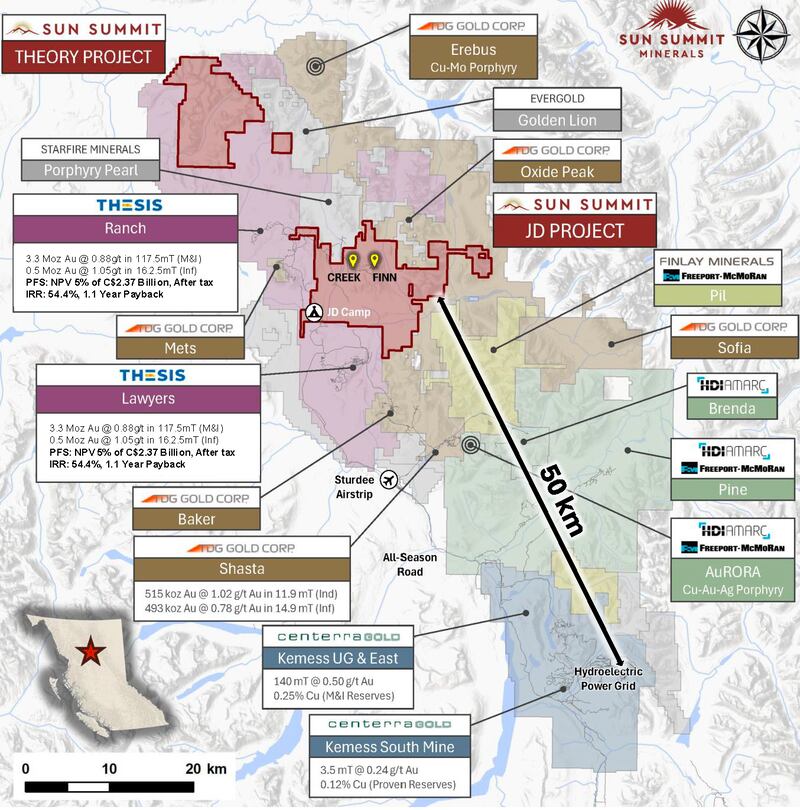
JD sits in the heart of the Toodoggone, an area now attracting sustained investment from majors and mid-tiers as infrastructure improves and permitting timelines become more predictable.
Exploration activity in B.C.’s Toodoggone district has increased in recent years, with several groups advancing gold-silver epithermal and copper-gold porphyry targets and projects, including Thesis Gold, TDG Gold, Amarc Resources, Centerra Gold, and Eagle Plains Resources.
“I’ve spent most of my career working in British Columbia,” MacDonald said. “Right now, it’s a very supportive jurisdiction for mining and exploration, especially in the Toodoggone. There’s strong First Nations engagement, road access, and real momentum.”
Sun Summit is currently advancing exploration agreements with multiple First Nations across the JD area, a process that management sees as foundational rather than procedural.
“These relationships are critical,” Marotta said. “They’re about long-term collaboration and making sure development benefits the communities involved.”
Why investors are watching
With a market capitalization hovering near $40 million, Sun Summit trades at a fraction of the valuation assigned to neighbouring developers that already host defined resources.
The difference, management argues, is timing.
“Our neighbours are further along the curve,” Marotta said. “Our job over the next 12 to 18 months is to catch up on the development side by putting real ounces on the board.”
If successful, that transition could be material.
“For investors, the key things to watch are simple,” he said. “A fully funded, record drill program, consistent high-grade results, and progress toward a first resource estimate. Those are the milestones that tend to influence how exploration companies are valued over time.”
As gold and copper continue to anchor the macro narrative heading into 2026, Sun Summit offers exposure to both, with the added leverage of being early in a district that is quickly moving from overlooked to contested.
For a junior explorer, that combination is rare. And now, it is fully funded.
To learn more about Sun Summit, visit its website. For the latest updates, follow Sun Summit online: Facebook, X, LinkedIn, and YouTube.
The scientific and technical information contained within this article has been reviewed and approved by Ken MacDonald, P. Geo., Sun Summit Mineral Corp.’s Vice-President Exploration, who is a Qualified Person, as defined under the terms in National Instrument 43-101.

