Disseminated on behalf of: Idex Metals Corp.
- Idex Metals enters 2026 with copper intersected in every hole of its 2025 maiden drill program at Freeze, headlined by 101 metres of 1.02 per cent copper from surface in hole KSMT25002.
- An $8 million brokered private placement announced in April fully funds a 2026 drill program targeting what three independent data sets suggest is a porphyry copper system at depth beneath the North Breccia.
- Idex’s land package spans over 46,000 acres across Idaho’s emerging copper belt, giving the company district-scale exposure in a region now drawing increased exploration and capital.
Copper has moved to the centre of the U.S. industrial agenda. Data centres, grid rebuilds, and electric vehicles are colliding with a domestic supply base that has struggled to bring a major new copper mine online in decades. Federal and state policy is now actively pushing to reshore critical metals, and Idaho — once a footnote in U.S. mining — has re-emerged as one of the most active copper exploration districts in the country.
That is where Idex Metals (TSXV: IDEX | OTCQB: IDXMF) now finds itself. The Vancouver-based explorer holds more than 46,000 acres across 15 properties in Idaho, anchored by the Freeze copper-gold-molybdenum project in the emerging Idaho Copper Belt. A 2025 drill program at Freeze produced copper in every hole and pointed the geology toward a deeper porphyry target. An $8 million financing, closed May 5, now positions the company to drill that target as soon as the field season opens.
We’re exploring for copper in Idaho, which is a Tier 1 jurisdiction in the United States. Last season was a resounding success. We discovered copper. We fell short of discovering a porphyry, but based off what we did find, we believe there is one located near where we were drilling, at a target called the North Breccia.
— CEO Clayton Fisher
A 2025 program that reset the entry point
When Idex opened its first drill bit at Freeze in 2025, the property had not been seriously tested in 60 years. The last holes there were drilled in 1965, none reaching beyond 130 metres.
Six holes and 2,282 metres later, every single one had hit copper.
The headline result came from KSMT25002: 101 metres grading 1.02 per cent copper from surface, inside a wider 421-metre intercept that averaged 0.37 per cent copper across the entire hole. For a porphyry-style target, which by definition is a bulk-tonnage, lower-grade deposit, pulling more than 100 metres of one per cent copper starting at surface is the kind of intercept that gets a project noticed.
It also matters for development economics. A high-grade oxide layer at surface is leachable, which means a future mine can recover copper without conventional milling. The economics of any eventual operation get pulled forward.
“That’s a world-class hole,” Fisher said. “100 metres of one per cent copper from surface. You don’t see that every day. And it’s not buried under 600 metres of rock. You’re getting into it right from surface. That’s huge.”
Three data sets, one target
The more important read on the 2025 program is not any single intercept. It is what three independent data sets are now telling Idex about where to drill next.
The first is surface geochemistry. Soil and rock sampling reveal a textbook concentric metal pattern: a copper core, wrapped in a molybdenum-tellurium shell, with a tungsten-bismuth envelope further out. In porphyry geology, that inside-out fingerprint points to a hidden mineralized centre somewhere below the surface.
The second is geophysics. An induced polarization survey and a separate MT/ELF survey, both completed in 2025, define a large coherent conductivity anomaly at depth, sitting roughly 300 to 800 metres beneath the North Breccia. The geometry suggests a substantial intrusive body, exactly what the surface chemistry implies should be there.
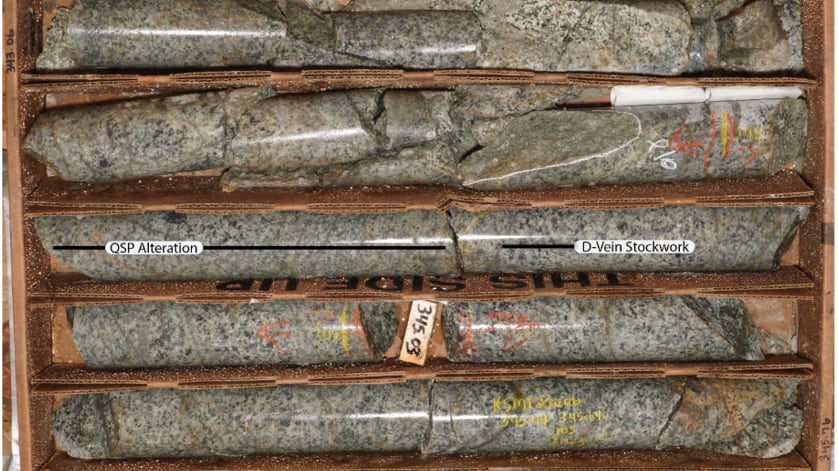
The third is the drilling itself. The final hole of the 2025 program, KSMT25006, pushed through a pyrite-rich shell and intersected the project’s first intrusive-hosted, copper-molybdenum mineralization, with molybdenite veining and quartz-sericite-pyrite alteration. In porphyry hunting, that is the geological equivalent of catching a scent. Pyrite shells flank these systems. Molybdenite is one of the metals they vent.
“The increasing molybdenum grades and molybdenite veining at the bottom of that hole provided exactly the kind of geological indicators we want to see as we vector towards a deeper magmatic source,” Fisher said. “When we overlay that data with our IP and MT/ELF geophysics, the picture becomes very compelling.”
Why North Breccia, and why now
The three signals converge on the same place: a bullseye at the North Breccia, where the surface zonation centres directly above the deeper conductivity anomaly. KSMT25006 ended at 428 metres, well short of the deep conductor that Idex’s geophysics places at roughly 300 to 800 metres beneath the North Breccia trend.
That sets up a near-term catalyst that is unusually clean for a junior. The 2026 program kicked off in early April with an expanded induced polarization survey across the Kismet Corridor, and drilling at the North Breccia is set to commence in early June once the IP survey is completed — the IP survey has been expanded by an additional 21 line kilometres. Assay turnaround typically runs roughly two months from the bit hitting rock.
ICYMI: IDEX Metals has kicked off its 2026 exploration season at the Freeze Property with a 37km IP survey over the Kismet Corridor, designed to refine high-priority drill targets and better define near-surface structures ahead of a planned May drill program.#copper #gold
— IDEX Metals (@IdexMetals) April 15, 2026
More… pic.twitter.com/o08EfMD33k
“Now $10 million has been spent and a year’s gone by, but you’re getting in at the same entry point as our go-public round,” Fisher said. “The project’s been de-risked. The near-term upside is quite substantial.”
The Idaho Copper Belt comes of age
Idex is not exploring in isolation. Hercules Metals’ Leviathan discovery in 2023 was the first confirmed porphyry in the belt. Privately held Scout Discoveries is now drilling its Cuddy Mountain property next door, interpreted as a possible shallow extension of the Leviathan system, and Idex’s Freeze sits within the same broader copper belt to the north. Porphyries are known to cluster, and the company believes the belt may host additional centres still to be tested. That clustering thesis is part of why majors have arrived.
That discovery attracted a strategic equity investment from Barrick of approximately C$23 million, and Hercules has since expanded its land package to more than 100,000 acres in partnership with the major. The validation effect on the broader district has been substantial.
Permitting tailwinds add to the picture. Roughly 90 per cent of Freeze sits on Idaho state mineral lease, which Fisher describes as a structural advantage that predates the federal push to accelerate critical-metal timelines. Idaho’s current administration has actively courted mining investment, and the regional precedent set by neighbouring developers advancing toward production has reinforced the case for capital deployment in the state.
The other 15 properties
While Freeze is the focus, Idex holds approximately 15 additional projects across roughly 20,000 further acres in Idaho, assembled over five years of staking. Management views this as strategic optionality. Option agreements, joint ventures, or outright sales of secondary projects can generate non-dilutive capital and reduce reliance on the equity market.
That portfolio approach matters in a sector where dilution is often the single largest drag on shareholder returns.
What 2026 looks like
The April financing fully funds the 2026 drill program at Freeze, with treasury room, by Fisher’s reckoning, to carry the company to year-end without an immediate need to return to market. The work scope: drill the North Breccia first, then step out across the Kismet corridor and additional targets including CM, Olive Creek, and Devils Slide. The CM target alone hosts a copper-in-soil anomaly that is 1.5 kilometres by two kilometres, with a coincident chargeability anomaly beneath it, and rock samples in the area that have returned up to 33 grams per tonne of gold.
The investment case Fisher articulates is straightforward. A confirmed porphyry discovery would be a huge event with the potential to materially re-rate the company. The Hercules precedent, a 2023 porphyry discovery that drew Barrick into a strategic placement and reset the company’s market valuation, is the template Fisher points to.
In a market relearning that copper is strategic and that the United States needs domestic supply, Idex has done the unglamorous work — boots on the ground, six holes, three independent data sets all pointing to the same place. Now it gets to drill the target it has spent a year building toward.
The scientific and technical information contained within this article has been reviewed and approved by David Hladky, P.Geo. (registered in Alberta), Idex Metals Corp.’s Vice-President of Exploration, who is a Qualified Person as defined under National Instrument 43-101.
About Idex Metals Corp.
Idex Metals Corp. (TSXV: IDEX | OTCQB: IDXMF) is a Vancouver-based mineral exploration company advancing a portfolio of base and precious metal projects in Idaho. The company controls more than 46,000 acres across 15 properties, anchored by the Freeze copper-gold-molybdenum porphyry project in the Idaho Copper Belt. Additional projects include Amie (silver-gold epithermal) and Mineral Mountain (silver-lead-copper carbonate replacement).
For more information, visit idexmetals.com. Follow on X and LinkedIn.

