Disseminated on behalf of: American Critical Minerals Corp.
- Backed by Red Cloud Securities’ newly initiated BUY (S) rating and a C$0.75 per share target, American Critical Minerals is advancing a fully permitted Q3 2026 drill program targeting potash, lithium, and bromine from a single Utah land position.
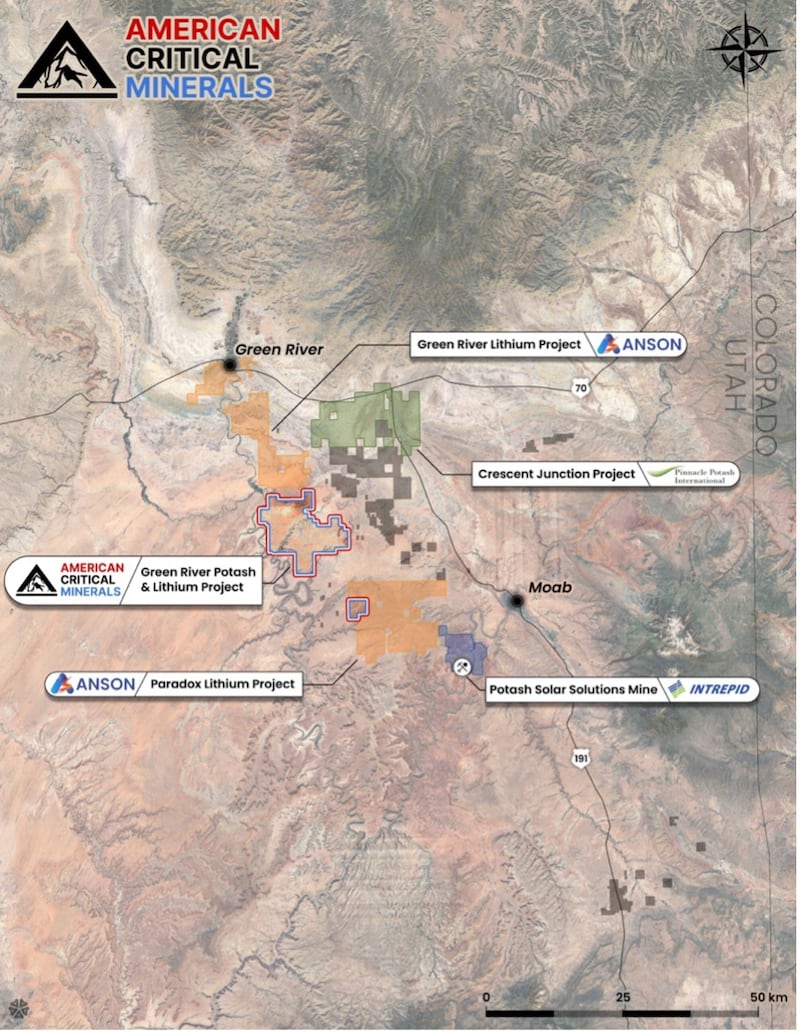
- The project is bracketed by two validated peers. Intrepid Potash operates a potash solution mine 30 kilometres away that has produced for more than 50 years, while Anson Resources’ adjacent lithium project posted annual EBITDA of US$153 million and a 47 per cent IRR at definitive feasibility stage**.
- An NI 43-101 potash exploration target points to 500 to 950 million tonnes of sylvinite at 19 to 29 per cent KCl, alongside a lithium exploration target of 615,000 to 1.7 million tonnes of lithium carbonate equivalent, and bromine exploration target of 3.2 to 9.1 million tonnes representing a differentiated multi-commodity profile among U.S.-listed junior critical mineral plays*.
Critical minerals have moved to the centre of American industrial policy. Washington has expanded the federal critical minerals list, the U.S. Department of Energy has committed US$2.91 billion to domestic battery supply chains, and the USDA’s fertilizer production and expansion program has deployed roughly a billion dollars to rebuild American fertilizer production capacity.
The reasons are structural. The United States imports more than 94 per cent of its potash and over 50 per cent of its lithium. Domestic potash production has fallen 65 per cent since 1999. Even with recent shifts in U.S. trade policy, American supply remains concentrated in foreign producers, leaving farmers and battery makers exposed to geopolitical and logistical shocks.
For American farmers and battery makers, the result is the same: rising costs, fragile supply, and growing political pressure to reshore.
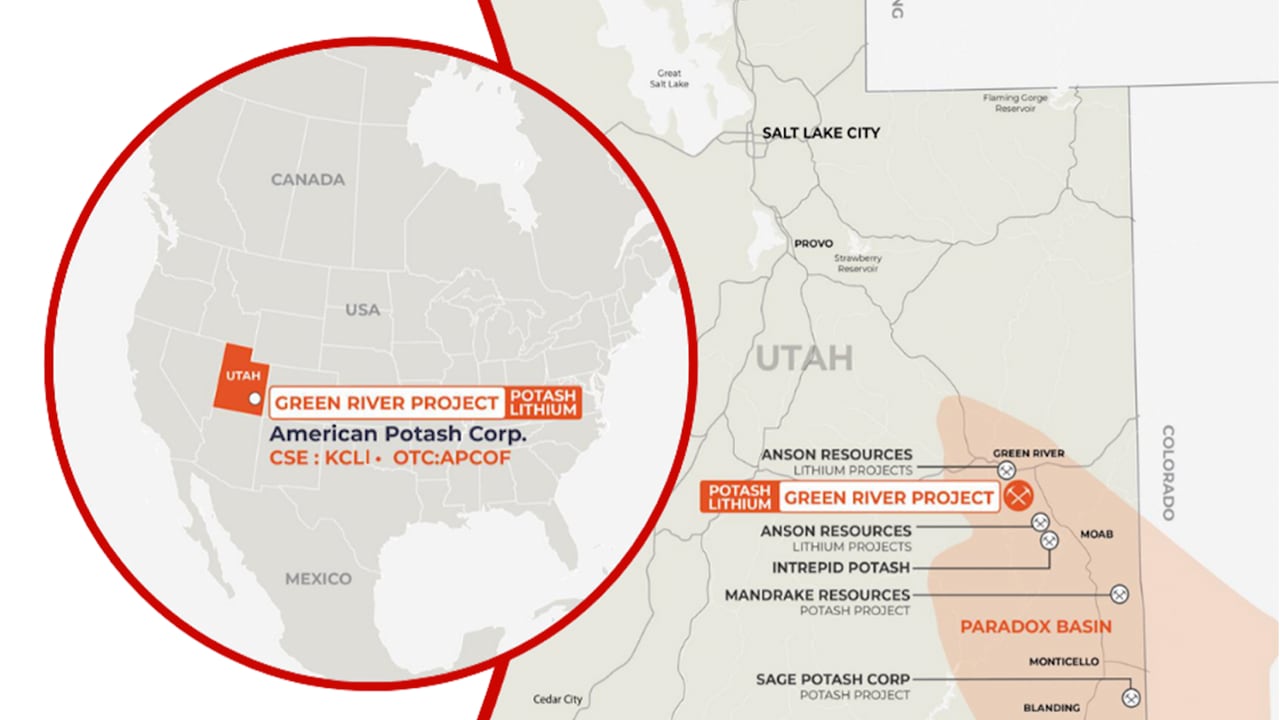
That is where American Critical Minerals Corp. (CSE: KCLI | OTCQB: APCOF | FRA: 2P3) now finds itself. The Vancouver-based explorer is advancing the Green River Potash and Lithium Project in Utah’s Paradox Basin, the only U.S. sedimentary basin classified as a super basin for potash, and one of the few places in the country where potash, lithium, and bromine can all be targeted from the same well.
Our thesis is pretty simple. We want to secure supply for America long term such that farmers can produce the crops to support their population long term.
— Dean Pekeski, CEO of American Critical Minerals Corp.
A basin with pedigree, not a frontier
The Paradox Basin is not a speculative geological story. It is a working district.
Intrepid Potash (NYSE: IPI) has been solution-mining the same potash beds American Critical is now targeting since 2000, about 30 kilometres from KCLI’s ground. The Moab operation itself dates back to 1963 and produced 118,000 tonnes of finished potash in 2021, using the same low-cost extraction method KCLI plans to deploy***.
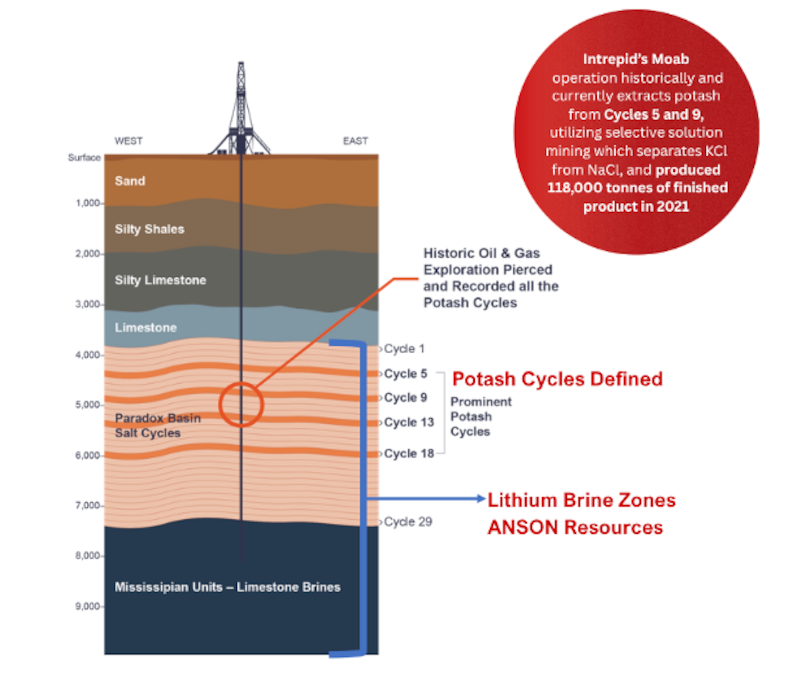
Bracketing the Green River Project on the north and south is Anson Resources (ASX: ASN), which is advancing two lithium brine projects on the same aquifer system. A definitive feasibility study on Anson’s Green River Lithium Project outlined annual production of 13,000 tonnes of lithium carbonate equivalent, annual EBITDA of US$153 million, and a 47 per cent internal rate of return**. A successful pilot program with Koch produced battery-grade lithium, and POSCO holds a definitive agreement to construct and fund a demonstration plant on the project.
The implication is direct. The geology works. Two neighbours have already proven that potash can be mined and that lithium brines in this basin are commercially viable.
“We’ve got two neighbours that are less than 30 kilometres away,” says CEO Dean Pekeski. “One has a mining operation that’s been in operation for decades. The other is publishing feasibility studies and has agreements in place with key offtakers. We’re going to be drilling through the same formations that those groups are either evaluating or mining. The pedigree of the region is very strong”
Three commodities, one drill hole
What separates American Critical from a single-commodity junior is what comes back from each well.
Beneath the Green River Project, the Paradox Basin holds stacked potash beds, known in geological shorthand as Cycle 5, Cycle 9, and Cycle 18, with lithium- and bromine-rich brines hosted in deeper aquifers below. A single deep well can sample all three.
The company’s NI 43-101 exploration target points to 500 to 950 million tonnes of sylvinite grading 19 to 29 per cent KCl for potash, between 615,000 and 1.7 million tonnes of lithium carbonate equivalent in the brine aquifers, and 3.2 to 9.1 million tonnes of bromine*.
(Per NI 43-101, these are exploration targets only. They are conceptual in nature and there has been insufficient exploration to define them as Mineral Resources. It is uncertain whether further exploration will result in the determination of a Mineral Resource.)
Two historic oil and gas wells on the property already intercepted potash mineralization at 3.4 metres of 26.4 per cent KCl, and 5.9 metres of 24.3 per cent KCl, the kind of grades and thicknesses that support economic solution mining.
For Pekeski, the multi-commodity profile is the heart of the investment case.
“All three of these critical commodities can be extracted simultaneously from this area. They won’t interfere with each other,” he says. “From a valuation perspective, we could be a potash producer, a lithium producer, a bromine producer. The economies of scale on the infrastructure could really be beneficial to us.”
Drills turning in Q3, fully permitted
The next 12 months will be defined by the drill bit.
American Critical is fully permitted for its inaugural drill program, scheduled to begin after the July 4 holiday and managed by RESPEC, a specialist engineering firm with deep experience in potash drilling across North America, including the Paradox Basin.
Each hole will be tested for all three commodities. At roughly US$4.3 million per well, the program is engineered to maximize information density rather than chase volume.
“It is very specialized drilling. You really only get one chance to core these horizons, so thorough planning is important,” Pekeski says. “Every drill hole we complete, we’ll be targeting essentially three different commodities. Three birds, one stone.”
Pekeski is not new to this work. He spent eight years at Western Potash Corp. taking the Milestone project in Saskatchewan from concept to development, then moved to Peak Minerals in Utah, where he led the Sevier Playa project through feasibility, front-end engineering, full federal and state permitting, and secured a US$80 million USDA grant under the USDA fertilizer production and expansion program.
That same playbook — drill, define, develop, permit, and finance with federal support — is now being applied to Green River.
Third-party validation
On May 21, 2026, Red Cloud Securities initiated coverage on American Critical Minerals with a BUY (S) rating and a C$0.75 per share price target.
In Red Cloud’s view, the company’s path forward is straightforward: turn the strength of its peer-validated geological setting into NI 43-101-compliant resources by drilling. The analysts argue that KCLI’s project sits on the same horizons mined by Intrepid and advanced by Anson, that the cost advantages of solution mining in the Paradox Basin (established infrastructure, low-impurity brines, abundant solar exposure for evaporation ponds) should accrue to KCLI as it advances, and that the company’s clean balance sheet leverages the equity to first drill results.
Why investors are watching
For a junior explorer with a market capitalization near C$22 million, the asymmetry is the point.
The company holds 100 per cent interest in the Green River Potash and Lithium Project, covering 7,050 acres of Utah state leases, 21,900 acres of federal lithium brine claims, and 25,000 acres of federal potash prospecting permits. Two of the three U.S. critical minerals it is targeting, potash and lithium, are explicit federal priorities. Insider ownership sits at 15 per cent, with strategic and institutional investors holding another 50 per cent. The drill program is permitted, the contractor is engaged, and the inaugural well is scheduled to spud this summer.
“There’s really every option on the table for us,” Pekeski says. “Multiple potash producers in the state could look to us. Multiple lithium producers and developers in the state could look to us. I’d like to leave all those options open and ensure that whatever that end result is, is delivering the maximum value to our shareholder base.”
As America scrambles to secure domestic sources of the minerals that feed its food and power its grid, the Paradox Basin is moving from overlooked to strategic.
American Critical Minerals is drilling first.
*The scientific and technical information contained within this article has been reviewed and approved by Dean Besserer, P.Geo., American Critical Minerals Corp.’s Chief Operating Officer and Director, who is a Qualified Person as defined under National Instrument 43-101.
Historical data disclosed in this article relating to historical wells from previous operators are historical in nature. Neither the company nor a qualified person has yet verified this data and therefore investors should not place undue reliance on such data. The company’s future exploration work may include verification of the data. The company considers historical results to be relevant as an exploration guide and to assess the mineralization as well as economic potential of exploration projects. Any historical well data disclosed are selective and may not represent true underlying mineralization. Please refer to the report titled, “Amended and Restated NI 43-101 Technical Report, Green River Potash and Lithium Project, Grand County, USA,” dated Jan. 27, 2026, and available under the company’s profile at www.sedarplus.ca.
The potential quantity and grades are conceptual in nature and there has been insufficient exploration to define a mineral resource, and, while reasonable potential may exist, it is uncertain whether further exploration will result in the determination of a mineral resource under NI 43-101. Targets for further exploration for potash, lithium and bromine at the Green River Project are used to provide a conceptual estimate of the potential quantity and grade of a mineral deposit, based on known and additional limited geological evidence. It is an early-stage assessment that will help to guide further exploration, but it is not a mineral resource or mineral reserve and should not be treated as such. The report titled, “Amended and Restated NI 43-101 Technical Report, Green River Potash and Lithium Project, Grand County, USA,” dated Jan. 27, 2026, and available under the company’s profile at www.sedarplus.ca provides details of the basis on which the targets for further exploration have been determined.
American Critical Minerals’ management cautions that results or discoveries on properties in proximity to the American Critical Minerals’ properties may not necessarily be indicative of the presence of mineralization on the company’s properties.
United States Geological Survey, Mineral Commodity Summaries, January 2024 (https://pubs.usgs.gov/periodicals/mcs2024/mcs2024-potash.pdf).
** Disclaimer: JORC defined mineral resource estimates are typically similar to but not necessarily equivalent to CIM NI-43-101 defined mineral resource estimates and there is no guarantee similar resources exist on the company’s project.
*** Intrepid Potash, Inc. 10‑K Annual Report for the fiscal year ending December 31, 2021 (SEC filing)
About American Critical Minerals Corp.
American Critical Minerals Corp. (CSE: KCLI | OTCQB: APCOF | FRA: 2P3) is a Vancouver-based critical minerals explorer focused on the Green River Potash and Lithium Project in Utah’s Paradox Basin. The project covers approximately 32,500 acres of state and federal leases targeting potash, lithium, and bromine: minerals central to U.S. food security, battery supply chain reshoring, and industrial production. The company is led by President and CEO Dean Pekeski, a professional geologist with more than 17 years of potash exploration and development experience, and Chairman Simon Clarke, formerly CEO of American Lithium Corp.
Learn more at acmineralscorp.com. Follow the company on LinkedIn, YouTube, and X.

