Disseminated on behalf of: Tiger Gold Corp.
- Colombia holds some of the largest undeveloped gold deposits in the Americas, yet still trades at a discount to comparable mining jurisdictions after years of underinvestment.
- Gold near record highs and a new incoming pro-mining president and government are drawing the majors back: AngloGold Ashanti, B2Gold, Zijin, and Agnico Eagle all hold Colombian gold exposure.
- Tiger Gold Corp. (TSXV: TIGR) is emerging as one of the country’s next major players, with more than two million ounces of current resources, a preliminary economic assessment that shows a US$1.2-billion net present value at a US$3,700 gold price, and drilling aimed at growing resources from two million ounces to four million ounces over the next year, major catalysts lie ahead for this exploration and development company.
Few gold addresses are as richly endowed as Colombia. The country hosts some of the largest undeveloped gold deposits in the Americas, yet years of security worries and a resource-wary government kept much of the investment world at a distance. That gap between world-class geology and second-tier valuations is now starting to close.
Two forces are closing it – gold is trading near record highs, and Colombia is about to install its most mining-friendly government in a generation.
A country the majors can’t ignore
The geology has never been in doubt. Colombia’s Mid-Cauca belt hosts AngloGold Ashanti’s La Colosa, a deposit of roughly 28 million ounces of gold, alongside Zijin Mining’s producing Buriticá mine and B2Gold’s Gramalote project. Aris Mining runs the historic Marmato mine in the same corridor.
What is changing is the appetite to build. President-elect Abelardo de la Espriella, set to take office on Aug. 7, campaigned on expanding mining and energy investment, as well as cracking down on illegal mining and the involvement of cartels within the country’s mining operations, a clear break from the outgoing government’s posture.
The majors are already positioning. Agnico Eagle, one of the world’s largest gold producers, has built a stake of about 15 per cent in Colombian explorer Collective Mining, whose flagship project sits roughly 20 kilometres from the ground at the centre of this story.
The signal is hard to miss. When the biggest names in gold start buying into a jurisdiction, its discount rarely lasts.
Tiger Gold’s moment
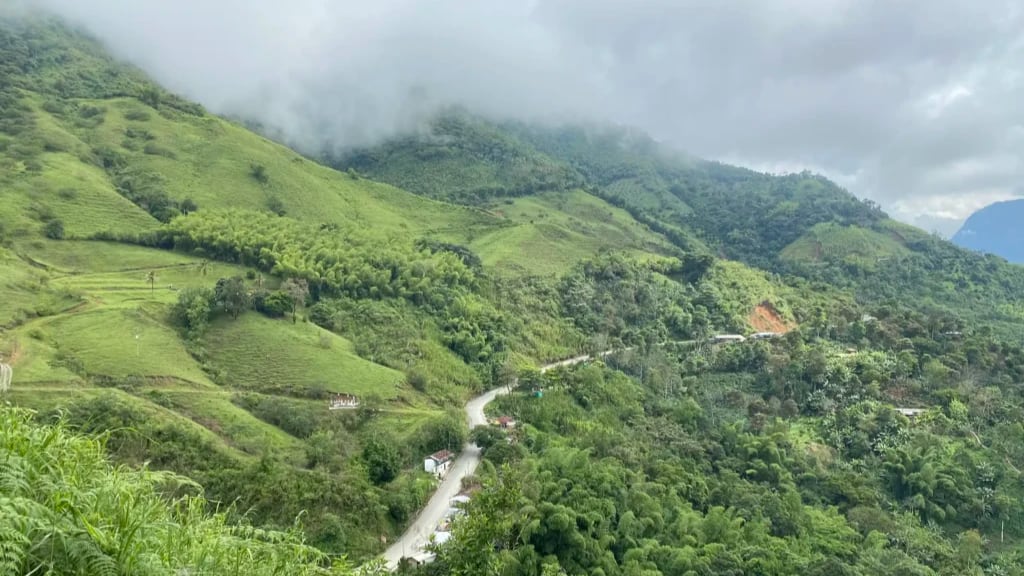
That ground belongs to Tiger Gold Corp. (TSXV: TIGR | FSE: D150 | OTCQB: TGRGF), a Vancouver-based gold exploration and development company advancing the Quinchía Gold Project in the heart of the same belt.
When Market One last covered Tiger in April, the company had three rigs turning on a resource of more than two million ounces. Since then, it has upsized and closed its most recent financing to C$21 million, and is accelerating drilling at its newest Ceibal target, separating itself from the pack.
We’re literally constrained only by resources. The more we put into this, the more we grow it, and the faster we grow it.
— Robert Vallis, President and CEO
A cluster, not a single mine
Quinchía’s structure is its edge. The deposits sit close enough to feed one central processing hub, which holds down capital and operating costs and lets production come on in stages.
Miraflores holds 510,000 ounces of measured and indicated high-grade gold and is already permitted for underground construction and operation. Tesorito, the open-pit centrepiece, adds about 1.57 million ounces in the inferred category and accounts for most of the project’s gold. Dos Quebradas carries roughly 459,000 historical ounces and the newly expanded Ceibal deposit shows potential for another multimillion-ounce deposit, which the company is accelerating drilling at to define a new mineral resource this year.
Two of those deposits, Miraflores and Tesorito, anchor a 2025 preliminary economic assessment, an early study of whether a project can pay for itself. At a US$2,650 gold price, it outlines about 138,000 ounces of annual production over a roughly 10-year life, an after-tax net present value of US$534 million, and payback in under four years. At US$3,700 gold, the same study puts that value at US$1.19 billion.
“You start with smaller initial capital, self-fund with high returns, then expand. That’s what the seniors salivate over,” Vallis said.
Ceibal could double the story
The clearest catalyst sits right beside Tesorito. Ceibal is a new discovery the company believes could match or beat Tesorito in size and is wide open at depth and on strike.
The proof is coming from step-out holes. The latest, CEDDH-010, cut 214 metres grading 0.7 grams per tonne gold from near surface, including 23 metres of 1.1 grams per tonne gold and nine metres of 2.2 grams per tonne, part of a 686-metre hole that ended in mineralization roughly 600 metres down. A step-out reported in May returned 226 metres at 0.6 grams, including 10 metres at three grams.
Wide, near-surface gold like this points to a bulk-tonnage deposit, the kind that can be mined cheaply from an open pit. That is why Tiger is following its initial 5,000-metre Ceibal program with a larger one, funded by the May raise, to expand drilling to 15,000 metres aimed at a maiden resource.
There is a second layer of upside underground. In February, a hole drilled beneath the Tesorito pit, TSDH-71, entered a breccia, a zone of shattered, mineral-rich rock that can act like a sponge and feed the deposits above it. It returned 16.9 metres at 2.3 grams per tonne gold and 0.25 per cent copper, including six metres at 4.1 grams and 0.43 per cent copper.
“There must be something feeding these millions of ounces. And indeed, there is. We’re just taking the first steps in,” Vallis said.
Add it up and management’s goal comes into view: to roughly double the resource toward four million ounces before rebooting the economic study in early 2027.
Why the market hasn’t caught up
For all that, Tiger trades well below its peers. In its January 2026 initiation, SCP Resource Finance valued the company at about US$15 per ounce of gold in the ground, against a peer average near US$122, and at roughly 0.1 times price-to-net asset value.
SCP started coverage with a buy rating and a C$2.60 price target.
Management’s plan is to keep closing that gap with results. A recent Tesorito hole, TSDH-86, cut 98 metres at 0.9 grams per tonne gold from surface, including 26.7 metres at 1.6 grams. A year-end resource update and a maiden resource estimate at Ceibal are coming next, with a rebooted preliminary economic assessment in Q1 2027 at much higher gold prices than $2,650 in 2025, which will undoubtedly increase this project’s net present value, and number of ounces produced per year.
“We have shifted into a growth company, focused on adding ounces, and expanding this project’s scale to realize its full potential,” Vallis says.
For investors weighing a proven district against a frontier gamble, that is the pitch. Colombia’s geology is no longer the question, and its political tailwinds are a major catalyst which have the entire market perking up. Tiger Gold already has millions of ounces. The real question now is, how much more is there?
About Tiger Gold Corp.
Tiger Gold Corp. (TSXV: TIGR | FSE: D150 | OTCQB: TGRGF) is a Vancouver-based gold exploration and development company advancing the multi-deposit Quinchía Gold Project in Colombia’s Mid-Cauca belt. The project hosts more than two million ounces of gold across the Miraflores, Tesorito, and Dos Quebradas deposits, alongside the emerging Ceibal discovery, and the company is running a 20,000-metre drill program to grow and de-risk that base toward a construction decision. Tiger is led by President and CEO Robert Vallis and COO Rickardo Welyhorsky, whose careers span Barrick Gold, Yamana Gold, and Detour Gold between them.
To learn more about Tiger Gold, visit their website here. For the latest updates, follow the company on social media: LinkedIn, Facebook, X or Instagram
The scientific and technical information contained within this article has been reviewed and approved by Robert Vallis, P.Eng., President, CEO and Director, who is a Qualified Person, as defined under the terms in National Instrument 43-101.

