Disseminated on behalf of: SECUR3D Holdings Inc.
- SECUR3D began trading on the CSE under the symbol SRD on July 17, 2026, entering the public market with in-market technology, disclosed commercial relationships, and a defined product roadmap.
- AssetSafe, the company’s proactive content screening product, is deployed with enterprise customers in gaming and entertainment, with more than 25,000 assets fingerprinted and analyzed.
- Commercial relationships span fashion, gaming, and entertainment across 14 customer and partner engagements, including Digital Brands Group involving Herschel Supply Co., SuperHive, and Zen Studios, whose licensed portfolio includes South Park, Jurassic World, Jaws, and Back to the Future.
Generative AI has rewritten the economics of copying. Producing a convincing imitation of a branded hoodie, a game character, or a designer print now takes a text prompt and a few seconds.
Enforcement has not kept pace. Most intellectual property protection still begins after the copy or misuse is already live, found by hand, and answered with a takedown notice that arrives once the damage is done.
That gap is expensive. Sales of counterfeit and pirated goods worldwide are estimated at between US$1.7 trillion and US$4.5 trillion a year, according to a Library of Congress review prepared for the U.S. Patent and Trademark Office. Counterfeiting is now the largest criminal enterprise in the world, ahead of drug and human trafficking.
SECUR3D Holdings Inc. (CSE: SRD) is building for that gap.
The Vancouver-based company builds artificial intelligence tools that screen digital content for potential theft, infringement, and misuse. AssetSafe, its in-market product, checks assets at or near the point of upload. Sentry, in development, is being built to compare reference assets with online listings by sweeping marketplaces and the open web for material that is already circulating, with development coverage now spanning 22 marketplace environments. A planned Creator Portal would extend similar protection to individual creators and smaller rights holders. All three will be powered by Sherlock AI, the company’s proprietary AI detection and analysis technology.
SECUR3D arrived in the public market with products deployed with enterprise customers in gaming and entertainment rather than a roadmap and a raise.
“Having tools that can proactively identify, analyze, and prevent potential brand misuses before publication is a big deal,” said CEO Otis Perrick.
A gatekeeper at the point of upload
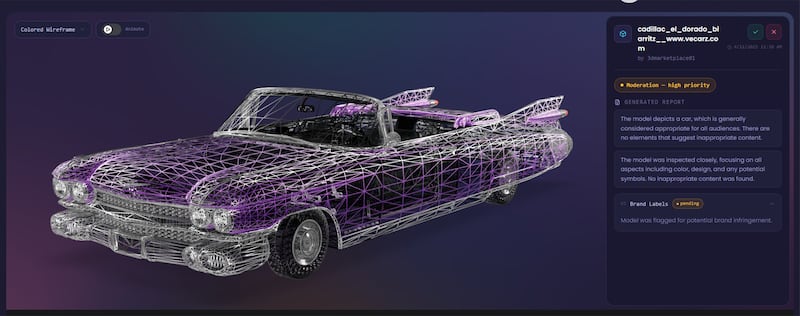
The difference between SECUR3D’s approach and many conventional brand protection workflows comes down to timing. Traditional tools often begin working after the content has been published. AssetSafe is designed to look before publication.
When a seller or creator submits an asset to a marketplace, AssetSafe fingerprints it at the point of upload and checks it against public libraries of reference materials, previously registered assets, and the marketplace ecosystem it is being submitted to. Potential matches are flagged and routed for review before they reach a buyer.
The marketplace still makes the call. SECUR3D supplies the evidence.
“Instead of having to go out there and find potential infringement or misuse, we take the approach of being a gatekeeper to proactively identify and prevent potential issues before they enter a marketplace or ecosystem,” said President Nitesh Mistry.
He reaches for a simpler comparison.
“Before you can board the airplane, everything and everyone needs to go through that security scanner,” Mistry said. “If it doesn’t meet the requirements of the platform, or it’s got potentially malicious content in it, it’s flagged and stopped before it even enters.”
Before you can board the airplane, everything and everyone needs to go through that security scanner.
— Nitesh Mistry, President of SECUR3D Holdings Inc.
How SECUR3D identifies modified content
Standard image comparison approaches can become less reliable when someone resizes, retextures, or remixes the asset. At that point, a pixel-level match fails, and the copy passes through.
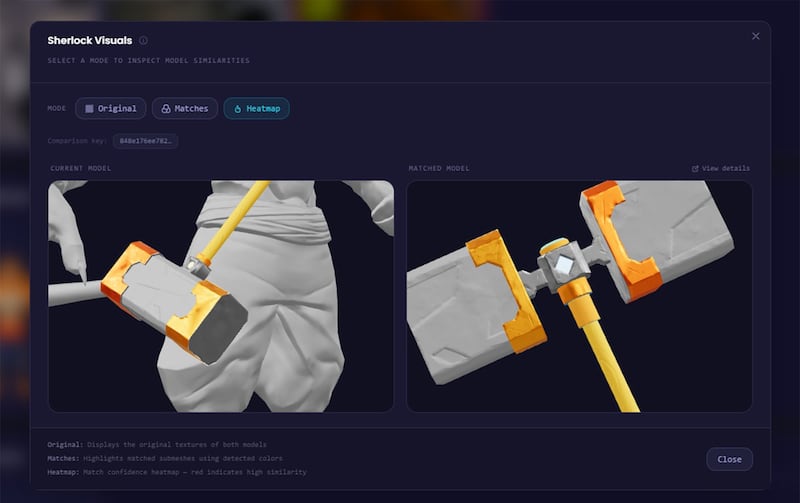
Unlike tools that depend on a pixel-perfect match, Sherlock AI evaluates multiple signals, including geometry, texture, visual similarity, and context. This helps surface meaningful similarities even when an asset has been resized, retextured, or remixed.
A good example is a character’s appendage or limb lifted from one model and attached to another. The finished object looks original. Its components are not. “A lot of folks can see the surface level,” Mistry said. “We go underneath to look at the components, the triangles, the vertices of what makes the content unique.”
That distinction is the product. A marketplace is not paying to catch obvious copies; it is paying to catch the ones engineered to slip past everything else.
Extending protection beyond the point of upload
Screening uploads only protects one door. The internet has many, which is where Sentry comes in.
Sentry is being developed to compare a brand’s reference assets with online listings, identify possible unauthorized use, organize supporting evidence, and prioritize findings for review. It is in active development and is not generally available, although initial capabilities are being tested and used in limited engagements with select enterprise customers.
On September 10, 2026, SECUR3D announced it had broadened Sentry’s development coverage to 22 marketplace environments, adding eBay, AliExpress, Poshmark, CGTrader, and MakerWorld to a list that already included Alibaba, Etsy, Sketchfab, Redbubble, and TurboSquid. Coverage now spans creator commerce, downloadable 3D models, and print-on-demand merchandise. The additions broaden the mix of listing structures, product categories, and seller environments to test and refine Sentry’s detection, evidence, and reporting workflows as the company works toward wider deployment.
“Brand teams are not dealing with exposure on one platform. They are dealing with a fragmented mix of marketplaces, seller types, and content formats,” Perrick said.
For a brand, an early sweep can double as an audit, providing a baseline for commercial exposure by showing where potential misuse is happening and how much revenue has already left the building.
According to Perrick, that record becomes the starting point: “We can help a brand better understand their commercial exposure, uncover where the potential leakage and revenue losses have happened in the past, organize the evidence, and outline what we’re going to be able to do to proactively mitigate it going forward.”
Extending similar tools to creators
The Creator Portal is the company’s answer to a structural gap in the market. Independent designers and user-generated content (UGC) creators face the same infringement and misuse risk as major brands, without the legal departments that large rights holders take for granted.
Some of those creators now run meaningful businesses. Few of them have in-house counsel.
The planned product is intended to give creators a more accessible way to register reference assets, document ownership information, and access protection and monitoring workflows across supported online channels. It remains on the roadmap, and management has not disclosed a launch date.
Early commercial validation
The technology is already running inside customer workflows, which is not the norm for a company this early in the public market.
The asset repository holds more than 25,000 fingerprinted and analyzed assets, and the company has disclosed 14 active customer and partner engagements, including Digital Brands Group involving Herschel Supply Co., SuperHive, and Zen Studios, whose licensed catalogue brings globally recognized entertainment properties into the fold.
The market it sits inside is growing on its own. Mordor Intelligence projects global content moderation spending will rise from roughly US$13.3 billion in 2026 to US$26.1 billion by 2031, growth of more than 14% a year.
Authentication and brand protection adds close to US$7 billion more by the same year. SECUR3D sells into both.
A tool, not the story
The July listing was a direct listing on the CSE, completed without a concurrent financing. Earlier private rounds funded product development and commercialization.
As of July 15, 2026, the company had 61,531,371 shares outstanding and 76,779,575 fully diluted, with roughly a third of outstanding shares held in escrow and not freely tradeable.
Management is careful not to oversell the milestone itself.
“The listing is a tool. It’s not the story by itself,” Mistry said. “The real story is the technology that we’ve built and continue to build, and the commercial opportunity, and our ability to deliver measurable progress against that opportunity.”
The listing is a tool. It’s not the story by itself. The real story is the technology that we’ve built and continue to build."
— Nitesh Mistry, President of SECUR3D Holdings Inc.
What investors can watch next
For the next 12 months, the measurable progress Mistry refers to comes down to a short list. Investors can watch AssetSafe usage and product performance, continued Sentry development, broader marketplace coverage, and the progression of initial enterprise engagements into deeper, repeatable commercial relationships and publicly disclosed revenue progress.
SECUR3D is entering a market where platforms and brands face growing pressure to understand and manage content and IP risk and liability. Its bet is that the fix is earlier, not faster: catching a copy at the point of upload rather than chasing it after publication. Live deployment with recognizable brands is what separates that bet from a thesis on paper.
“Investors should watch how we execute,” Perrick said. “That means product performance, continued development, and deeper enterprise adoption turning that into repeatable commercial usage.”
About SECUR3D Holdings Inc.
Founded in Vancouver, British Columbia, SECUR3D Holdings Inc. (CSE: SRD) is an AI-powered brand security and intellectual property protection company helping brands, creators and platforms detect and protect digital assets across online marketplaces and digital ecosystems. Its proprietary technology suite, including AssetSafe, Sentry and Sherlock AI, supports detection of unauthorized IP use, infringement monitoring and enforcement intelligence across fashion, entertainment, gaming and digital commerce.
Learn more at secur3d-investors.com.
Follow SECUR3D on LinkedIn, X, and Instagram.

