Disseminated on behalf of: Gold Terra Resource Corp.
- Gold Terra has three rigs active on the past-producing Con Mine, funded by a C$10.1 million financing that closed in August, with roughly C$7.2 million going straight into the drill programs.
- The Yellowknife Project hosts a combined 1.925 Moz including 103,000 ounces of gold in the Indicated category and 1,822,000 ounces in the Inferred category.
- Preliminary economic assessment (PEA) is targeted for year-end.
- At roughly US$35 per ounce of resource, Gold Terra trades well below the US$100 average for Canadian gold developers that have already completed a PEA, the exact study it expects to deliver this year.
Gold opened 2026 by setting a record above $5,600 per ounce. It has been trading around $4,300, more than double where it sat five years ago.
The new Gold era has started and most of the juniors such as Gold Terra have not been rerated for their undeveloped ounces in the ground. Deposits shelved in earlier cycles now clear the economic bar with room to spare, and investors are paying for ounces that already exist rather than ounces someone hopes to find.
Gold Terra Resource Corp. (TSXV: YGT | OTCQB: YGTFF | FSE: TX0) optioned its flagship asset in late 2021, when gold traded at less than half today’s price around US$1,700 per ounce. It has already spent C$20 million over the last 5 years and discovered already 1.925 Moz and it keeps drilling that asset out now.
The Vancouver-based company controls 836 square kilometres immediately north, south, and east of the City of Yellowknife, in Canada’s Northwest Territories. Its flagship is the Con Mine option property, held under option from a subsidiary of Newmont Corporation, where the Yellorex and 103N deposits extend the historical Con Mine to the south and north. Twenty kilometres north of the city, four wholly owned deposits add scale: Crestaurum, Sam Otto, Walsh Lake, and Barney.
The immediate goal is a preliminary economic assessment, the early engineering study that puts a first set of numbers around what a mine would cost and earn.
Our job is to create value by finding gold and de-risking the project to take it to production.
— Gerald Panneton, Chairman & CEO
A camp the majors walked away from
Yellowknife is not a frontier. The Con Mine produced 6.1 million ounces of gold between 1938 and 2003, at grades of 16 to 20 grams per tonne. Across the Campbell Shear, the structure that runs through the district, roughly 14 million ounces have been mined in total, counting Con’s output and the neighbouring Giant mine.
Production stopped when gold traded near $340 an ounce and the operator’s priorities moved elsewhere. Size, not geology, is why nobody came back.
“I have been involved in gold exploration for more than 40 years, and I would never give up a property with potential unless the potential is not there,” Panneton said. “A lot of projects get let go by majors and they never go back, because they’re too small, and the best example is what we did at Detour Gold (2006–2013).”
The economics that closed the mine have since inverted. An ounce that costs roughly $2,000 to produce now sells for more than twice that.
“Our break-even is probably somewhere around US$2,000 an ounce,” Panneton said.
Roughly two million ounces already on the board
Gold Terra has spent the years since taking on the Con Mine option in 2021 rebuilding that resource base.
The 2026 estimate covering Yellorex, Zone 103N, and Crestaurum reports 103,000 ounces of gold in the Indicated category and 895,000 ounces in the Inferred category, using a gold price of US$2,600 per ounce. A 2021 estimate covering Sam Otto, Walsh Lake, and Barney, which used US$1,500 per ounce, adds 927,000 Inferred ounces.
Combined, that is roughly 1.9 million ounces, for a company with a market capitalization near C$106 million. It puts Gold Terra among developers that already have the ounces to justify an economic study, rather than explorers still hunting a first discovery, and more with local infrastructure, and the mining lease that comes along with the past producing Con Mine now under option to be purchased by Gold Terra.
The largest single addition came from Zone 103N, the northern extension of the old mine, which contributed 595,000 Inferred ounces at 3.64 grams per tonne.
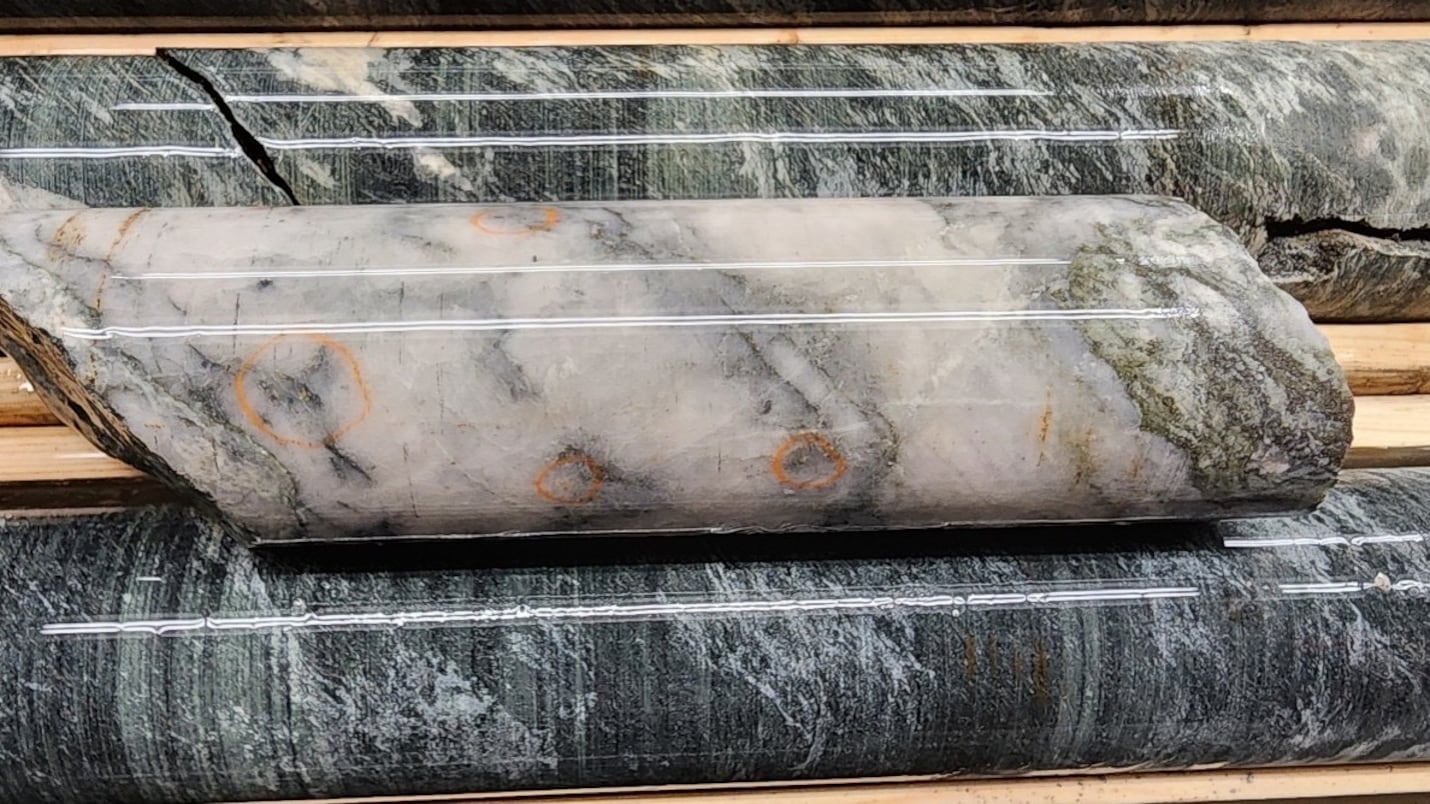
And the number keeps moving. At Yellorex, contiguous to the old workings, hole GTY26-001 returned 8.20 grams per tonne gold over 20.4 metres, including 18.7 grams per tonne over 6.8 metres. Hole GTY26-022 cut 5.88 grams per tonne over 19.0 metres, including 18.50 grams per tonne over 4.0 metres.
Those are wide, high-grade intervals sitting directly alongside infrastructure that already exists underground. Gold Terra drilled 16,000 metres this year, and the company expects that program to feed into the PEA.
Half the mine is already there
The strongest part of the Gold Terra case is not in the ground. It is on top of it.
The Con Mine is a brownfield site, and it comes with the bones of an operation: a mining lease and surface rights already in place, the 1,950-metre Robertson shaft rated at 2,000 tonnes per day, a C$20 million water treatment plant installed in 2015, and all of the accessible underground workings across the whole deposit. When the Mine shut down in 2003, the past operator Miramar left 650,000 ounces behind at grade between 10–12 g/t Au. Full ownership of that package follows completion of the Newmont option.
The location supplies the rest. Yellowknife brings hydro power, all-season roads, air access, and a skilled local workforce, which is why drilling here costs about C$250 per metre.
“The amount of money we’re saving by using the Con Mine could be up to $200 million,” Panneton said.
Today’s gold price allows a mine to be built for less than 2 million ounces when near infrastructure.
Permitting follows the same logic. Because the site is already disturbed and sits inside an existing lease, management expects re-permitting to take six to 18 months rather than the decade a new discovery can demand, while cautioning that timelines can slip.
The groundwork for that is already laid. Gold Terra works with the City of Yellowknife, the Yellowknives Dene First Nation, the Tłı̨chǫ Government, and the North Slave Métis Alliance, and took the Northwest Territories’ environmental and social responsibility award in 2023.
Panneton has done this before. “When we built Detour, we went from IPO to gold production in six years, including two years of construction,” he said. “We were able to permit the project in less than one year, with the support of the Ontario Government.”
Gold that has already been mined
One of the three programs is not drilling rock at all.
Ore milled at Con over 65 years of production graded 16 to 20 grams per tonne, and historic recoveries ran between 85% and 95%. On ore that rich, the 5% to 15% left behind still amounts to real metal, sitting at surface in the old tailings facilities.
“They left one to two gram material in the tailings residue,” Panneton said.
A sonic drilling program of approximately 7,000 metres has already started to test that material on a 40 by 40 metre grid, with holes averaging 10 to 30 metres deep, starting on the Upper Pud facility. A second facility, the Middle Pud, remains untested. The spacing is tight enough to support an Indicated-category resource, and the company hopes to fold the result into the PEA.
The attraction is simplicity. The company describes a low-grade stockpile already broken and at surface, requiring no crushing and possibly no regrinding, capable of feeding a future plant for years at start-up.
Strategic optionality north of town
The wholly owned deposits north of the city give Gold Terra a second gear.
Crestaurum, updated in this year’s estimate, holds 79,000 Indicated ounces and 122,000 Inferred ounces across open-pit and underground material. Sam Otto, Walsh Lake, and Barney, last estimated in 2021, hold 927,000 Inferred ounces between them. Several of those deposits carry open-pit material, the kind of ounces that come cheapest early in a mine plan.
All four sit about 20 kilometres north of Yellowknife, a haul of 20 to 30 kilometres to a future mill at the Con site, close enough to truck ore rather than build separate infrastructure.
Walsh Lake is delivering on its own. Hole GTWL26-024 returned 22.46 grams per tonne gold (uncut) over 5.7 metres, including 198 grams per tonne over 0.5 metres, and opened two new mineralized zones 200 metres apart with visible gold.
Why investors are watching
The valuation gap is the thesis.
Gold Terra’s enterprise value works out to roughly US$35 for every ounce in the ground. The average for Canadian gold developers that have completed a PEA is US$81, according to Capital IQ and Canaccord Genuity data compiled in early September, and the most richly valued trade well above US$100.
Management argues the discount reflects study stage rather than asset quality, and that finishing the PEA is what closes it. Panneton puts roughly 35% of the shareholder base in strategic and institutional hands, including Eric Sprott at 10.7%, Mackenzie at 7.1%, and David Harquail at 5.0%. Harquail added to his position in this summer’s financing.
The team is built for the next phase rather than the last one. Panneton founded Detour Gold in 2006 and took Detour Lake into production in 2013; the company was later acquired by Kirkland Lake Gold for about C$4.9 billion. CFO Mark T. Brown was previously Director of Finance at Miramar Mining, the Con Mine’s former operator. Chief Development Officer Todd Burlingame formerly chaired the Mackenzie Valley Environmental Impact Review Board.
The next 12 months are unusually well defined. The PEA lands by year-end. Gold Terra has surpassed the C$8 million minimum spend required under its Con Mine option, having invested roughly C$20 million as of June 2026, and Panneton expects to complete the acquisition and hold 100% of the property within six to 12 months. The fall program with three rigs is already ongoing with 10,000m already planned. A winter program will also follow with more than 10,000m or more in the work from January to mid April.
Nearly two million ounces. A mine site that still has its shaft, its power and its permits-in-waiting. And a valuation set well below the group it is about to join. For investors willing to look at a developer before the study lands, the risk-reward is compelling.
“It is not going to stay at $35 an ounce,” Panneton said. “The people who have a PEA out are already valued at $100 to $300 an ounce.”
The scientific and technical information contained within this article has been reviewed and approved by Joseph Campbell, P. Geo., Senior Technical Advisor of Gold Terra Resource Corp., who is a Qualified Person as defined under National Instrument 43-101.
About Gold Terra Resource Corp.
Gold Terra Resource Corp. (TSXV: YGT | OTCQB: YGTFF | FSE: TX0) is an advanced-stage exploration company focused on the Yellowknife Project, 836 square kilometres of contiguous land immediately north, south and east of the City of Yellowknife, Northwest Territories. The property covers nearly 70 kilometres of strike along the mineralized shear system that hosts the former Con and Giant mines. The Yellowknife Project is 100% owned by Gold Terra apart from the Con Mine Option property, held under option from a subsidiary of Newmont Corporation, where the company is drilling to expand resources ahead of a preliminary economic assessment. Gold Terra also holds the Mulligan gold project in New Brunswick, acquired in 2019 through the acquisition of Gold Matter, which has returned high-grade surface sampling results.
To learn more about Gold Terra Resource, visit their website here.
For the latest updates, follow the company on social media: X and LinkedIn.

