Disseminated on behalf of:SuperQ Quantum Computing Inc.
- SuperQ closed an oversubscribed C$4.6 million brokered placement led by Canaccord Genuity in June and reported roughly C$5 million in treasury against approximately 37 million shares outstanding.
- SuperQ’s SuperPQC cybersecurity suite produced the company’s first major enterprise deal in post-quantum security in May, a commercial agreement to move NASDAQ-listed AI Financial Corporation’s payments and trading infrastructure onto quantum-resistant encryption.
- Two government-backed programs opened within a week in July: selection into a Global Affairs Canada-supported U.S. defence accelerator, with a place at Fed Supernova 2026 in Austin, and Deep Tech Canada’s November Trade Mission to Barcelona.
Artificial intelligence has taught industry to predict. It has not taught industry to decide.
Most hard business problems are optimization problems: routing fleets, scheduling power across a grid, narrowing millions of molecular candidates down to the handful worth synthesizing. Classical computers can produce an answer. They cannot guarantee the best one.
Quantum computing can close part of that gap, but only in combination with the classical machines already doing the work. Almost no enterprise employs the specialists required to make the two operate together.
That is where SuperQ Quantum Computing Inc. (CSE: QBTQ | OTCQB: QBTQF | FSE: 25X) now finds itself.
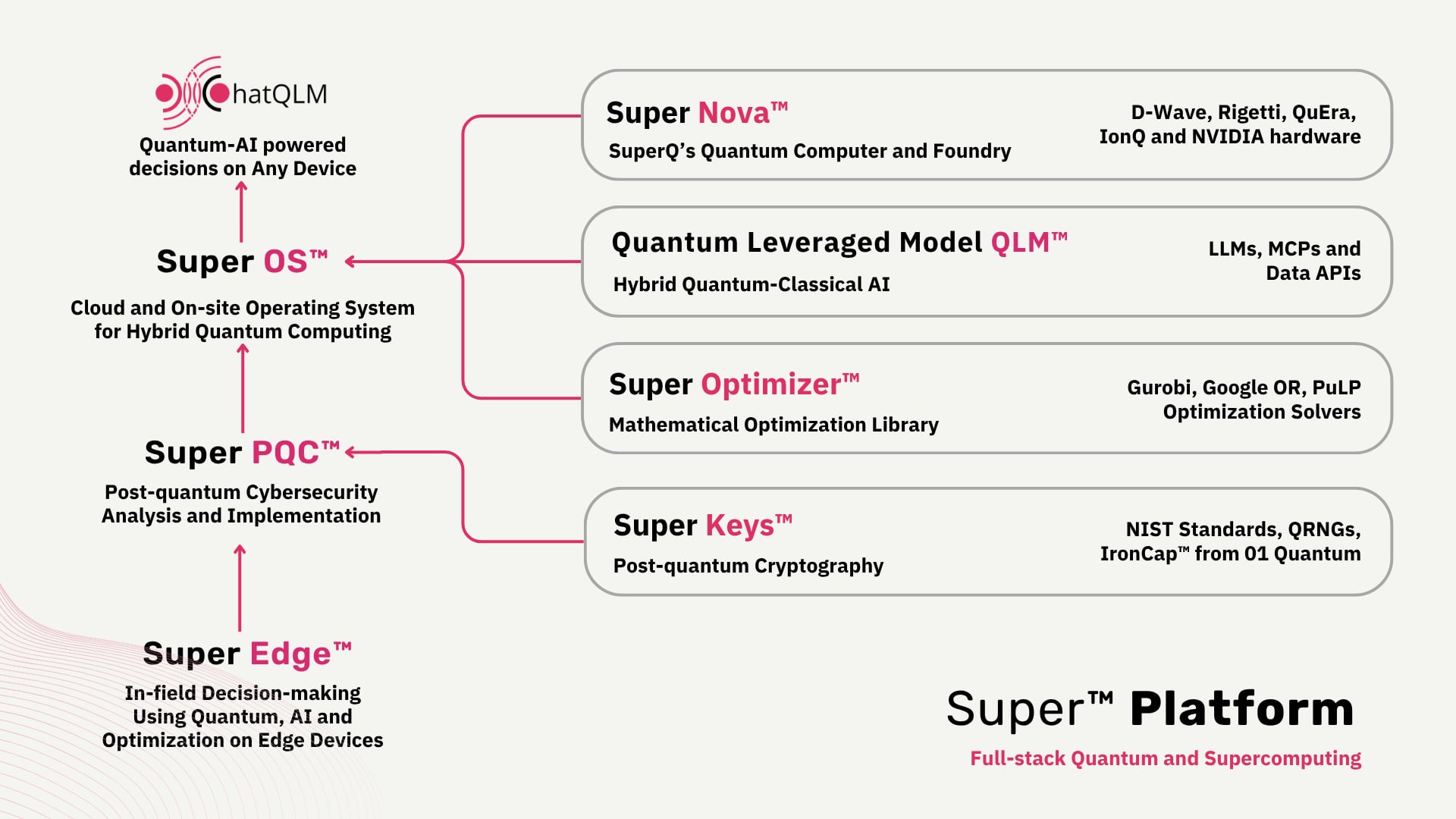
The Calgary-based company sells the Super platform, a commercially available system that builds and runs hybrid quantum-classical solutions on a customer’s behalf. The platform’s two modules handle optimization and post-quantum cybersecurity.
Super OS, in development, is the orchestration layer designed to run that stack across data centres, on-site infrastructure, and third-party quantum hardware. Super Nova is the modular computer built to run Super OS natively. ChatQLM is a separate consumer app putting quantum-backed reasoning in a phone.
One argument runs through all of it: quantum computing scales commercially only when someone builds the layer that makes it usable.
“When you use your laptop, you use the CPU and GPU seamlessly through Windows or macOS or Linux,” said Founder and CEO Dr. Muhammad Ali Khan. “We are creating the same experience for quantum computing.”
What a customer can buy today
Most quantum companies are selling something you cannot buy yet. SuperQ’s core product is already on the market.
The Super platform behaves less like software and more like staff. A customer describes a business problem in plain language. The platform breaks it down, decides which parts belong on classical hardware and which belong on a quantum processor, builds the solution, and returns results in the customer’s own vocabulary.
“The user doesn’t have to have expertise in computer science or physics,” Khan said. “They only focus on their problem domain and they let the platform do the work.”
Khan is deliberate about what is being sold. “We don’t sell technology. We sell value, and the value we sell is mathematical optimization. Quantum computing is just a tool.”
Security is the other half of the business
The technology that solves those problems also threatens the encryption protecting everything else. RSA-based cryptography secures most passwords and payments in use today, and is expected to weaken as quantum machines scale.
The deadlines are already being set. Google has committed to completing its post-quantum cryptography migration by 2029, a year ahead of the date the U.S. National Institute of Standards and Technology (NIST) has set to deprecate the current standards.
SuperPQC diagnoses that exposure and manages the migration. It is the module that produced the company’s first major enterprise deal in post-quantum security.
In May, SuperQ signed a commercial agreement with AI Financial Corporation (NASDAQ: AIFC), formerly ALT5 Sigma. The work covers securing the payments and trading infrastructure behind the client’s digital asset platform, and extends into AI and compute infrastructure.
“AI Financial is our first major enterprise deal in post-quantum cybersecurity,” Khan said.
The buyer put it in bigger terms. “By partnering with SuperQ, AI Financial is among the first to embark on the journey toward a quantum utility and security economy,” said Tony Isaac, CEO of AI Financial Corporation.
Why SuperQ says it does not have competitors
Investors comparing listed quantum names usually start with qubit counts. Khan argues that is the wrong scoreboard, because SuperQ is not trying to win it.
“Anyone who’s producing quantum hardware, we don’t see them as competitive,” he said. “We’re an enabler for other quantum companies.”
Super OS is designed to run on third-party quantum machines as readily as on SuperQ’s own. Every hardware maker that ships a machine becomes a potential channel rather than a threat.
That position also shapes what SuperQ is building itself. “We created the hardware because we saw that not everyone would want to buy a $50 million machine that does only one type of calculation,” Khan said.
We don’t sell technology. We sell value, and the value we sell is mathematical optimization.
— Dr. Muhammad Ali Khan, Founder and CEO of SuperQ Quantum Computing Inc.
Hardware priced to be purchased
Super Nova is where the software thesis becomes a hardware business. The machine is modular, combining superconducting quantum chips, GPUs, and control electronics, with customers taking only the stacks they need.
Development of this quantum hardware layer takes place at the University of Waterloo’s Digital Quantum Matter Lab, supervised by renowned superconducting quantum physics expert Professor Matteo Mariantoni. Leveraging Waterloo’s state-of-the-art clean room and advanced fabrication facilities enables rapid prototyping, device iteration, and seamless system integration, supporting a modular architecture designed to directly integrate with enterprise IT environments and significantly lower capital costs.
The commercial argument is cost. A quantum computer today typically runs US$20 million to US$50 million, Khan said, and performs one class of calculation. Super Nova is being targeted at under US$10 million.
“We can achieve a lot through our operating system by making a smaller number of qubits work with classical hardware,” he said.
The first on-premise deployment of Super OS is expected this fall, though no customer has been named. The first Super Nova unit is slated for the first half of 2027 and will be built in-house at the company’s manufacturing lab.
Two government-backed doors, one week apart
July brought validation from an unusual direction.
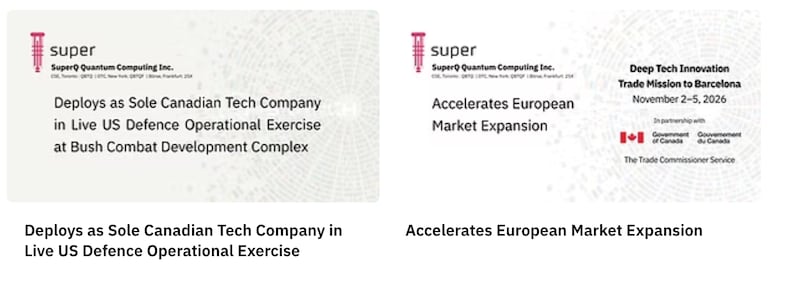
SuperQ was selected into the Canada and Q-Branch Dual-Use Accelerator, backed by a formal agreement with Global Affairs Canada. The program put the company in front of U.S. defence and federal buyers through curated meetings, including three days at Fed Supernova 2026 in Austin from August 18–20.
“Our technology is of significant interest for dual-use purposes,” Khan said, pointing to six months of engagement with Canadian defence primes.
A week later came Europe. SuperQ was selected for Deep Tech Canada’s Trade Mission to Barcelona, exhibiting in the Canadian pavilion at the Smart City Expo World Congress in November.
The target application is urban optimization: transportation, logistics, and energy movement through congested networks.
Barcelona is a deliberate choice. The city hosts the €22 million Quantum Spain initiative and the €43 million Vall de la Quàntica program, concentrating public buyers in one place.
From curated meetings to a live exercise
On October 1, SuperQ received the evaluation report from a live military exercise at the Bush Combat Development Complex in Texas. The company tested Super Edge, its optimization platform for use on devices in the field, and was the only quantum firm and the only Canadian technology provider in the international cohort.
SuperQ says the report shows completion of all primary operational objectives, sustained performance under simulated network degradation, and integration with existing military command systems. The full report is published in a public repository.
“It was fantastic to see SuperQ as the only Canadian company participating in the international cohort of companies testing products at the Bush Combat Development Complex in a real test environment,” said Duane Robson, Consul and Senior Trade Commissioner at the Consulate General of Canada in Dallas.
A field test under contested conditions is a different order of proof than a commercial pilot.
Leadership driving commercialization
To execute this vision, SuperQ has assembled a seasoned leadership and advisory team. Khan is a Silicon Valley entrepreneur and computer scientist with over 20 years of experience, and has scaled private and public companies across Canada, the U.S., and the UAE. A former academic trained at the University of Cambridge and the University of Calgary, he is a Vanier, Killam, and Commonwealth Scholar, and launched the ChatQLM app at CES 2026.
Chief Business Officer Manoj Joseph brings deep B2B enterprise sales and business development experience, having previously worked with major technology companies, including Eros, Smartron, and DLT Ledgers.
The team is further strengthened by Senior Strategic Advisor Bob Dameron. Formerly the Head of Business Development for the quantum unicorn Multiverse Computing, Dameron also brings decades of public markets experience from senior executive roles at the Toronto Stock Exchange (TSX).
Why investors are watching
The capital structure is the quiet part of the story.
SuperQ carries roughly 37 million shares outstanding, a small float that gives existing shareholders more exposure to any commercial success.
The company reported roughly C$5 million in treasury after the June financing. Khan said the long enterprise sales cycles that produced few closed deals last year are now converting.
He said the goal is to balance burn against revenue by year-end. “Even if that doesn’t happen, we have a 12-month runway based on the cash position we have right now,” he said.
The next 12 months carry defined catalysts: the first on-premise Super OS deployment, the first Super Nova build, follow-through from the Texas exercise, and European entry through Barcelona.
For investors weighing quantum exposure, most listed names are a bet on a machine. SuperQ is a bet on the layer that machine will need to run.
About SuperQ Quantum Computing Inc.
SuperQ Quantum Computing Inc. (CSE: QBTQ | OTCQB: QBTQF | FSE: 25X) is building the operating system, Super OS™, to unify quantum and supercomputing for data centre and enterprise deployment. This OS will run on SuperQ’s in-development Super Nova™ hybrid quantum computers and third-party hardware. The company’s already commercialized Super™ platform enables enterprises, government, and research institutions to autonomously solve complex optimization and cybersecurity challenges by combining quantum and high-performance computing. The company is also putting quantum computing in the palm of consumers’ hands through ChatQLM™ - the world’s first consumer application powered by hybrid quantum and supercomputing.
Learn more at superq.co.
Follow SuperQ on LinkedIn, X, Instagram, YouTube, and TikTok.

