Disseminated on behalf of: Arrow Exploration Corp.
- Arrow Exploration has set two production records in seven weeks, reaching more than 6,500 barrels of oil equivalent per day on October 22, 2026.
- Proved plus probable reserves rose 82% to 21.4 million barrels of oil equivalent, with a before-tax net present value of US$410 million.
- The company holds more than US$28 million in cash and no debt, after paying for its Alberta acquisition entirely from cash on hand.
Oil is back near triple digits. Brent crude, the international benchmark, closed at US$109.78 a barrel on October 23, up about 81% since January. Conflict in the Middle East and tanker attacks in the Strait of Hormuz have pushed seaborne crude to a steep premium, and producers paid on Brent-linked prices are capturing that gap.
That environment rewards a specific kind of company. Investors are favouring producers that can add barrels quickly, keep costs low, and fund growth without borrowing. Arrow Exploration Corp. (TSXV: AXL | AIM: AXL) checks all three boxes.
The Calgary-based company’s core asset is the Tapir Block in Colombia’s Llanos Basin, where it holds a 50% beneficial interest. Arrow has made five oil discoveries on the block, most recently the Icaco field this spring, alongside Carrizales Norte (CN), Rio Cravo Este (RCE), Alberta Llanos and Mateguafa. It also holds other interests elsewhere in Colombia and in Canada.
In August 2026, Arrow expanded its portfolio into Canada, acquiring a 100% working interest in the producing Thorsby property in central Alberta for C$12.15 million, adding approximately 550 boe/d of production.
The acquisition contributed to a new production record the following month, with Arrow surpassing 6,000 barrels of oil equivalent per day on 4 September. The company said the record reflected recent drilling successes, workovers and the Thorsby acquisition. Seven weeks later, on 22 October, Arrow set another record, reporting total corporate production of more than 6,500 barrels of oil equivalent per day following further drilling success at Icaco.
“Six thousand barrels a day is a target we’ve had for quite some time,” said CEO Marshall Abbott. “In fact, today we’re through 6,500 barrels a day, and we still have a horizontal well to turn on that’s going to add materially to that production base.”
They are some of the cleanest reservoirs I’ve dealt with in my career.
— Marshall Abbott, CEO, Arrow Exploration Corp.
One pad, several reservoirs
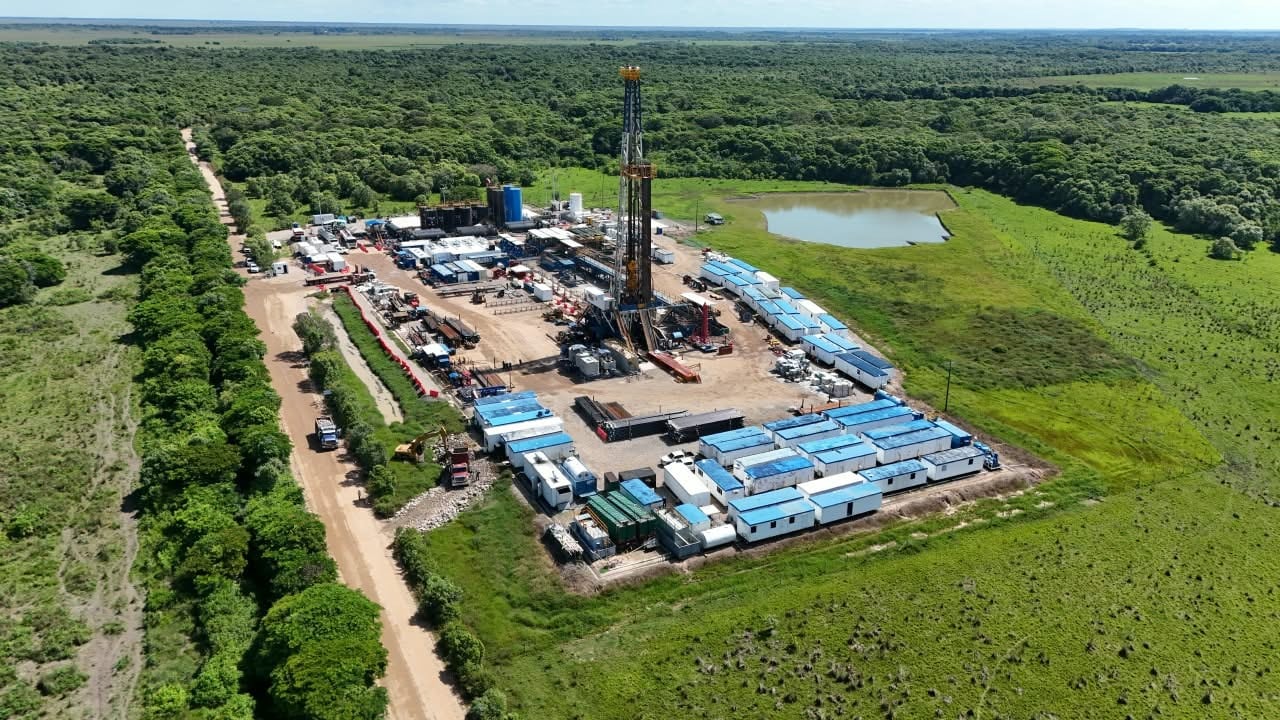
The Icaco discovery is the engine behind the record. Arrow drilled the discovery well in just five days in May 2026 and has been developing the field ever since.
What sets Icaco apart is that the oil sits in several stacked rock zones, all of which can be reached from a single drilling pad. That gives every well multiple targets.
IC-8, the latest well brought onto production, shows why that matters. It found net pay, the thickness of rock holding oil that can be economically produced, in four separate zones, including 72 feet in the Carbonera C7 and 85 feet in the Ubaque (both numbers in measured depth). The well came on production October 12, and as of October 22, was producing at a restricted rate of about 1,204 barrels of oil per day gross, or 602 barrels net to Arrow, from the C7 formation.
Arrow has built 16 well cellars on the Icaco pad, and its latest well breaks new ground. IC-HZ9 is the first horizontal well drilled into the Carbonera C7 reservoir anywhere on the Tapir Block.
A horizontal well runs sideways through the oil-bearing layer, so it contacts far more rock than a vertical one. IC-HZ9 finished drilling on October 20 with roughly 950 feet of horizontal oil pay.
For Abbott, the quality of the rock is the real story. “The oil comes out very fast in these reservoirs. They are some of the cleanest reservoirs I’ve dealt with in my career,” he said.
Wells that pay for themselves in weeks
For investors, one of the most telling numbers is how quickly a well earns back what it cost to drill. At Icaco, the answer has been weeks rather than years, with Arrow reporting in September that its best wells paid out in under two months.
Pricing is a big part of the speedy payout period. Arrow sells its crude at Brent-linked prices, and on October 22 Brent closed US$113.70 a barrel, US$14.23 above WTI, the U.S. benchmark.
That pricing supports a strong netback, the profit per barrel after royalties, transport, and operating costs. Arrow reported a netback of US$52.44 per barrel for the first half of 2026, and its presentation cites a 500% internal rate of return, an annualized measure of profit on capital, for its Carrizales Norte horizontal program.
That kind of consistency is rare, according to Abbott. “It’s difficult in any context of the market to enjoy IRRs that are that consistent from well to well.”
A familiar play closer to home
Thorsby gives Arrow a second growth engine, this time in the company’s home province. Arrow paid C$12.15 million in cash, about US$8.9 million, for a 100% working interest in the property, which sits roughly 200 kilometres north of Calgary and produced about 550 boe/d at the time of the deal.
The acquisition brought 4.973 million boe of proved reserves and 7.537 million boe of proved plus probable (2P) reserves, according to a third-party report. Proved plus probable is the industry’s standard best estimate of recoverable oil and gas, and Thorsby’s reserves are just over half oil and liquids, with natural gas making up the rest.
Management has identified 22 drilling locations, with each two-mile horizontal well expected to cost about C$2.2 million. The geology will also look familiar to Arrow’s team, since Thorsby’s reservoir is trapped the same way as the company’s Colombian fields, in rock layers that rise and seal against a barrier.
“From a geological and engineering perspective,” Abbott said, “it is very similar to what we pursue down in the Llanos.”
What an extension could unlock
In September, independent evaluator Boury GEC put Arrow’s 2P reserves at 21.4 million boe, up 82% from year-end 2025. Discounted at 10% a year, those reserves carry a before-tax value of US$410 million and an after-tax value of US$255.8 million. For comparison, Arrow’s market capitalization stood at about C$226 million on October 23.
Those figures rest on the Tapir contract, which expires in February 2028 and includes two five-year extension options granted at the discretion of state-controlled oil company Ecopetrol. Arrow’s proved (1P) reserves assume the contract ends in 2028, while its 2P figure assumes the first extension is granted and its 3P figure assumes both extensions are granted.
Arrow says it has met every obligation the contract lists for the extensions and has filed all required documentation, though its 50% interest also remains subject to Ecopetrol’s formal consent to its assignment. The company describes its talks with regulators as constructive and says Colombia’s newly elected government supports expanding oil and gas development.
A formal extension would let more of each well’s producing life count toward Arrow’s most conservative reserves, a point Abbott made plainly. “Right now, the reserves are limited by the tenure we have on the block,” he said. “If we are successful in getting an extension, that reserve number grows overnight.”
Cash in hand, and an appetite for deals
Arrow carries no debt, and its estimated cash balance passed US$28 million on October 1, up from US$21.8 million a month earlier after the Thorsby payment. The company also has access to a crude prepayment facility of up to US$20 million with an integrated energy major.
That flexibility matters in the current market. Abbott said equity financing for some oil deals is hard to find right now, which puts cash-rich buyers in a strong position, provided the deal fits. As he puts it: “The best time to look for money is when you’ve got money.”
Arrow’s bar for any acquisition is clear. It must be accretive, meaning it adds value for existing shareholders, and it must be capable of at least doubling the asset’s production.
Why investors are watching
Arrow’s progress has not gone unnoticed, and its shares have climbed sharply this year. The company now pairs record production with a debt-free balance sheet and a deep inventory of wells still to drill in two countries.
The next year carries several catalysts:
- IC-HZ9 comes onto production.
- Further development drilling at Icaco.
- The first development pad at Thorsby, scheduled for 2027.
- A decision on the Tapir extension, which Abbott expects within the next year.
With the barrels already flowing, the question now is how many more the market will give Arrow credit for.
The technical information contained within this article has been reviewed and approved by Nilanjan Ganguly, Chief Geophysicist of Arrow Exploration Corp., who is a Qualified Person.
About Arrow Exploration Corp.
Arrow Exploration Corp. is a publicly traded oil and gas company with a portfolio of premier assets in Colombia and Canada that are underexploited, under-explored, and offer high potential growth.
In Colombia, Arrow operates via a branch of its 100% owned subsidiary Carrao Energy S.A. The company’s business plan is to expand oil production from some of Colombia’s most active basins, including the Llanos, Middle Magdalena Valley (MMV), and Putumayo Basin. The asset base is predominantly operated with high working interests, and the Brent-linked light oil pricing exposure combines with low royalties to yield attractive potential operating margins. By way of a private commercial contract with the recognized interest holder before Ecopetrol S.A., Arrow is entitled to receive 50% of the production from the Tapir block. The formal assignment to the company is subject to Ecopetrol’s consent.
Arrow’s seasoned team is led by a hands-on executive team supported by an experienced board. Arrow is listed on the AIM market of the London Stock Exchange and on TSX Venture Exchange under the symbol “AXL”.
For more information, visit arrowexploration.ca
For the latest updates, follow Arrow Exploration on social media: Facebook, X, Instagram, and LinkedIn

