TORONTO — Online prediction markets that allow users to place bets on the outcome of real‑world events are facing growing scrutiny, amid allegations that traders may be profiting from insider information and that betting on wars and political crises raises profound ethical concerns.
Prediction markets, such as Polymarket operate by offering contracts tied to future events, often posing yes‑or‑no questions about subjects ranging from interest rate moves to Oscar winners and sports.
“It’s essentially like taking a bet on an outcome of a future event,” said Werner Antweiler, an economics professor at the UBC Sauder School of Business. “And you can buy shares and sell shares all the time until the event actually happens.”
Advocates argue the platforms can be powerful forecasting tools, sometimes better than traditional polling or expert analysis. “They can be very good at aggregating information under the right conditions,” Antweiler said.
Critics say the same mechanisms that make prediction markets attractive can also open the door to abuse — particularly because trading can be anonymous and bets can be tied to conflicts and political decisions.
“If people are betting on the outcome of war and people’s lives are involved, that is highly problematic in an ethical way,” said Antweiler.
Concerns escalated this year after a series of highly specific trades on Polymarket — the world’s largest prediction platform — appeared to anticipate major geopolitical developments. Reporting by The Associated Press found that newly created accounts made large, profitable bets ahead of the ceasefire announcement between the United States and Iran on April 7. One account reportedly earned approximately US$200,000 from a single wager placed, just hours before the news.
‘Shielded by anonymity’
Suspiciously timed bets were also placed hours before Venezuela’s then-president, Nicolás Maduro, was captured by U.S. forces.
Antweiler said those cases raise serious questions about insider trading.
“We don’t know these people are who traded,” he said. “They’re shielded by anonymity, but there is a strong suspicion that they were trading on advanced information.”
He says if their identities were known, they could be held accountable.
“For example, breaking their oaths of secrecy if they are in the U.S. administration,” says Antweiler
The White House last month reportedly warned staff not to leverage their positions and place bets on futures markets and Polymarket has said it is cracking down on insider trading.
Ethical concerns have also emerged after an Israeli journalist said he’d received threats from gamblers because he reported on a missile strike, which negatively affected their bets. He said they attempted to pressure him into altering his story.
“If a lot of money is at stake, we could see various nefarious types of actions,” Antweiler said.
Polymarket faced further backlash after allowing users to place bets on the fate of two crew members of an F15 shot down over Iran.
“I would call these contracts immoral, but that’s my personal take,” said Antweiler.
Despite its popularity in the United States, Polymarket does not legally operate in Canada and is banned in Ontario until at least 2027, though access can be gained using VPNs and cryptocurrency.
Currently, only two firms — Wealthsimple and Interactive Brokers Canada — are allowed to offer limited event contracts tied to economic, financial and environmental indicators. For instance, you can wager on the daily high temperature in a city or whether interest rates will go up.
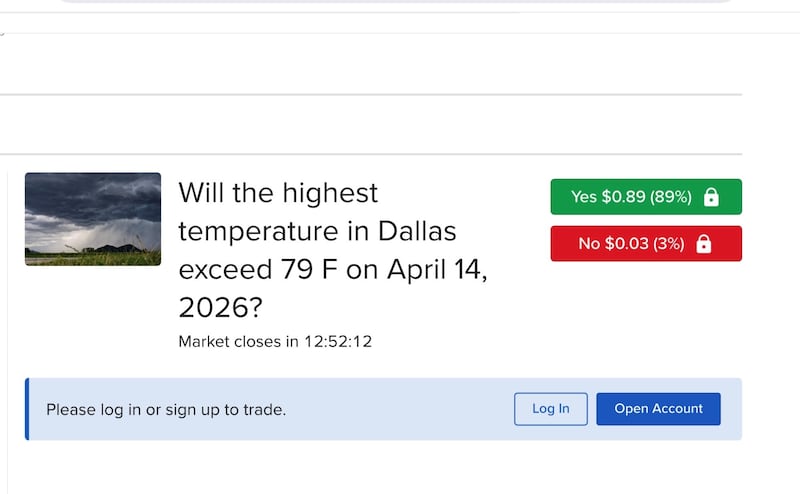
“They have a very limited authority to trade in a select group of outcomes that do not cover sports, that do not cover events of a political type or such as elections or what’s happening in the Middle East,” Antweiler said.
Financial planner Jason Pereira, a senior partner at Woodgate Financial, said prediction markets are often promoted as a type of investing, but fundamentally resemble gambling.
“These things have binary outcomes. You win or you lose,” said Pereira.
Both experts noted the products appeal mostly to young men.
“They have gamified these apps, where they have turned this into the same kind of experience that’s borderline sports betting,” said Pereira.
He says men disproportionately become addicted to gambling and that calling the trades “investing” sends the wrong message.
“More often than not, the millennial generation and younger has been given tools to blow themselves up financially under the guise of democratization of their investment options.”
As some U.S. lawmakers push to further regulate prediction markets, Antweiler said Canada should resist any pressure to liberalize.
What is Kalshi?
“The way Kalshi and Polymarket are operating today is, I think, very problematic,” he said. “We should be very careful. We should encourage provincial cooperation in this domain, so that we have a Canada‑wide approach.”
With files from the Associated Press

