Experts say U.S. President Donald Trump’s latest tariff threat on Canada will affect both Canadians and Americans.
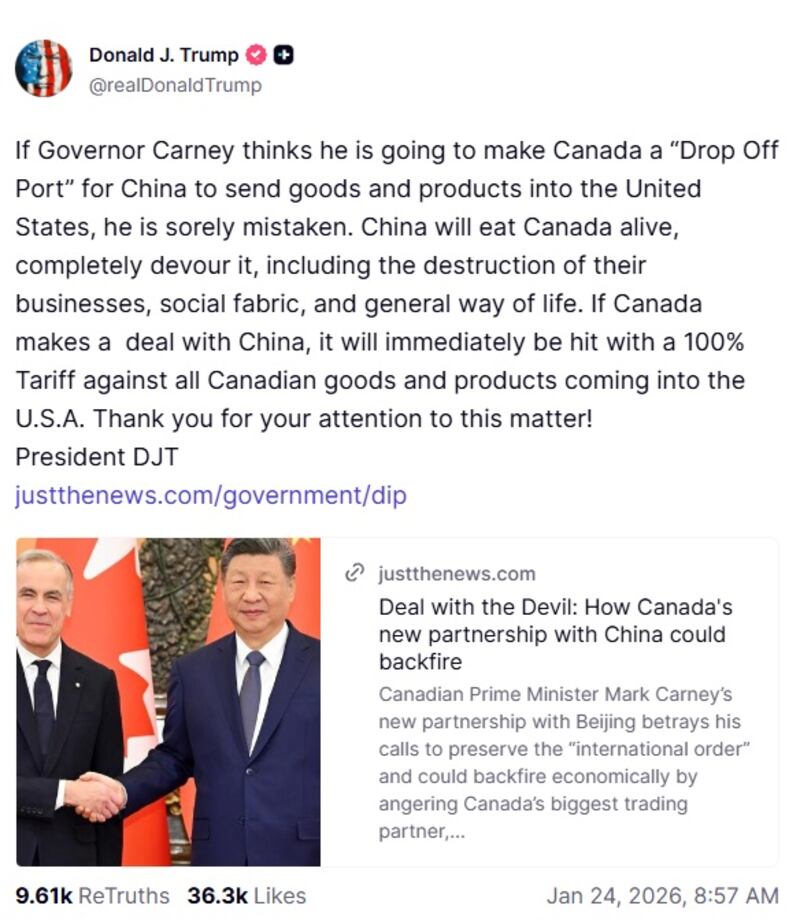
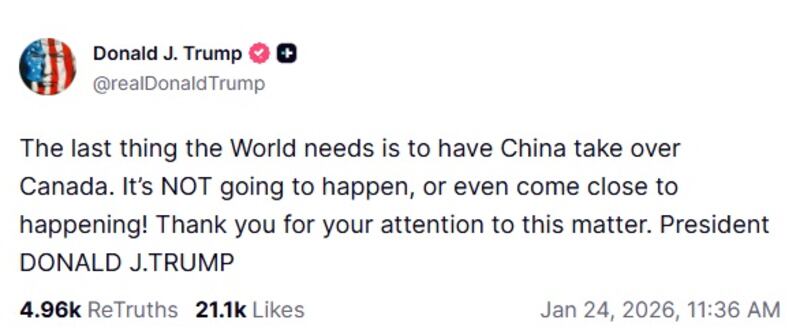
Trump posted on Truth Social Saturday that Canada could face a 100 per cent tariff on all Canadian goods entering the U.S. if Prime Minister Mark Carney “makes a deal with China.”
“I don’t think we should be surprised,” Julian Karaguesian, former special adviser on international policy analysis at Finance Canada, told CTV News Channel on Saturday.
“Volatility and creating uncertainty are Trump’s primary modus operandi. That’s how he operates. He tries to get you off foot and says one thing one day, and then changes his position the next day.”
Canada-China deal
Trump’s tariff threat comes after Carney reached a deal with Beijing on Jan. 16.
As part of the deal, up to 49,000 Chinese electric vehicles will be permitted into the Canadian market each year at a 6.1 percent tariff, down from the current 100 per cent rate.
In exchange, Canadian canola meal, lobsters, crabs and peas will no longer be subject to China’s “anti-discrimination” tariffs from March until at least the end of the year.
Canola oil will remain subject to a 100 per cent tariff.
Following the two countries’ agreement, Trump told reporters at the White House that “it’s OK. That’s what he should be doing.”
”However, on Saturday, Trump took to Truth Social to say that if Canada becomes a “drop-off port” for China to send goods into the U.S., “China will eat Canada alive, completely devour it, including the destruction of their businesses, social fabric and general way of life.”
Karaguesian said Carney needs to act with caution, adding that Canada is facing its biggest challenge to its prosperity.
“We have to be careful because China has an incredible amount of market power and leverage,” he said. “But currently, the country that we trade most with by far is the U.S.”
“We live off international trade, and we send 75 to 80 per cent of our exports there (...). Basically, we’re being forced into a corner.”
The impact
Dominic LeBlanc, Canada’s minister of internal trade, wrote on X that Canada and the U.S. have a longstanding economic and security partnership, adding the federal government remains committed to protecting that relationship.
Carney also posted on X Saturday to highlight the federal government’s “buy Canadian" policy, first introduced in December, urging Canadians to support domestic businesses.
However, Matthew Holmes, executive vice-president, international and chief public policy officer at the Canadian Chamber of Commerce, told CTV News Channel on Saturday that given the depth of the trade relationship between the two countries, the impact of tariffs would be significant.
“About 75 per cent of our exports go to the U.S., and we wouldn’t stop exporting. They would just be more expensive, and they would largely be more expensive for the American consumer and American businesses,” Holmes said.
“We have supply chains that rely on both parts of that border working and being porous and allowing the movement of people and goods to continue, and if that stops, or gets harder or more expensive, the costs will be borne on both sides of the border.”

