WASHINGTON -- U.S. and Mexican negotiators meet in Washington on Tuesday for a second round of talks focused on agriculture and energy in an effort to revamp the North American trade agreement, as U.S. President Donald Trump casts doubt on the future of a 32-year-old free trade zone that also includes Canada.
Agricultural groups are urging Trump to extend the Canada-United States-Mexico Agreement (CUSMA) on trade for another 16 years with duty-free farm products, strengthened provisions for genetically modified corn and ethanol access in Mexico and improved access to Canada’s largely closed dairy market.
The closed-door talks will take place on Tuesday and Wednesday following negotiations last month in Mexico City that revealed an expansive U.S. demand to require 50 per cent of North American motor vehicle content come specifically from the U.S., pushing up the regional threshold to 82 per cent.
Canada has so far been shut out of formal negotiations, although its trade minister, Dominic LeBlanc, continues to meet with U.S. Trade Representative Jamieson Greer.
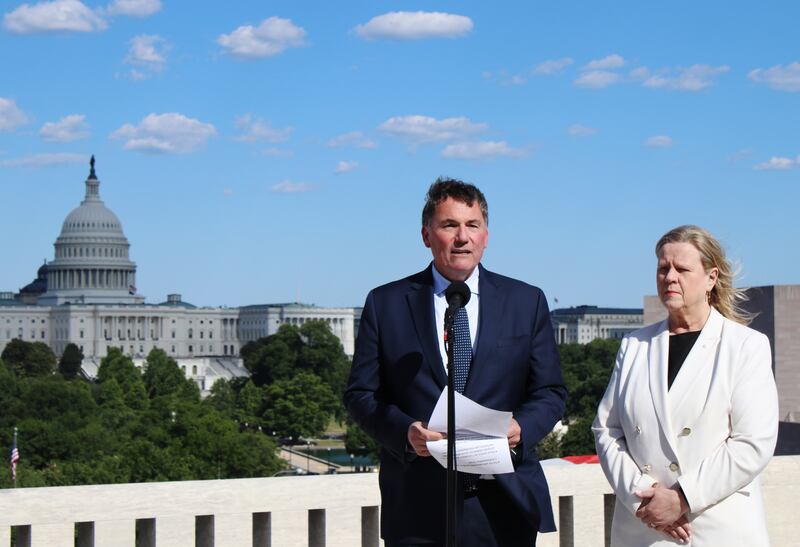
“I’m not looking to renew it,” Trump said of CUSMA last week. “We don’t need anything that Canada has. We don’t need anything that Mexico has, but they need everything that we have. They have to treat us better.”
It was unclear whether Trump’s remarks were a negotiating tactic aimed at extracting more concessions, but he has frequently expressed frustration with the trade pact that he signed in 2020 to replace the 1994 North American Free Trade Agreement - particularly in the face of persistent U.S. goods trade deficits with its two largest trading partners.
The three countries on July 1 need to decide whether to extend the pact as is or recommend changes, but revisions will not be negotiated in time for that deadline. Instead, July 1 is expected to start a clock for termination of CUSMA in 10 years, during which time negotiations would continue.
The U.S. and Mexico have scheduled a third round of talks in Mexico City for the week of July 20.
Kevin Brady, a former Texas congressman who once chaired the powerful U.S. House of Representatives Ways and Means Committee, said Greer has a difficult task extracting enough concessions to keep Trump interested in CUSMA while preserving as much of the duty-free structure that underpins the North American economy and nearly US$1.6 trillion in annual regional trade.
“It’s a bit of a Texas two-step,” said Brady, who is now lobbying on behalf of CUSMA at law firm Akin Gump. “You know, Ambassador Greer’s got to negotiate an agreement that’s in the U.S. interest all the way, and the second step is he’s got to convince the president to sign it.”
Trump has already modified the trade pact by imposing unilateral tariffs on Mexican and Canadian autos, steel and aluminum, and Greer has said that duties will remain, but perhaps at lower rates.
While Mexico and Canada could try to drag the negotiations out for years, trade experts say such a move could prompt Trump to invoke a separate termination clause allowing any member country to leave the pact six months after written notice.

‘Catastrophic’ for farmers
Canada and Mexico are now the top two agricultural markets for the U.S., accounting for more than $58.6 billion in farm exports in 2025, according to U.S. Department of Agriculture data. Those two countries make up more than a third of the global total of U.S. agricultural exports, as China slashed its purchases in response to Trump’s punitive tariffs.
“Failure to renew CUSMA would be catastrophic for U.S. agriculture,” Minnesota soybean farmer Jamie Beyer said in testimony last week to the House Agriculture Committee. “Entire industries, companies, farmers and families depend on this agreement. We hope appropriate improvements can be made, but the agreement’s long-term extension must never be in doubt.”
Beyer, an American Soybean Association executive committee member, said farm trade with Mexico and Canada has provided stability amid uncertainty surrounding other foreign markets, including China.
But the U.S. last year ran agricultural trade deficits of $13.2 billion with Mexico and $11.1 billion with Canada.
One way to bring the Mexico deficit down is to press Mexico to allow ethanol blending with gasoline in major cities, said Nancy Martinez, director of public policy, trade and biotechnology for the National Corn Growers Association. She said this move could boost annual U.S. ethanol exports to Mexico by $2 billion.
Mexican grip on energy
The U.S. and Mexico this week also will try to resolve a longtime disagreement over the Mexican government’s increased control over its energy sector to benefit state oil producer Pemex, despite committing in CUSMA to allow more U.S. oil investment.
“The government of Mexico has demonstrated that it is using the laborious, now years-long dispute process in CUSMA to advantage Pemex vis-a-vis private and foreign oil and natural gas investors,” the American Petroleum Institute said in public comments submitted to USTR on the trade deal.

The trade group representing a wide swath of the U.S. energy sector suggested that USTR insist on a “rapid response” mechanism for state-owned enterprise compliance, modeled after a CUSMA mechanism designed to ensure labor rights at manufacturing plants by denying trade deal benefits to individual companies.
A CUSMA trade dispute over genetically modified corn has produced better results for U.S. corn growers, prompting Mexico to repeal decrees banning the import of GMO corn for human and animal consumption, but Mexico continues to ban the local planting of biotech corn.
Martinez said the group would like to see a provision that clarifies that Mexico cannot use non-scientific reasons to regulate the trade of GMO corn, which accounts for some $5 billion in annual U.S. exports to Mexico.
(Reporting by David Lawder; Editing by Dan Burns and Paul Simao)

