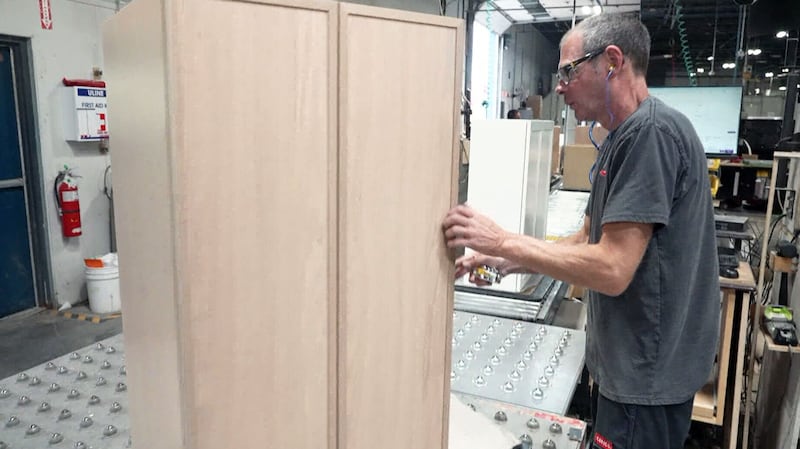
COATICOOK, Que. – Even though there are up to 15,000 moving parts on any given day at Alain Ouzilleau’s custom cabinet plant in Coaticook, Que., it’s only running at half capacity.
Ouzilleau spent $25 million to expand Cabico&Co’s operations over the last five years, with a new 50,000-sq. ft building and state-of-the-art robots. But instead of growth, the double hit of 25 per cent U.S. tariffs and a flood of foreign imports now has him breaking even.
He laid off about 200 of his 700-person workforce, which includes the company’s second plant in St. Catharines, Ont.
“It’s very frustrating and painful,” he said. “We love our people.”
U.S. President Donald Trump threatened to double those tariffs to 50 per cent in January, but delayed that move by a year. However, even at the 25 per cent level, Ouzilleau says Cabico&Co “cannot be profitable.”
“We’re breaking even, but we want to continue to invest. We want to continue to grow,” he told CTV News at the plant. “One of the options we’ll have to start looking at, to continue to protect our Canadian jobs, will be to look at having operations south of the border, which I would hate to do.”
Ouzilleau is a member of the Canadian Wood Products Alliance (CWPA), which represents the kitchen cabinet, hardwood flooring and wood furniture industries. They have been pushing the federal government for help, and Ouzilleau says the biggest “milestone” was securing the launch of a rare trade tool: a safeguard inquiry into foreign imports.
“It allows companies to impose tariffs in a time of emergency, when precisely like this, when there’s a flood of product coming into the market, and it allows countries to save their industries from a massive change in in trade flows,” explained William Pellerin, a partner with McMillian LLP who is representing the CWPA.
But the Canadian International Trade Tribunal (CITT) doesn’t have to report to Finance Minister Francois-Philippe Champagne with a decision until Jan. 15, 2027. In the meantime, the wood products industry is pushing for provisional tariffs of 100 per cent or more.
“This is an emergency measure,” Pellerin said. “It’s needed now, and we can’t wait until February, or the industry will be gutted.”
Pellerin explains the issue with foreign imports is also connected to tariffs. Other countries around the globe face high tariffs to sell to the U.S. and see Canada as an attractive alternative. He says that’s why the CWPA is calling for such a high tariff in the interim.
“When companies like Cabico are all of a sudden flooded and don’t know what to do, a safeguard is what they’re asking for to impose… a tariff for three years – no more, not renewable – just so that people can catch their breath, so that their business doesn’t die in the meantime, until companies can readjust,” he said.
The CWPA says 3,000 jobs have already been lost in Quebec alone, with another 7,000 at risk by 2028.
But the Retail Council of Canada (RCC) doesn’t support provisional tariffs, warning they will raise prices for Canadians. The group is acting as an intervenor during the CITT’s inquiry, which it describes as in the “early days.”
“We’re very much against any sort of pre-emptive action by the government,” Matt Poirier, vice-president of federal government relations for the RCC, told CTV News.
“If we have to pay a 100 per cent tariff or whatever percentage tariff on these goods, those costs will be passed on to the consumer because retailers, everyone in the supply chain, frankly, is stretched to the limit at the moment,” Poirier said. “So any new cost, in addition to all the inflation that we’re seeing, all the disruptions that we’re seeing, will need to be passed on.”
The Canadian Kitchen Cabinet Association (CKCA) says that concern focuses on the short term, while ignoring a longer-term risk if measures aren’t taken to protect the industry.
“If Canadian manufacturers continue to disappear, Canadians will ultimately have fewer domestic suppliers, less competition and fewer choices,” said CKCA president Luke Elias.
“We will become increasingly dependent on imported products and far more vulnerable to global supply chain disruptions, trade disputes, currency fluctuations and decisions made outside of Canada,” Elias said in an email to CTV News. “That is not a stronger marketplace for consumers. It is one with less resilience, less competition and, ultimately, higher prices.”
The federal government hasn’t responded to the request yet – nor has it ruled it out.
“The government is closely monitoring imports and continues to assess whether additional action is warranted while the CITT inquiry is ongoing,” John Fragos, a spokesperson for the finance minister, told CTV News in a statement.
“The government has been in constant partnership with the forestry and wood sector and, through consultation with stakeholders, introduced a myriad measures to better support the sector, understanding the vital role it plays in rural and remote communities across the country – and in propelling the economy ahead,” read part of the statement.
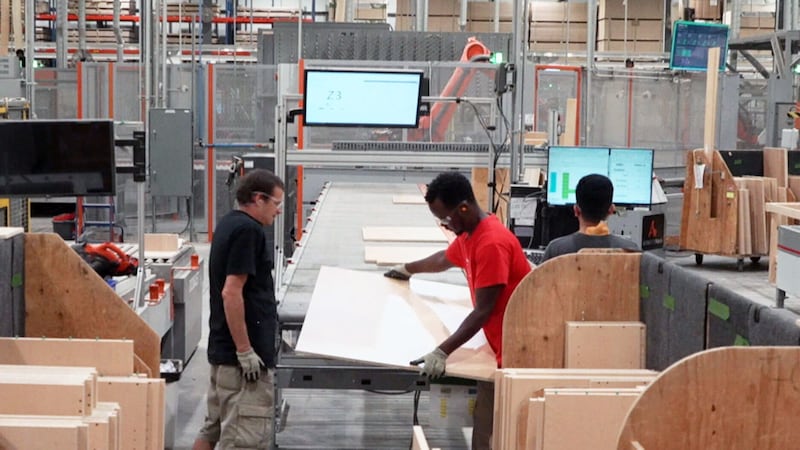
Ouzilleau took CTV News on a tour of the entire production in Coaticook, located in the Eastern Townships, 15 minutes from the Canada-U.S. border shared with Vermont.
With the plant only operating at half capacity, he showed us multiple machines sitting silent and an area used as storage, waiting for a fourth line complete with robot that was supposed to be up and running.
He says layoffs at his plant impact the broader supply chain, as well as the local economy.
“If we produce less cabinets, guess what? In the forest, they’re cutting less trees, and the sawmills don’t have as much work. It’s the whole supply chain that is suffering, down to the local restaurant in Coaticook.”

