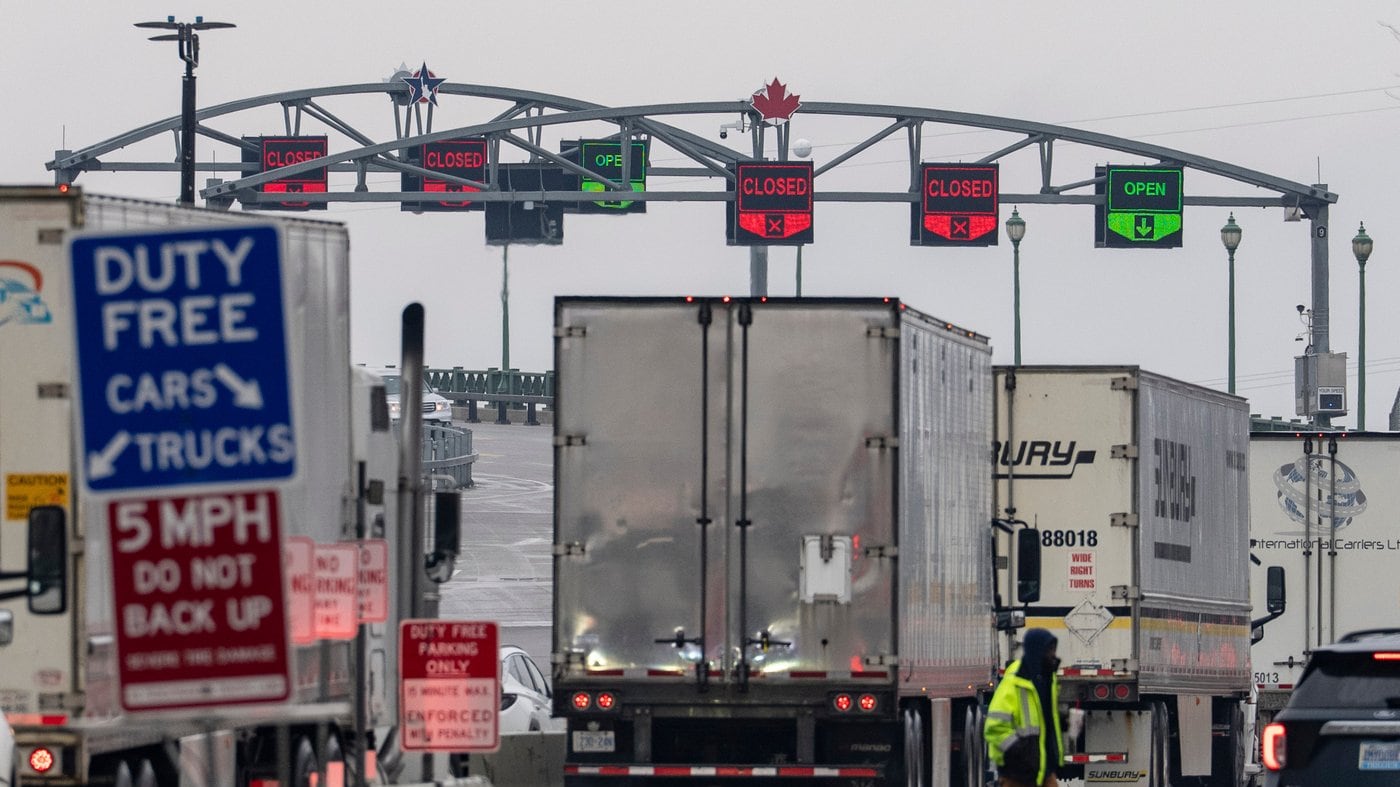
MONTREAL — Canadian shippers are adopting a wait-and-see approach to the latest round of tariff threats from Donald Trump, trade experts say, even as a fresh feeling of angst sweeps over the commercial landscape.
The U.S. president on Monday announced 50 per cent import duties that would take effect Aug. 19 on a raft of Canadian products ranging from dairy to dishware to down jackets.
However, manufacturers and exporters hardened by more than a year of on-again, off-again tariff battles are adopting a measured response to the latest salvo, said Lachlan Wolfers, national leader at KPMG Law.
“This is the storm before the calm,” he said.
“This is a repeat of what happened with the initial announcement back in February 2025 that preceded the Liberation Day tariffs.”
In that case, the White House threatened a series of duties on virtually all goods entering America from Canada and Mexico, paused the plan, then imposed the levies, then quickly moved to ensure they would not apply to products compliant with the Canada-U.S.-Mexico Agreement, which covers the vast majority of cross-border merchandise trade — all within six weeks.
“We’ve been on this roller-coaster now for a couple of years,” said Lisa McEwan, co-owner of customs brokerage firm Hemisphere Freight.
“At this point in time, people are just going to do the wait-and-see.”
In a matter of weeks, however, that cool reaction from shippers could shift into something more feverish.
“A little bit closer to the 30-day timeline, then I do expect a rush of products coming across the border, because the impact, if it hits, is 50 per cent” — with no CUSMA exemption — said Wolfers.
American officials said the new levies, rolled out under the 96-year-old U.S. Tariff Act — never before invoked by a president — are a response to provincial bans on U.S. alcohol, Canada’s supply-managed dairy system and quotas on American cars.
But observers argue the real goal is to ratchet up pressure in trade talks by targeting goods with high U.S. market concentration, even if the move appears to contravene the existing free trade pact that Trump himself signed in 2018.
“They fit President Trump’s signature style of leveraging the American market to force partners into making concessions,” said Desjardins managing director Royce Mendes in a note to clients.
“It’s a bit like the schoolyard bully that punches a kid and then says, ‘Mommy, mommy, he hit me back,’” added Michael McAdoo, a partner at consulting firm BCG’s global trade and investment group. “Well, you threw the first punch.”
Trump has threatened tariffs before in retaliation for alleged Canadian breaches over issues ranging from an electric vehicle deal with China to certification of U.S.-made jets to an Ontario government television ad south of the border showcasing former president Ronald Reagan’s anti-tariff stance. None of those threats came to pass.
Prime Minister Mark Carney said Tuesday he had spoken with Trump that morning and they agreed to intensify trade negotiations.
Despite the ticking of yet another tariff clock, time could be on Canada’s side, giving companies all the more reason to take an unhurried approach to the would-be levies.
“The fragility of the U.S. economy at the moment, the inflationary pressures, the political cycle coming into the midterm elections — you can see why time may in fact be Canada’s friend on this,” said McAdoo.
American businesses could be hit as hard as Canadian ones, since U.S. importers would either be paying the duties or forced to search elsewhere for suppliers.
More than two-thirds of the items listed in the president’s proclamation are sold between businesses, out of sight of retail buyers — an indication that U.S. officials may seek to mask the toll — said Wolfers.
“It suits the U.S. administration to ensure that these are not tariffs that will directly show up to U.S. consumers. It’s more going to be embedded in the supply chain costs,” he said.
Targeted industries where that would be especially true include electronics and electrical equipment, plastics and rubber products, and machinery and mechanical equipment. Canadian exports from those three sectors alone represent more than US$9 billion in annual trade, according to the U.S. Census Bureau.
Other hard-hit sectors such as furniture, apparel and jewelry are more customer-facing, but comparable items could be sourced locally or from other countries, McAdoo said.
The hit would be hard for certain Canadian industries, but relatively small for the economy as a whole.
Slightly more than five per cent of Canada’s exports to the U.S. would be subject to the proposed tariffs, according to Desjardins.
“They’re hardly broad-based. Moreover, the tariffs aren’t set to take effect for another 30 days, leaving ample time for de-escalation,” said Mendes.
“The new tariffs are exactly the type of escalation we expected to see during this phase of the trade negotiations — if anything, they’re somewhat less aggressive than feared.”
---
Christopher Reynolds, The Canadian Press
This report by The Canadian Press was first published July 22, 2026.