


CHARLOTTETOWN – Prime Minister Mark Carney says his four-hour meeting with Canada’s premiers on Thursday is an example of “the federation working as it should,” pointing to the leaders’ unity in the face of the latest tariff threat from U.S. President Donald Trump.
Telling reporters that “everything is on the table” when considering retaliation against the United States — if there’s no agreement before the new slate of tariffs come into effect next month — Carney also insisted Canada is responding.
“Let’s be clear about how Canada is responding,” he said. “Yes, we are intensifying our negotiations with the United States in pursuit of a comprehensive agreement that addresses all tariff-related sectors.”
The prime minister also referenced other topics around the table in his meeting with the premiers, including the federal electricity strategy and consensus on working toward an agreement-in-principle to remove internal trade barriers.
But, negotiations with Canada’s largest trading partner seemingly occupied the lion’s share of Thursday’s talks. Ahead of the meeting, Carney vowed to “do whatever it takes” to defend the country in Trump’s latest escalation of the trade war.
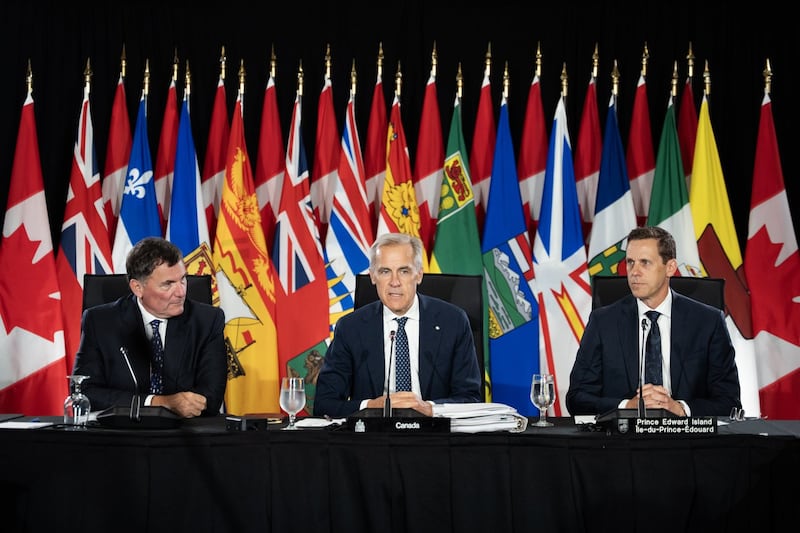
“As everyone knows, on Monday the U.S. administration announced its intention to impose the latest in a series of unilateral, unwarranted trade actions,” Carney said, speaking to the room of provincial and territorial leaders, and dozens of senior staff members from all levels of government.
“Canadian governments around this table will do whatever it takes to defend and support our families, our workers, and our business.”
Carney also said that in his estimation, Canada is “in a stronger position” now than when the trade war started 18 months ago, in large part thanks to the resolve of Canadians and the efforts from premiers to strengthen the domestic economy, alleviate interprovincial trade barriers, and find new trading partners internationally.
Before concluding his public comments and continuing the conversation behind closed doors, Carney drew a parallel to the predicament the Fathers of Confederation found themselves in 162 years ago when they gathered in the same city, facing the threat of American invasion due to limitations in trade and infrastructure.
“We face in some respects, many similar challenges ... but we have many more advantages,” Carney said, citing Canada’s diversity, prosperity, and focus. “And we have the lessons of history. And the core lesson of history is that when Team Canada is united, there is nothing that you can’t do.”
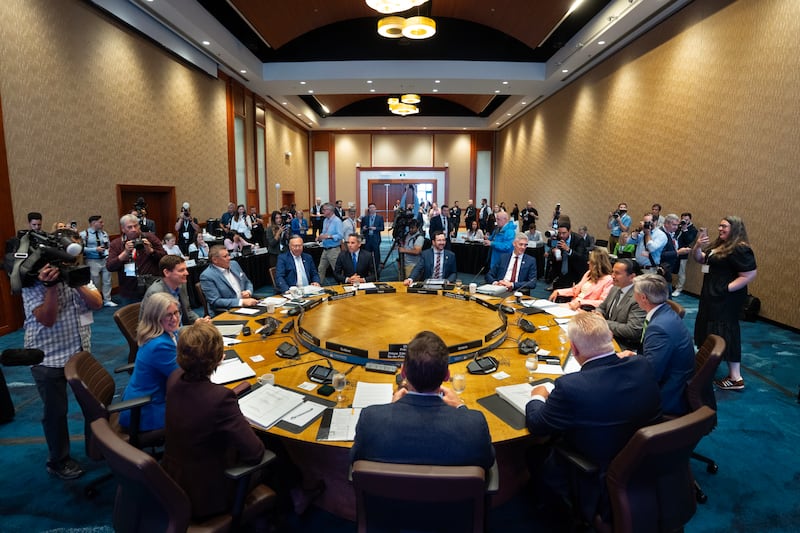
Premiers wanted to hear a plan
Ahead of the meeting, premiers made it clear they’re feeling a “new sense of urgency” and wanted to know Ottawa’s negotiation plan.
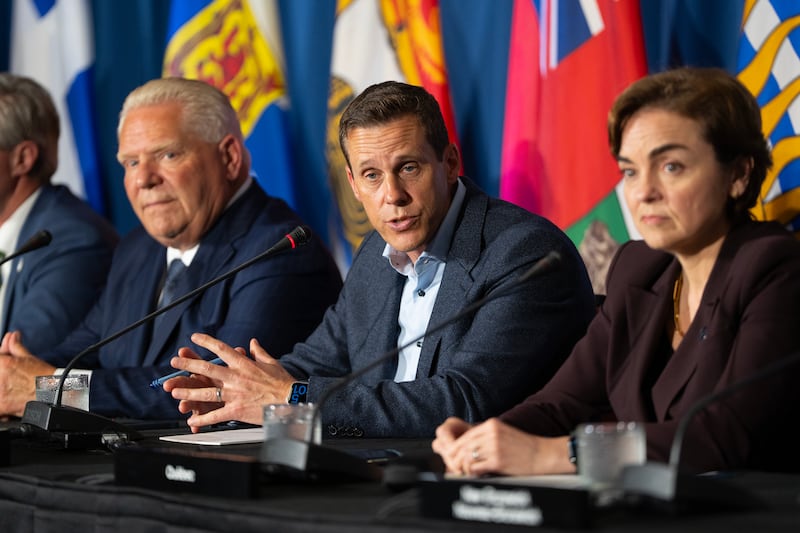
Speaking to reporters on Thursday morning, Ontario Premier Doug Ford said he hoped to hear a “strong” plan.
Asked what happens if that’s not what the prime minister comes to the table with, Ford said he isn’t expecting every ‘t’ to be crossed or ‘i’ dotted, but he does want to see a “Team Canada” approach.
“It’s very hard to deal with President Trump when he changes his mind every single day. One day, the prime minister is with him side-by-side, and the next thing you know President Trump turns on him like a rabid dog,” Ford said. “We just have to stay united. We’re a strong country. We’re a sovereign country, and we need to fight tooth and nail.”
Ford also said that while premiers have expressed a range of views on retaliation, that doesn’t mean they aren’t on the same page.
“We differ across the country, we have different needs.”
During Wednesday’s press conference wrapping up the premier-only portion of the annual gathering, Alberta Premier Danielle Smith said she thinks Canada has “a window” over the next month to “sharpen the pencil, to sharpen the focus.”
Saskatchewan Premier Scott Moe voiced similar optimism about reaching an agreement “in the near term,” given the layers upon layers of tariffs Trump has imposed or threatened on this country.
“This is an opportunity for us as Canadians and our bargaining team, or our negotiating team … to really intensify those negotiations in the effort to find some type of a reviewed and renewed CUSMA (Canada-United States-Mexico Agreement),” Moe said.
“I’m bullish, but I’m not entirely confident we’ll get there.”
Premiers want a comprehensive deal
Amid divisions over how strongly, or if, Canada should retaliate to Trump’s latest 50 per cent tariff salvo on a range of goods, premiers say they all agree that “a comprehensive deal that includes the full range of tariff-affected sectors, including softwood lumber, steel, aluminum, manufacturing and auto industries,” would be the best-case scenario.
“I’ll just speak for Ontario: everything’s on the table. We can’t keep rolling over for Donald Trump. So that’s what I believe in: standing up strong, negotiate through strength. You don’t negotiate through weakness, especially with President Trump.”
Premiers have expressed that not all provinces are being impacted as directly by the latest batch of proposed tariffs, while emphasizing how that shouldn’t alter every premiers’ resolve to continue presenting a united front.
“Although we’re 97 per cent tariff-free, we’d like to be 100 per cent. We’d like every other province to be at 100 per cent tariff-free as well,” Smith said.
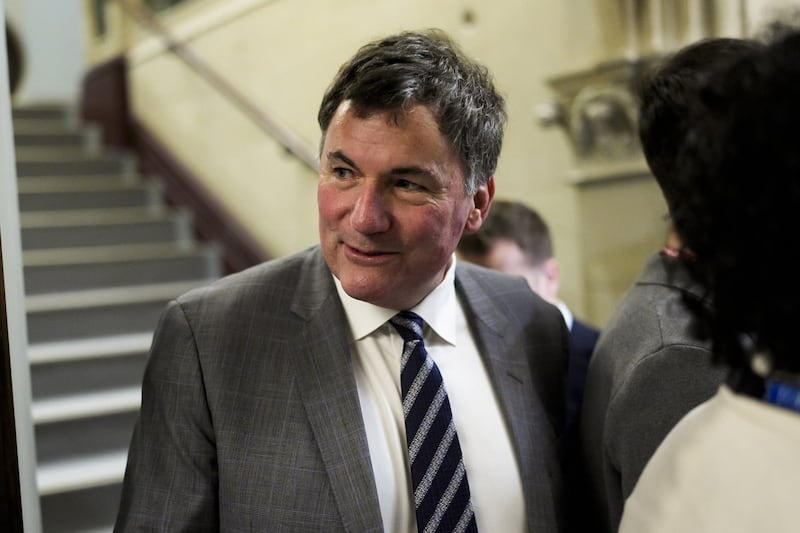
Lead negotiators in the room
Canada-U.S. Trade Minister Dominic LeBlanc and Canada’s Chief Trade Negotiator to the U.S. Janice Charette have joined Carney in Charlottetown on Thursday for the First Ministers’ Meeting. LeBlanc’s office confirmed to CTV News that the minister did last speak with U.S. Trade Representative Jamieson Greer on Tuesday, after Carney spoke to Trump about intensifying Canada-U.S. trade talks in the coming weeks.
“We look forward to further engagement on addressing outstanding issues with the U.S. to the mutual benefit of our citizens,” LeBlanc’s office said in an email.
There have been indications that Charette and Canada’s Ambassador to the U.S. Mark Wiseman have been looking at points of pressure for the Americans that could factor into any retaliatory response, despite Greer telling U.S. lawmakers that his understanding was that Canada wouldn’t be hitting back.
These could include targeting regions where the cost of living for Americans is particularly high, and where that could intersect with close congressional races coming up this fall.
Asked Thursday what he made of such a strategy, Ford said while he hasn’t heard anything directly, he’d be fully supportive if that’s the direction Carney goes. “I can tell you one thing, no matter if they’re Democrat or Republican, the ground is shifting down there,” the premier said. “People are getting anxious. They want certainty … and as long as he continues to fight with his No. 1 customer in the world, there’s not going to be stability.”
“It’s in everyone’s best interest in North America, the entirety of North America, for us to come to agreement on a reviewed and renewed CUSMA,” Moe said.
“All we can do is to make every effort, myself as a subnational leader, to support our federal government and support those that are sitting at that bargaining table with information from our respective jurisdictions.”
Demanding transparency in negotiations
In their joint communique issued at the conclusion of Wednesday’s Council of the Federation meeting, the leaders of Canada’s provinces and territories also implored the federal government “to maintain a clear, timely consultation process with provinces and territories during negotiations.”
P.E.I. Premier Rob Lantz, chair of this week’s annual gathering, told reporters that while premiers have focused their discussions amongst themselves around strengthening each provincial and territorial economy to make the country stronger, “there’s no doubt our conversation with the prime minister tomorrow will have a new level of urgency.”
“I expect we’ll hear his strategy about how to deal with this current situation with the U.S. … I hope we go aggressive and try to make real progress that we’ve been hoping for over the last 12 months,” Lantz told reporters Thursday morning before meeting Carney.
“Put everything on the table, let’s get this done.”
With files from CTV News’ Spencer Van Dyk

