


The Trump administration said Thursday it is hitting dozens of countries, including Canada, with duties citing forced labour in supply chains hours before its previous tariff tool was set to expire.
Canada, Mexico and the United Kingdom are among the countries getting hit with a 10 per cent tariff, while other nations are seeing a 12.5 per cent levy.
The new duties will not apply to goods compliant under the Canada-U.S.-Mexico Agreement on trade, known as CUSMA, so it is not expected to affect the tariff regime Canada has been under since February.
Canada is also being slammed by U.S. President Donald Trump’s separate tariffs on sectors like steel, aluminum, automobiles and cabinetry.
“President Trump recognizes that decades of moral suasion have not eradicated forced labour from global supply chains,” United States Trade Representative Jamieson Greer said in a news release.
“The United States has had a forced labour import ban for nearly a century, and rigorously enforces it; it’s well past time for our trading partners to do the same.”

The Trump administration launched trade investigations earlier this year through Section 301 of the Trade Act of 1974 after the U.S. Supreme Court in February struck down the tariff tool used for the “Liberation Day” and fentanyl-related duties.
To temporarily replace his tariffs, Trump used Section 122 of the Trade Act of 1974 for a 10 per cent global duty. That statute was set to expire Friday unless Congress voted to extend it — the same time the new 301 tariffs will now go into effect.
Experts have said the 301 investigations into forced labour in 60 countries were a more permanent and durable way to rebuild Trump’s tariff wall around the United States.
We Pay the Tariffs, a grassroots coalition of 1,200 American small businesses, said the real motivation behind the so-called “forced labour” tariffs is clear.
“You can’t address potential forced labor concerns in Côte d’Ivoire by slapping tariffs on Australian wine and Swiss cheese,” said executive director Dan Anthony in a news release. “Yet that is what we are supposed to believe from this Section 301 action.”
But the Trump administration has said the 301 investigations have already prompted some countries to make changes to end forced labour.
“I am encouraged by the trading partners who have moved quickly to adopt forced labour import prohibitions, and look forward to ensuring their effective enforcement,” Greer said.
In its justification for the tariffs, the U.S. trade office’s report said “Canada has failed to effectively enforce its forced labour import prohibition.”
Canada-U.S. Trade Minister Dominic LeBlanc said in a statement Thursday that the measure is part of a broader series of unilateral U.S. trade actions but “is not unexpected,” as the United States previously signalled its intention to replace existing baseline global tariffs.
“Notably, the new Section 301 tariffs include an exemption for USMCA-compliant goods, maintain existing exemptions for certain products, and will be applied at a 10 per cent tariff rate for Canada and a small number of countries, rather than the 12.5 per cent applied to the remaining countries,” he said.
LeBlanc said Canada shares the United States’ objective of ensuring goods produced with forced labour don’t enter its supply chains.
“That is why Canada has one of the world’s most robust frameworks to prevent and address forced labour, backed by strong legislative and enforcement measures. We continue to strengthen this framework, including through the introduction of new legislation to further enhance enforcement mechanisms last month,” he said.
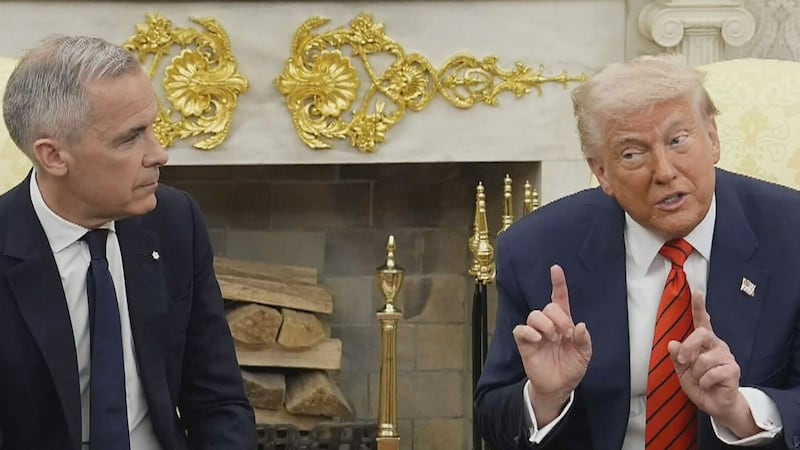
“We will continue engaging constructively with the United States on this matter, as well as other outstanding issues, over the coming weeks to the mutual benefit of our citizens.”
The Canadian government previously told the Trump administration that new legislation combating forced labour in supply chains should shield Canada from the new tariffs.
Canada already had legislation intended to curb forced labour in supply chains, which requires annual reports to the federal government. But the federal government tabled a bill last month to boost enforcement.
Bill C-35 would create a public list of products that have been linked to forced labour in specific regions, based on intelligence from embassies and other authorities. It would require importers to prove that specific products from listed regions were not made through slavery.
“In light of Canada’s existing prohibition, complementary supply chain transparency measures, newly introduced stand-alone forced labour import legislation and continued commitment to Canada-U.S. co-operation, Canada respectfully submits that there is no basis for the imposition of additional Section 301 duties on Canadian goods,” the federal government said in a written submission to Greer’s office earlier this month.
The timing of the announcement is “somewhat suspect” as previous rounds of tariffs sunset, said Matthew Holmes, executive vice-president and chief of public policy at the Canadian Chamber of Commerce.
“Canada is a leader on this with a formal prohibition on the importation of goods produced with forced labour, more legislation coming to strengthen this regime, and businesses investing significantly in compliance, due diligence and supply chain transparency,” he said in a news release.
“If the intent is truly to address forced labour, the focus should be a co-ordinated approach through a multilateral mechanism.”
Trump on Monday also signed orders to impose 50 per cent tariffs next month on a range of Canadian exports, including honey, liquor and hockey sticks.
The Trump administration said the measure is a response to provincial bans on U.S. liquor, Canada’s supply-managed dairy system and quotas on certain U.S. vehicles.
This report by The Canadian Press was first published July 23, 2026.
Kelly Geraldine Malone, The Canadian Press
With files from Catherine Morrison, Kyle Duggan and Sarah Ritchie in Ottawa and The Associated Press

