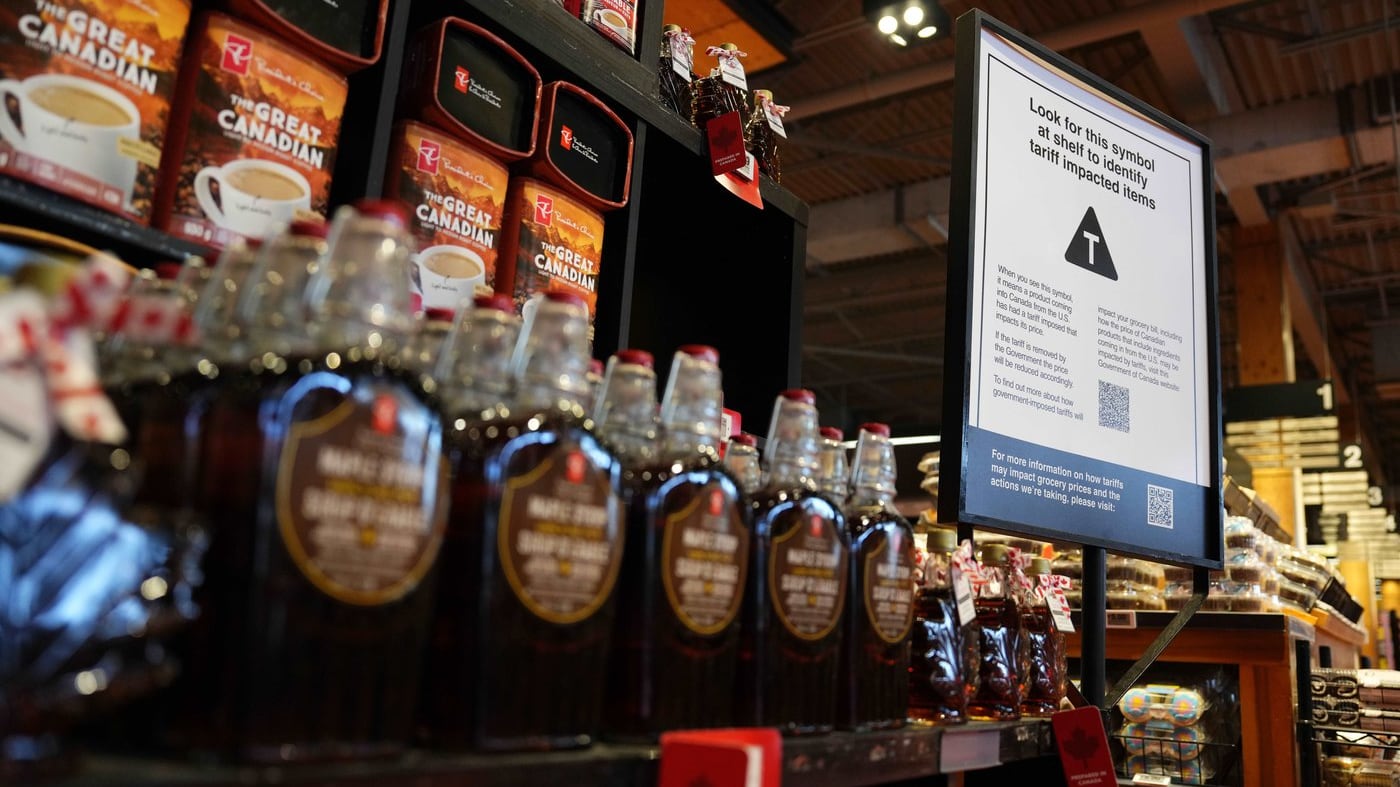
Canadian grocers are adding more signage to highlight homegrown products as trade tensions escalate between Canada and the United States.
Loblaw says it is bringing back the T symbols to its grocery shelf labels to signal products that have seen price increases due to tariffs, replicating its response from last year when the tariff war first began.
Customers will start noticing the T symbols on a small number of products, which will grow as tariffs are applied across more categories, Loblaw chief executive Per Bank wrote in a LinkedIn post on Tuesday.
“And one commitment is especially important: Loblaw will not benefit from tariffs,” he said.
“Where tariffs increase our cost, any resulting increase on our shelves will reflect that impact — penny for penny.”
The grocer will continue to use the maple leaf symbol in its stores for homegrown products and reintroduce country-of-origin labels in its fresh produce aisles.
Meanwhile, Sobeys parent company Empire Co. is planning to ramp up its store signs to highlight Canadian products, spokesperson Karen White-Boswell said in an emailed response on Wednesday.
“Customers can expect to see even more elements featuring local products prominently alongside provincial flags so that customers (can) identify items locally grown or made in Canada,” she said.
Metro said it already gives priority to Canadian products and will continue to emphasize them in store and online, given the current geopolitical context.
It comes as U.S. President Donald Trump imposed 50 per cent tariffs on about $28 billion worth of Canadian products over the weekend after trade talks collapsed. The charges affect goods ranging from honey to toiletries.
Ottawa responded with dollar-for-dollar tariffs on a range of items on Tuesday, which will take effect on Sept. 8.
The flare up in trade tensions has led to a renewed wave in buy Canadian sentiment among shoppers.
This time around, though, grocers are in a better position to respond to the renewed heightened demand for non-American products, with an already robust list of local suppliers on their roster.
“At Loblaw, we are in a stronger position than we were the last time tariffs were introduced,” Bank said in his social media post.
Henry Chambers agrees it will be easier for the grocers to revert to showcasing Canadian products this time.
“Anything you do a second time round, you learn from your mistakes you did the first time — and also you bring the efficiency and speed,” Chambers, senior vice-president of Canada and the Americas at consulting firm Sentinel, said in an interview.
“The retailers will have that information (on sources of products), they’ll be able to put that up quickly,” he said.
Consumers, meanwhile, are also more savvy in telling apart Canadian items from non-Canadian products, Chambers said.
But grocers will likely give it two to three weeks to see if consumers stick with the buy Canadian sentiment before they bring more changes to their supply chain, he added.
The buy Canadian wave first surged last year as Trump’s attacks on trade with Canada and the world led to a litany of economic uncertainty, tariffs and other threats. Back then, Canada had responded with its own counter levies, including on symbolic food items, such as Florida orange juice.
But the movement later faded as high food costs took a toll on households.
Last November, Bank told analysts that some customers were starting to return to buying products that were cheaper after tariffs were dropped, and that was going to affect sales of Canadian products.
Metro also indicated the movement was decelerating halfway through 2025.
Amar Singh, senior director and head of Canadian retail insights at Kantar, said consumers, especially more affluent shoppers, will once again flock to Canadian products, but that may not be the case for lower-income households.
Singh said the surge in demand for Canadian items is going to be a blip in the short-term.
“Many Canadians, if not most Canadians, want to support Canadian items. They want to buy local, but their wallet does not support their sentiments,” he said.
“There’s a dichotomy right now where you want to do something, but we can’t really afford it,” Singh said.
“That story is going to play out because Canadians are so struggling with housing affordability, high inflation, and everything in the grocery aisles.”
---
Ritika Dubey, The Canadian Press
This report by The Canadian Press was first published Aug. 26, 2026.

