
Investors do not like uncertainty and the stock market tends to perform poorly when uncertainty is high and increasing. Uncertainty is just around the corner, as the U.S. midterm elections take place on Tuesday, Nov. 3, 2026.
Currently, the Republicans hold majority control, with a narrow margin, in both the U.S. Senate and the U.S. House of Representatives. If the Democrats were to gain control of either house of Congress, this could be problematic for Trump and the Republican Party. The Republicans would have a lot of difficulty creating and passing legislation. In addition, it is possible to see increased talk of trying to impeach Trump if the Democrats were able to achieve a majority in both houses.
Uncertainty surrounding government policies is a headwind for the S&P 500 and other North American stock markets to move higher. In U.S. presidential elections and midterm elections, the average price pattern for the S&P 500 is for the stock market to decline in September and bottom sometime in late September or early October. Why?
The markets tend to bottom approximately a month before the election date, as investors at this point have already priced in the uncertainty effect around the midterm elections. In midterm election years from 1974 to 2022, the S&P 500 has been positive 38 per cent of the time in September and 77 per cent of the time in October, according to Bloomberg.
The graph below shows the average midterm election year. Every year is different, but the average clearly shows a negative trend in September and a positive trend in October heading into the midterm elections. The trend after the elections tends to be slightly positive.
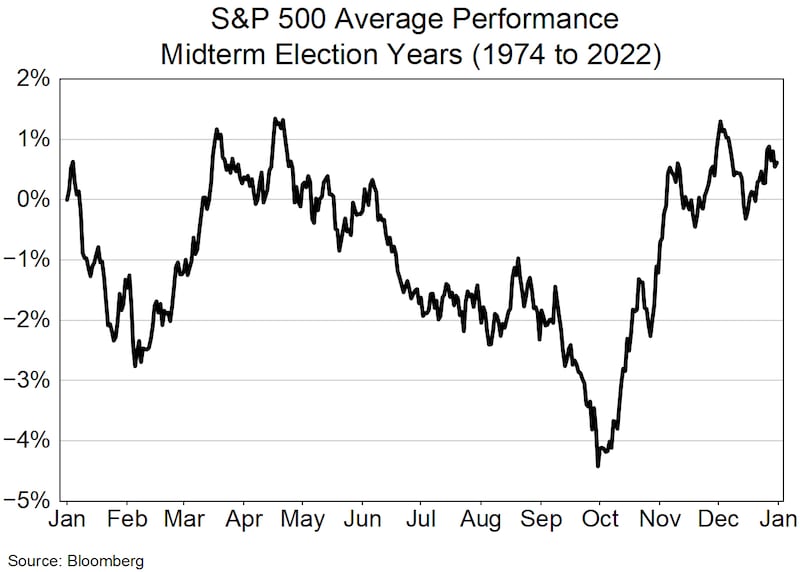
The good news is that on average the stock market’s negative trend in September, in midterm election years, can provide an entry opportunity into the markets.
Many investors might be saying that if the Democrats win both houses, then the economy could suffer a setback. Other investors may see this as a positive, as political gridlock could mean less government involvement, which could be better for the economy. Investors would be wise not to get caught up in how they think the outcome should align to their personal preference. In the end, the market may not see it their way.
Will we follow the same average trend this year of a negative September and positive October? Not necessarily. So far in 2026, the S&P 500 has produced a strong gain, which is not typical of midterm election years. It is always difficult to forecast the future around political events and how the stock market might react to certain outcomes of an election. When Trump was running for president in 2016, many investors expected the stock market to correct sharply if Trump won the election. It didn’t, it rallied sharply.
There are a lot of other major factors driving the markets that have overwhelmed concerns about upcoming midterm elections. Now that we have entered into the month of September, investors should expect more discussion in the media of the upcoming midterms and increased uncertainty in the markets. Any downdraft in the S&P 500 in September could lead to a buying opportunity at the end of the month or early October.
The views and opinions expressed herein are solely those of the author(s) and may not necessarily reflect the views of Global X Investments Canada Inc. All comments, opinions and views expressed are generally based on information available as of the date of publication and should not be considered advice to purchase or sell any securities mentioned. Before making any investment decision, please consult your investment advisor or advisors.

