The Canadian economy has had an anchor on it for the better part of a decade. A big part of that anchor was due to policy decisions at the federal level. That trend appears to be changing.
Our chart today highlights the Canadian dollar (top) and two major drivers of Canada’s current (trade in crude oil) and capital accounts (trade in debt securities).
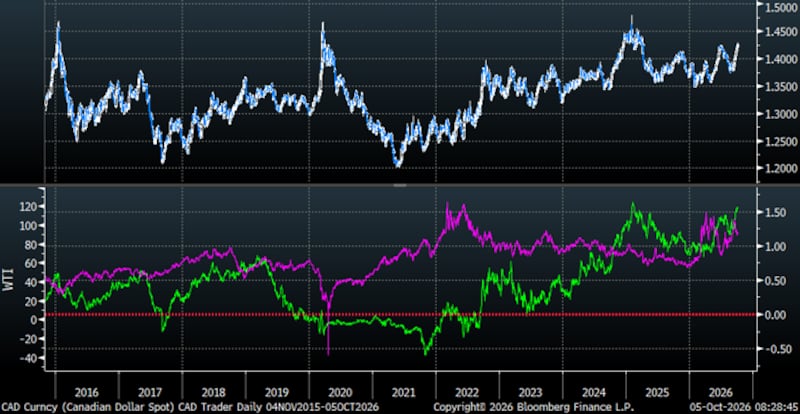
Historically, crude oil (pink line) was a major driver of the trade balance in Canada. While Canada holds a trade surplus with the U.S., we have a deficit excluding crude.
There has been a lower correlation in recent years on crude oil and an increasing correlation on interest rate differential. When international investors generally want a higher yield, they look to countries that have better total return possibilities. That seems to be improving.
For most of the past decade, Canadian interest rates have been below U.S. rates when looking at the two-year maturity (green line). For the prior decades post coming off the gold standard in the early 1970s, Canada needed to offer higher yields than in the U.S. to attract capital. We have needed lower rates here due largely to a weaker structure and support for our economy.
There are several known unknowns for the Canadian economy in front of us that are negatively impacting the Canadian dollar.
Separatist movements in Quebec and, now, Alberta that have little chance of passing, but have enough support to offer some pause to foreign investment. The uncertainty of trade (less free than it used to be) with what will always be our biggest trade partner, the United States, due to proximity, is also a current negative on sentiment.
All this has combined to push the Canadian dollar to undervalued levels. Most of these issues will linger, but there should be more clarity on all fronts in the months to come. This opens an opportunity.
As Canadians, we already own the Canadian dollar, so, for most, there is no action to take. But for your investment portfolios outside Canada, it’s time to consider hedging currency exposure.
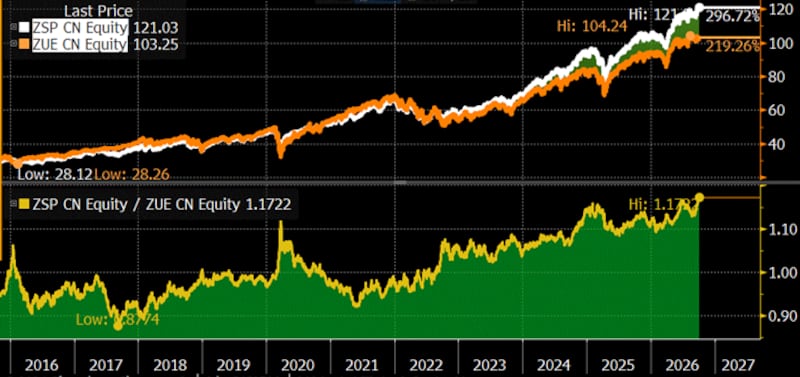
A simple example is the difference between owning the S&P 500 with ZSP or ZUE (hedged). The weakness in the Canadian dollar has added to returns of ZSP (unhedged) compared to the hedged version. There are a few factors. The cost of hedging right now is about 140 bps per year (this changes as rate expectation change).
If the Canadian dollar is more than 1.4 per cent stronger than the U.S. dollar in one year, the hedge version will outperform the unhedged version. This is a great idea in retirement portfolios that do not have tax consequences to trading. We think the fair value for the Canadian dollar is much closer to 80 cents than 70 cents (where it is today).
There are scenarios where it keeps weakening, to be sure, those are tied largely to no trade deal or an actual separation, which seem remote. For international investors, with better policy intentions at the federal level, Canada could start to look good compared to our U.S. “friends” that seem to be all about them.