
Q3 earnings season unofficially kicked off this week with the release of the U.S. bank earnings. The bank earnings were a mixed picture and did not provide a catalyst for the S&P 500 to move higher.
What should investors expect for the rest of the earnings season?
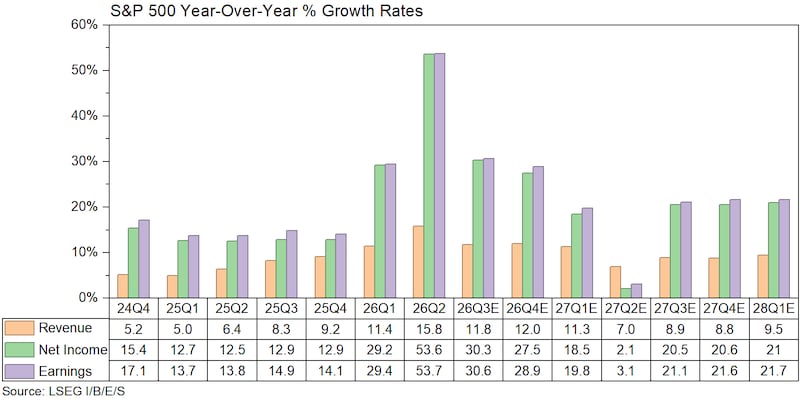
The Q2 earnings season was spectacular, with earnings growth coming in at 53.7 per cent, and revenue growth at 15.8 per cent (LSEG I/B/E/S).
These results were well above the historical average. What happened?
To start with, the earnings growth is a year-over-year comparison. The Q2 results in 2025 were fairly tepid, creating a base effect that helped to boost the results in Q2 of 2026.
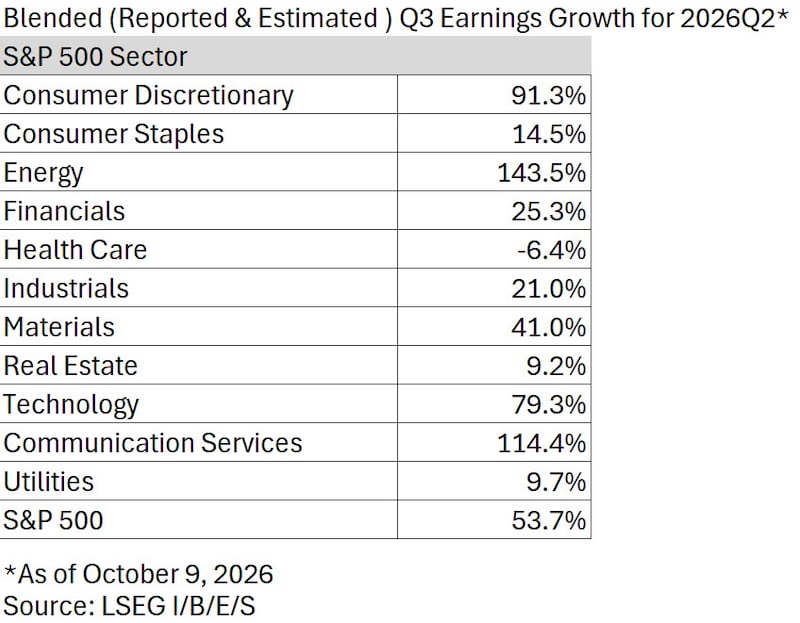
The biggest factor driving the Q2 earnings growth was the mandatory reporting of unrealized gains by some of the large technology companies that had invested in other technology companies.
According to GAAP, these gains have to be declared as other income. Some of these gains were huge. The technology sector and in particular the AI sector companies generally had large rallies. The communication services sector, which includes companies such as Meta and Alphabet, also showed strong earnings growth for similar reasons.
The Q2 very strong earnings results were probably a one-time phenomenon and is not expected to be repeated.
In Q3, earnings growth is expected to decrease to 30.6 per cent and revenue growth to 11.8 per cent (LSEG I/B/E/S). These results are still very strong compared with historical norms.
The trend over the following quarters, heading into Q2 of 2027 is expected to continue to see earnings growth head lower. In Q2 of 2027, it is expected to be the lowest level of earnings growth on a year-over-year basis over the next two years. The low growth in Q2 of 2027 is the result of the base effect working in reverse.
If the earnings results for Q3 come in below expectations, this could be very problematic for the stock market, even if the earnings expectations are stronger than historic norms.
In the current earnings period, investors will be hyper focused on the large technology company earnings and in particular the Magnificent 7 (Mag 7) companies, which are expected to report in the near future:
- Tesla (TSLA): Oct. 21, 2026
- Alphabet / Google (GOOGL) Oct. 28, 2026
- Meta Platforms (META) Oct. 28, 2026
- Microsoft (MSFT) Oct. 28, 2026
- Amazon (AMZN) Oct. 29, 2026
- Apple (AAPL) Nov. 2, 2026
- NVIDIA (NVDA) Nov. 18, 2026 (estimated)
The earnings expectations for the technology sector are expected to grow at 66.5 per cent on a year-over-year basis in Q3. The communications services sector is expected to have earnings growth of 47.8 per cent.
The market has priced in the high growth rates of the last quarter. It can also be said that the market has probably substantially priced in the lower growth rates of this quarter.
Nevertheless, investors could be disappointed with stronger than historical growth rates for both revenue and earnings by the fact that they could be substantially less than the Q2 earnings.
The Mag 7 earnings results are probably going to be an inflection point in the market. If the earnings results are stronger than expected, this could be a springboard for a renewal of a market rally. If the Mag 7 results fall short of expectations it is likely that the stock market will stumble. If the market stumbles, a lot of investors will be calling for market rotation into other sectors of the market.
Although this is a possibility, investor sentiment would probably sour and provide a strong headwind for the stock market to advance in the short term. The last week of October is going to be a very important week for the stock market, just before the U.S. mid-term elections.
The views and opinions expressed herein are solely those of the author(s) and may not necessarily reflect the views of Global X Investments Canada Inc. All comments, opinions and views expressed are generally based on information available as of the date of publication and should not be considered advice to purchase or sell any securities mentioned. Before making any investment decision, please consult your investment advisor or advisors.