
The U.S. dollar has been rocketing higher and acting as a wrecking ball for markets around the world, particularly the commodity markets and commodity equities.
The graph below shows the U.S. dollar rising relative to world currencies using the U.S. Dollar Index (DXY). The bottom panel shows how the U.S. dollar has performed on a normalized basis relative to the Euro, Canadian dollar and Japanese Yen.
The U.S. dollar has been rising relative to most currencies with the outperformance starting in early 2026.
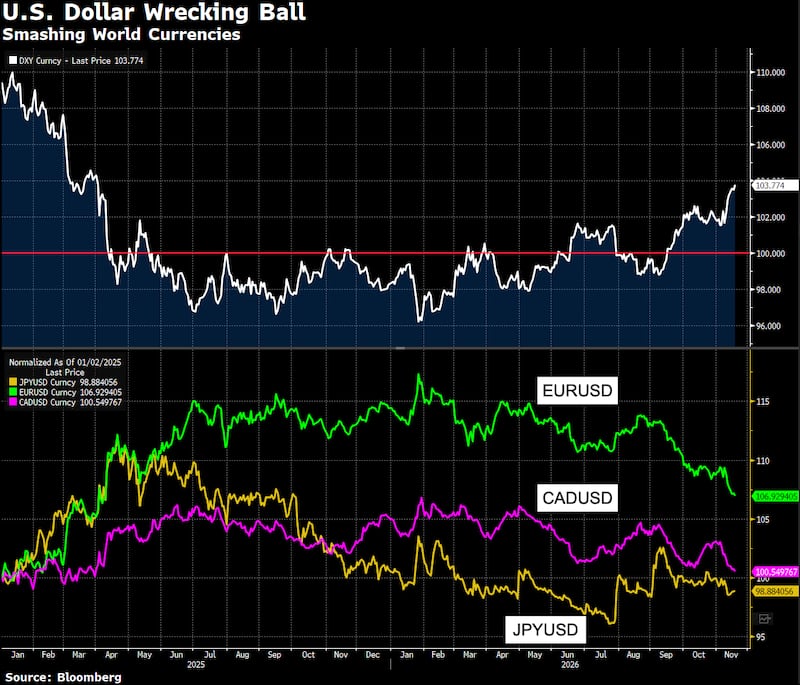
The U.S. dollar is moving higher for a number of reasons, including a strong U.S. economy, tighter global monetary conditions, a move to risk-off conditions in the markets and rising interest rates.
When U.S. interest rates are rising, it incentivizes governments and institutions to increase their demand for U.S. dollars to make higher interest payments and to pay down their loans.
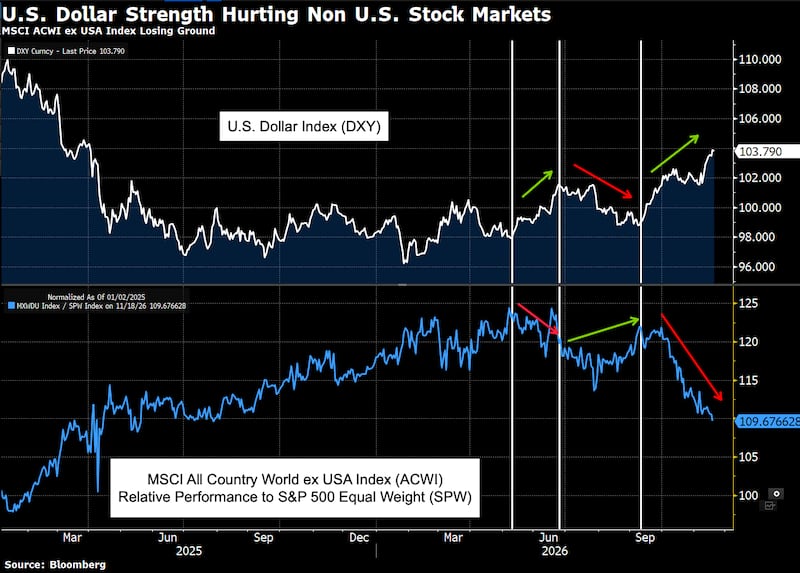
There are many variables that affect the relative valuations between the U.S. stock market and foreign stock markets. The U.S. dollar has a major impact. In general, when the U.S. dollar is rising, the U.S. stock market tends to outperform and vice versa.
The graph below shows the relationship between the U.S. stock market using the equal weight S&P 500 Index (SPW) and the MSCI All Country World ex USA Index (ACWI).
The equal weight S&P 500 is used to somewhat abate the dominance of the large cap technology stocks skewing the analysis.
Earlier this year in May and June, the U.S dollar rose rapidly (green arrow) and as a result, foreign stock markets underperformed (red arrow). From July to September, the inverse happened.
From September to present, the U.S. dollar has been rising rapidly and as a result, foreign stocks have dramatically underperformed.
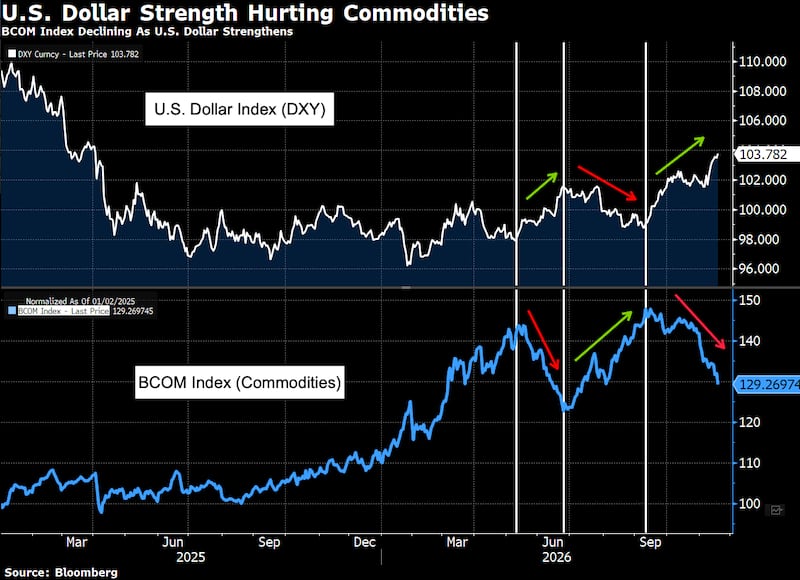
The rising U.S. dollar has been hurting the performance of commodities.
The graph below shows the BCOM Index (commodities) behaving inversely to the strength of the U.S. dollar.
This makes sense because commodities trade in U.S. dollars.
As a result, with a rising U.S. dollar we have seen downward pressure on many commodities, including gold, copper, steel, uranium and others.
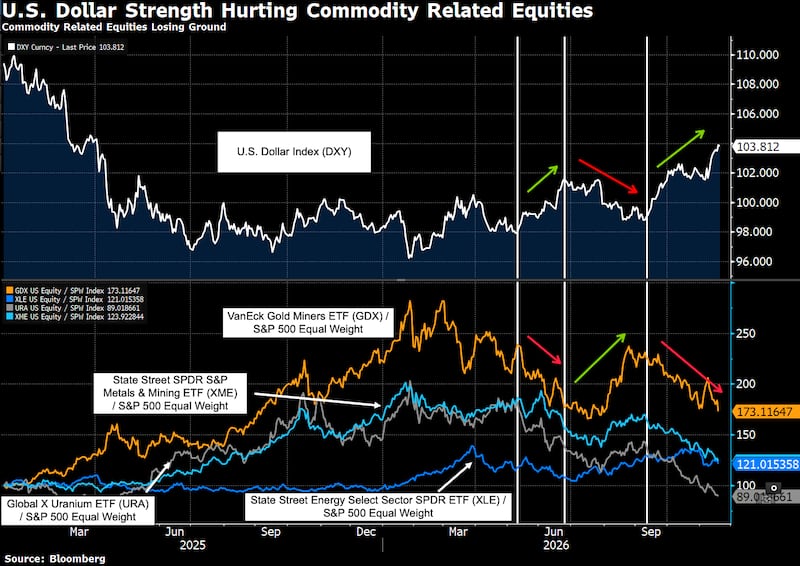
Commodity equities (companies that derive most of their revenue from the mining or production of raw commodities) are typically a leverage investment on underlying commodities that they mine or produce.
As commodities have declined in price, commodity equities have also declined, but at a greater magnitude. The graph below shows the relationship of a rising U.S. dollar having an inverse relationship with commodity equities.
More recently, since September, the rapidly rising U.S. dollar has occurred in an environment of a weak stock market.
This has added substantial negative pressure on commodity equities.
The U.S dollar has been acting as a wrecking ball, putting downward pressure on other currencies, foreign stock markets, commodities and commodity equities.
Can the U.S. dollar continue to move higher? Yes. If interest rates around the world continue to move higher and liquidity continues to tighten, this is fertile ground for a strong U.S. dollar.
Currently, the U.S. Federal Reserve is expected to raise its federal funds rate by 25 basis points on Dec. 9. This is helping to support a strong U.S. dollar; however, if economic numbers start to weaken, expectations of further hikes could decline, which would help to put downward pressure on the U.S. dollar.
Investors would be wise to follow what is happening to the U.S. dollar, due to its large impact on many investments.
The views and opinions expressed herein are solely those of the author(s) and may not necessarily reflect the views of Global X Investments Canada Inc. All comments, opinions and views expressed are generally based on information available as of the date of publication and should not be considered advice to purchase or sell any securities mentioned. Before making any investment decision, please consult your investment advisor or advisors.

