When a market gets tactically oversold, a counter trend rally is inevitable. We obviously are seeing that today with Jensen being reinstated at Nvidia and Korea, Taiwan and China intervening in markets to curb short selling.
When evaluating markets from a technical perspective, oversold conditions are somewhat easier to trade than identifying market tops. The basis for this is the understanding that people do not get anxious when making money, but they do when losing money.
This is the basis of the Nobel Prize winning Loss Aversion Theory (Kahneman, Tversky 2002).
Investors tend to dislike losses twice as much as they like the same dollar value of a gain. This behaviour explains the skew we tend to see in how fast markets decline versus rally.
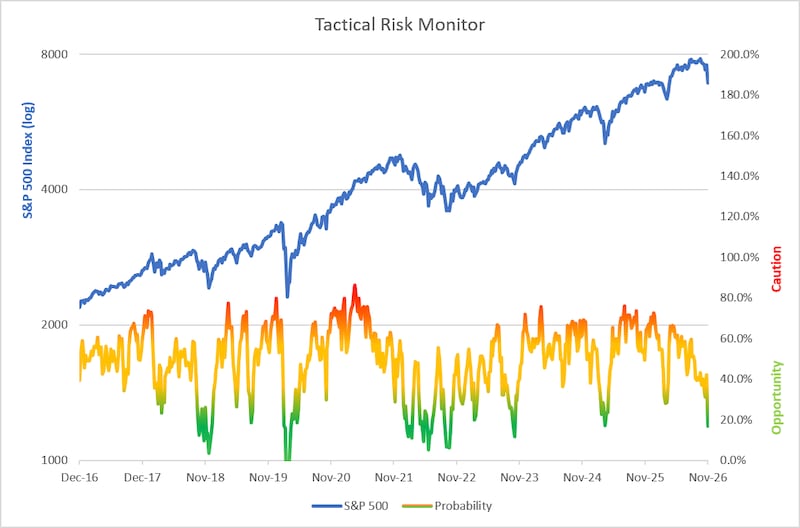
Last week, most of our 12 tactical factors were statistically oversold. Several breadth measures, volatility measures, and sentiment measures.
The only positives were generally seasonal patterns.
This combination suggests the bounce can get to the area of the old lows.
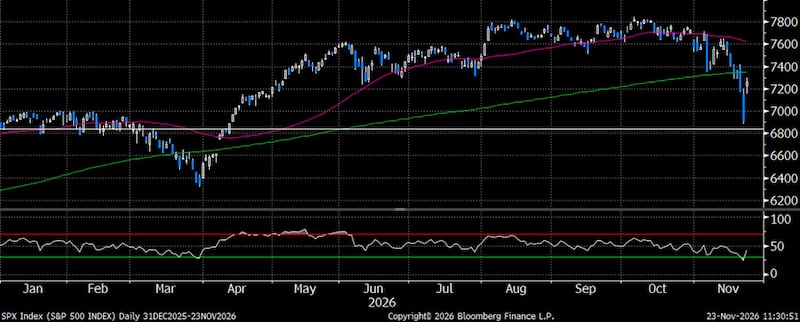
For most of the past six months, the S&P 500 found support around 7300 where the 200-day average is sitting.
For this bounce to be the beginning of a new rally leg, we need to hold above the 200-day average for more than a few days.
For now, we think this is an oversold bounce. We probably need another quarter of earnings to convince investors this is not the peak artificial intelligence (AI) period that many were concerned about.
We are bullish on AI for the long-term, but the magnitude of the volatility swings suggests that more time is needed to work off some of the froth that built up.
The good news is that the equal weight S&P 500 was still up about 10 per cent on the year at Friday’s close, so it’s clearly not a broad based sell off that would be the case if investors were worried about a recession.
Follow Larry
YouTube: LarryBermanOfficial
LinkedIn: LarryBerman