Oil shipments through the Strait of Hormuz picked up on Friday after the United States and Iran signed a ceasefire deal, with Gulf producers preparing to raise exports despite concerns over conditions set by Tehran for using the vital waterway.
Washington and Tehran released the text of an interim agreement signed on Wednesday to end the conflict, although U.S. President Donald Trump warned he could resume attacks and target Iranian officials if commitments are not honored.
At least four tankers carrying crude, oil products and liquefied petroleum gas entered the strait on Friday, heading for Iraqi Gulf ports, according to MarineTraffic data.
A Japanese-owned crude tanker exited the strait after being delayed by the war and was bound for Japan.
Separately, Indian-flagged crude supertankers Desh Vibhor and Desh Vaibhav had commenced voyages through the strait to India after days of disruption.
VESSELS SWITCH ON SIGNALS AS TRAFFIC RETURNS
Ships resumed broadcasting positions as they transited Hormuz, after weeks of concealing movements by switching off transponders.
There were 25 commercial crossings through Hormuz on June 18 - the highest single-day count since April 18 and more than five times the average daily level of the first 10 days of June, AXS Marine data showed. Traffic remains well below the pre-conflict level of about 120 daily crossings.
Gulf oil producers were already active with tenders.
Kuwait Petroleum Corp is offering crude for July delivery via a tender, a document showed on Friday, after lifting force majeure and announcing plans to ramp up output, while Abu Dhabi National Oil Company issued its fourth tender this month.
The U.S. formally lifted its blockade of Iranian ports on Thursday.
“Mariners should be advised of the existence of mines and expect naval presence as clearance operations continue,” the U.S. navy-led Joint Maritime Information Center said late on Thursday.
It advised vessels to avoid the Traffic Separation Scheme because of mine risks.
The scheme, adopted by the United Nations’ shipping agency in 1968, established routing lanes through Iranian and Omani waters in the strait.
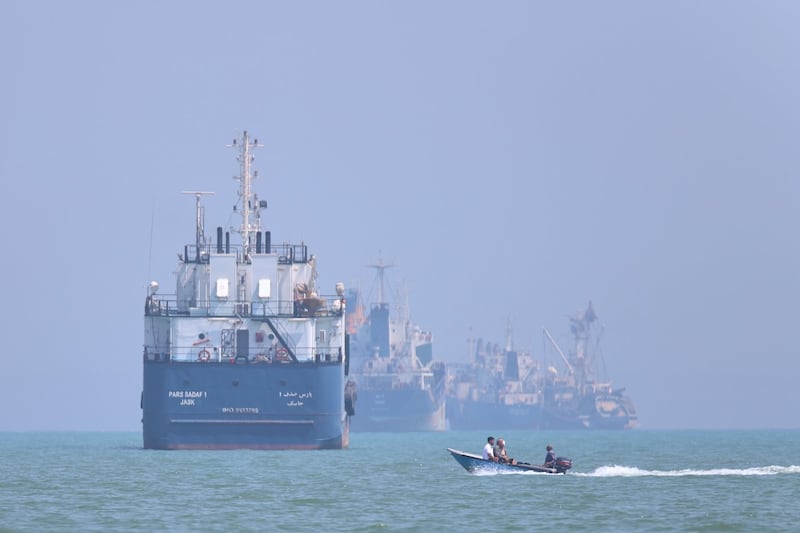
“Risks range from the danger of mines ... to that of getting stuck in the Mideast Gulf should tempers flare and Iran block Hormuz once again,” ship broker Braemar said in a note.
“The deal ... opens the possibility for Iran to charge fees to manage Hormuz transits after 60 days.”
IRAN’S CONDITIONS WORRY SHIPPERS
Switzerland said U.S.-Iran talks on a broader peace pact would not take place on Friday and Vice President JD Vance canceled a planned visit, underscoring uncertainty over a lasting settlement.
Iran signaled tighter control over shipping, with state TV reporting that vessels must coordinate transit with the Revolutionary Guards navy.
British maritime security firm Ambrey said Iranian forces ordered a Hong Kong-flagged tanker and a Saint Kitts and Nevis-flagged bulk carrier to turn back on Thursday.
In an undated advisory circulated to the maritime industry in the last 24 hours and seen by Reuters, Iran’s Persian Gulf Strait Authority said “no vessel is permitted to pass through the Strait of Hormuz without a valid passage permit issued by the PGSA.”
The PGSA, which describes itself as the sole body authorized to issue permits, also said it reserves the right to introduce insurance fees, requiring shipowners to obtain and renew coverage.
The shipping industry has rejected any fee or toll system being imposed on what they say is an international waterway.
Meanwhile, aflotilla of 10 laden Iranian-flagged supertankers carrying close to 20 million barrels of oil were sailing from Iran’s Chabahar anchorage in the Gulf of Oman and heading to Asia for likely teapot refineries in China, according to analysis from U.S. advocacy group United Against Nuclear Iran, which monitors Iran-related tanker traffic.
“There is apparently no longer the hot potato issue of unilateral American sanctions,” UANI senior advisor Charlie Brown said.
(Reporting by Jonathan Saul, Florence Tan, Siyi Liu, Renee Maltezou, Nidhi Verma, Editing by Louise Heavens)

