
Government bond investors had a huge tailwind from 1981 to 2020 as long term government bond yields maintained an overall downward trend across four decades. Times have changed. yields on government bonds are trending higher. Bonds no longer provide the same level hedge against equity declines as they have over the last four decades.
Interest rates started to fall in the early 1980s after central banks managed to crush the inflation of the 1970s with tight monetary policy. Investors reaped the benefit, as government bonds performed well and provided an excellent diversification hedge for equities. When the economy slowed and equity markets declined, government bond positions increased in value as investors shifted to safer assets such as government bonds.
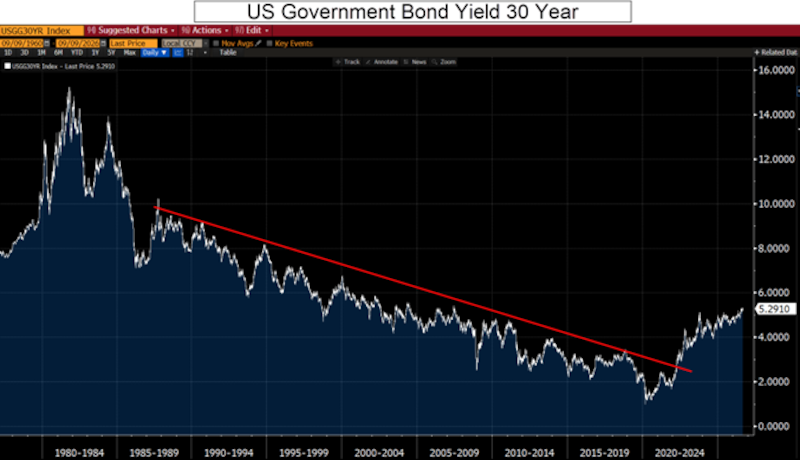
The trend of lower long-term interest rates appears to have bottomed in 2020 and broken in 2022. In 2022, long-term interest rates accelerated sharply higher as central banks raised their policy rates to combat inflation. The result was a year where equities declined in major stock markets and at the same time bonds also declined in value.
The graph below shows the yield of the US Government Bond Yield 30 Year. The multi year downward trend was broken in 2022.
The graph below shows the yield of the Canadian Government Bond Yield 30 Year.
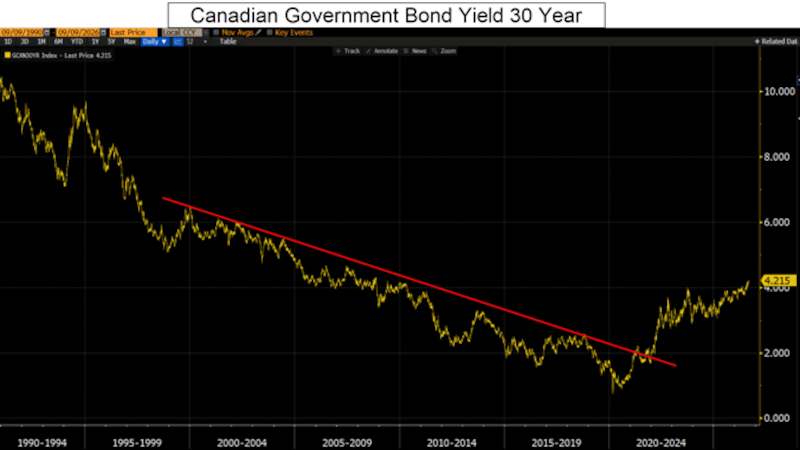
In 2022, bonds were a very poor hedge for equity declines. Both the S&P 500 and U.S. long-term bonds declined. Canada had the same result with its stock market declining along with government bonds.
Rising government bond yields is not a problem just limited to the U.S. and Canada. Below is a long-term graph of government 30 year bond yields of a few major countries.
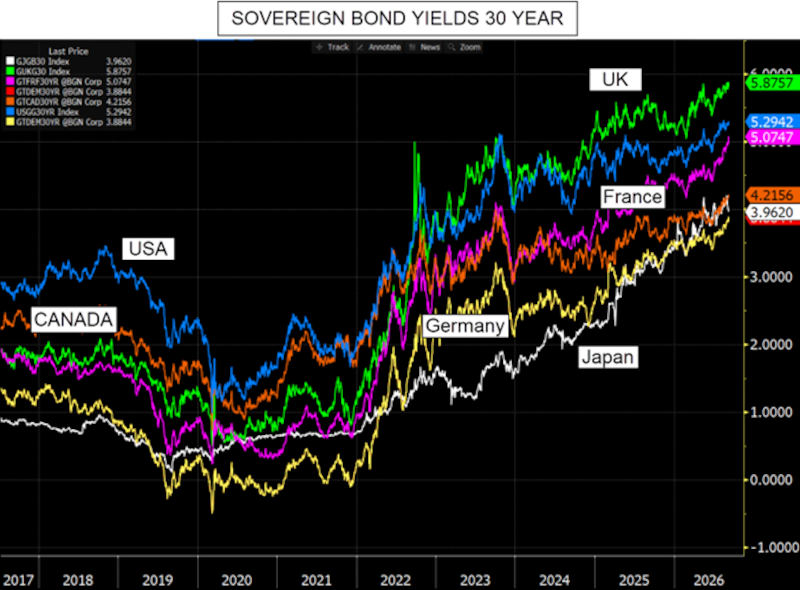
In the graph above, there is a clear trend: a decline in yields into 2020, a bottoming pattern through 2021, a sharp increase in 2022 and a rising trend until the current date. Rising government bond yields is a widespread phenomenon across many countries around the world.
Government bond yields have several drivers, but three of the major reasons yields increase are: a strengthening economy, rising inflation expectations and increasing government spending. Strong economies are not driving bond yields higher. Most western countries have had tepid growth over the last two years. The main exception to this would be the U.S. with most of its GDP growth rates above two per cent over the last three years. Nevertheless, the U.S. growth rate has not been strong enough to be a major factor in its rising bond yields.
Yields are currently being driven mainly by inflation expectations remaining high. Inflation has come down from 2022, but it has remained sticky. Canada currently has a 3.0 per cent inflation rate. The U.S. currently has an inflation rate 3.4 per cent. Investors are concerned that inflation could remain above target or even develop a sustained upwards trend.
As yields have been rising on government bonds, investors are becoming increasingly concerned with government’s high indebtedness. Currently, the U.S. has a government debt to GDP ratio is 123 per cent. Canada has a 114 per cent gross government debt to GDP ratio, according to the International Monetary Fund (IMF). As interest rates increase, governments have to pay out higher amounts of interest on their loans. When interest rates were declining from the 1980s increased government spending was manageable as interest payments were in some cases decreasing. Today, rising yields on government debt are driving interest payments substantially higher.
When looking at the forces driving the direction and magnitude of the price levels for government bonds, the equation has changed since the 1980s. Currently, government bonds are being priced in an environment of high government debt, problematic inflation, slow economic growth and governments with a penchant to spend. If economic growth were to slow further and equities decline substantially, on the margin government bonds would become more attractive. However, investors’ fear of increased government spending and inflation has grown substantially, and it is entirely possible to see sustained bouts of both the stock market and government bond declines.
The views and opinions expressed herein are solely those of the author(s) and may not necessarily reflect the views of Global X Investments Canada Inc. All comments, opinions and views expressed are generally based on information available as of the date of publication and should not be considered advice to purchase or sell any securities mentioned. Before making any investment decision, please consult your investment advisor or advisors.

